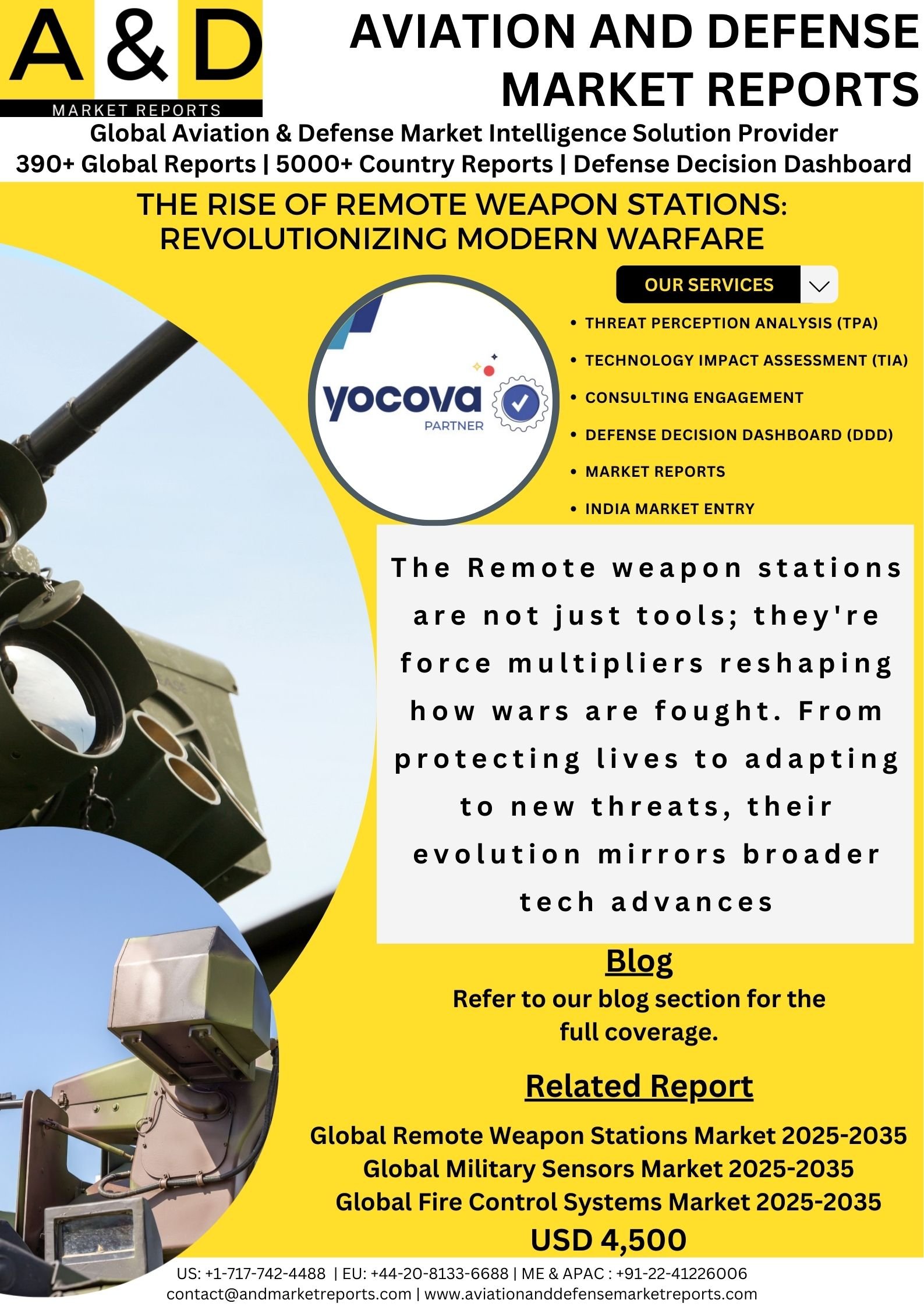
In the fast-evolving landscape of military technology, few innovations have transformed combat as profoundly as the remote weapon station (RWS). These systems allow operators to control powerful firearms from a safe distance, minimizing exposure to danger while maximizing precision and firepower. Essentially, an RWS is a remotely operated weapon platform equipped with sensors, cameras, and fire-control systems, mounted on vehicles, ships, or even stationary positions. They represent a shift from traditional manned turrets to automated, tech-driven solutions that enhance soldier safety and operational efficiency. As global defense budgets swell and conflicts become more asymmetric, RWS are becoming indispensable tools for armed forces worldwide. This blog dives deep into their history, mechanics, applications, pros and cons, and future outlook, exploring why they’re a game-changer in 2025 and beyond.
A Brief History of Remote Weapon Stations
The concept of remote weaponry isn’t entirely new; its roots trace back to the Industrial Age, where innovations like landmines allowed operators to inflict damage without direct engagement. However, the modern RWS emerged from advancements in gyroscopic stabilization during World War II. Invented by Charles Stark Draper, early mechanical gyros provided the foundation for stabilizing weapons on moving platforms. Post-war, the technology evolved slowly until the late 20th century, when digital sensors and fiber optic gyros (FOG) revolutionized accuracy.
A pivotal milestone came in 2001 with the full-scale production of the Kongsberg Protector RWS, a Norwegian innovation that set the standard for modular, vehicle-mounted systems. By 2004, FOG devices were integrated into the U.S. Army’s Common Remotely Operated Weapon Station (CROWS) program, enabling precise firing from Humvees and other vehicles. The Iraq and Afghanistan wars accelerated adoption, as RWS proved vital in urban combat, reducing casualties from roadside bombs and ambushes. In 2017, India’s Bharat Heavy Electricals Limited (BHEL) launched its own tank-mounted RWS, followed by demonstrations from Mahindra Defence Systems in 2018 and Larsen & Toubro’s SHARANG in 2019. Russia’s SerVal system debuted in 2019, highlighting global proliferation. Today, over 20,000 Protector units alone are in service across 23 nations, underscoring the rapid maturation of this technology.
How Remote Weapon Stations Work: Key Components
At its core, an RWS integrates mechanical, electronic, and optical elements to create a seamless remote firing experience. The stabilized firing platform is the heart, using gyroscopes and actuators to counteract vehicle motion, ensuring steady aim even at high speeds. Fire-control systems, often joystick-operated, allow gunners inside the vehicle to pan, tilt, and fire via high-resolution displays.
Sensors play a crucial role: Day/night cameras, thermal imagers, and laser rangefinders provide real-time visuals, with some models like the Protector Nordic featuring a 95-degree field-of-view day camera and infrared aim lasers. Weapons range from 5.56mm light machine guns to 30mm cannons, with modular designs allowing quick swaps. For instance, the Saab Trackfire includes counter-unmanned aerial system (C-UAS) capabilities, blending offense with defense. Power comes from the host vehicle’s systems, and environmental resilience is key—many operate from -46°C to +65°C. Non-lethal options, like smoke grenade dischargers, add versatility for peacekeeping missions.
Types and Applications in Modern Warfare
RWS come in various flavors to suit diverse environments. Light systems, such as Kongsberg’s RS2 Protector Lite (weighing just 30kg), are man-portable and ideal for tripods or light vehicles. Medium variants like the RS4 handle 12.7mm machine guns, while heavy ones, such as Rheinmetall’s Fieldranger or Krauss-Maffei Wegmann’s FLW 200, support larger calibers on tanks like the Leopard 2 A7.
Applications span land, sea, and air. On ground vehicles, they’re retrofitted to Humvees, Strykers, and ASLAVs for convoy protection and urban patrols. Naval versions, like FN Herstal’s Sea deFNder or Elbit’s dual-axis stabilized station, equip patrol boats and frigates for anti-piracy and coastal defense. Air-based systems are emerging, projected to grow from $4.5 billion in 2025 to $10.2 billion by 2035 at 8.6% CAGR, for drones and helicopters. Stationary setups guard borders, as seen with India’s Line of Control deployments. In asymmetric warfare, they counter insurgents without exposing personnel.
Advantages and Disadvantages
The biggest advantage of RWS is operator protection: Gunners stay inside armored vehicles, reducing vulnerability to small arms fire or IEDs. Enhanced accuracy through stabilization and sensors improves hit rates, even in rough terrain. Versatility allows integration with non-lethal tools for crowd control, and modularity means easy upgrades. In humanitarian ops, they minimize collateral damage via precise targeting.
However, drawbacks exist. High costs—systems like CROWS run into millions per unit—strain budgets. Reliance on electronics makes them susceptible to cyber threats, jamming, or EMPs. Maintenance is complex, requiring specialized training, and power failures could render them useless. In dense urban settings, sensor limitations (e.g., fog or dust) might hinder performance. Despite these, the pros outweigh cons in most scenarios, as evidenced by widespread adoption.
Notable Systems and Manufacturers
Leading the pack is Kongsberg’s Protector family, with variants like the RS4 (used in U.S. CROWS) and RT series for medium calibers. FN Herstal’s deFNder series offers light to medium options for land and sea. Saab’s Trackfire excels in on-the-move firing with C-UAS integration. Rheinmetall’s Natter and MSSA provide modular solutions, while Elbit’s naval station features automatic tracking. Emerging players like IEC Infrared’s T360 emphasize concealment and flexibility. Aselsan’s SMASH and STOP systems dominate in Turkey and exports.
Future Trends: AI, Autonomy, and Market Growth
Looking ahead, the RWS market is booming. Valued at $13.1 billion in 2024, it’s projected to reach $14.52 billion in 2025, growing at 10.8% annually through 2034. By 2035, it could hit higher figures with a 9.5% CAGR. Key trends include AI-driven targeting—30% of systems may feature AI by 2025—for autonomous threat detection. Lighter designs, like Sig Sauer’s Pitbull, reduce weight for better mobility. Integration with 5G enables remote ops from command centers, while edge computing speeds responses. At AUSA 2025, armored vehicles showcased hybrid RWS with drone countermeasures, signaling a focus on multi-domain warfare.
In conclusion, remote weapon stations are not just tools; they’re force multipliers reshaping how wars are fought. From protecting lives to adapting to new threats, their evolution mirrors broader tech advances. As we move into an era of AI and autonomy, RWS will likely become even more integral, balancing lethality with ethics in global security. Whether on the battlefield or in defense strategies, their impact is undeniable—and only growing.