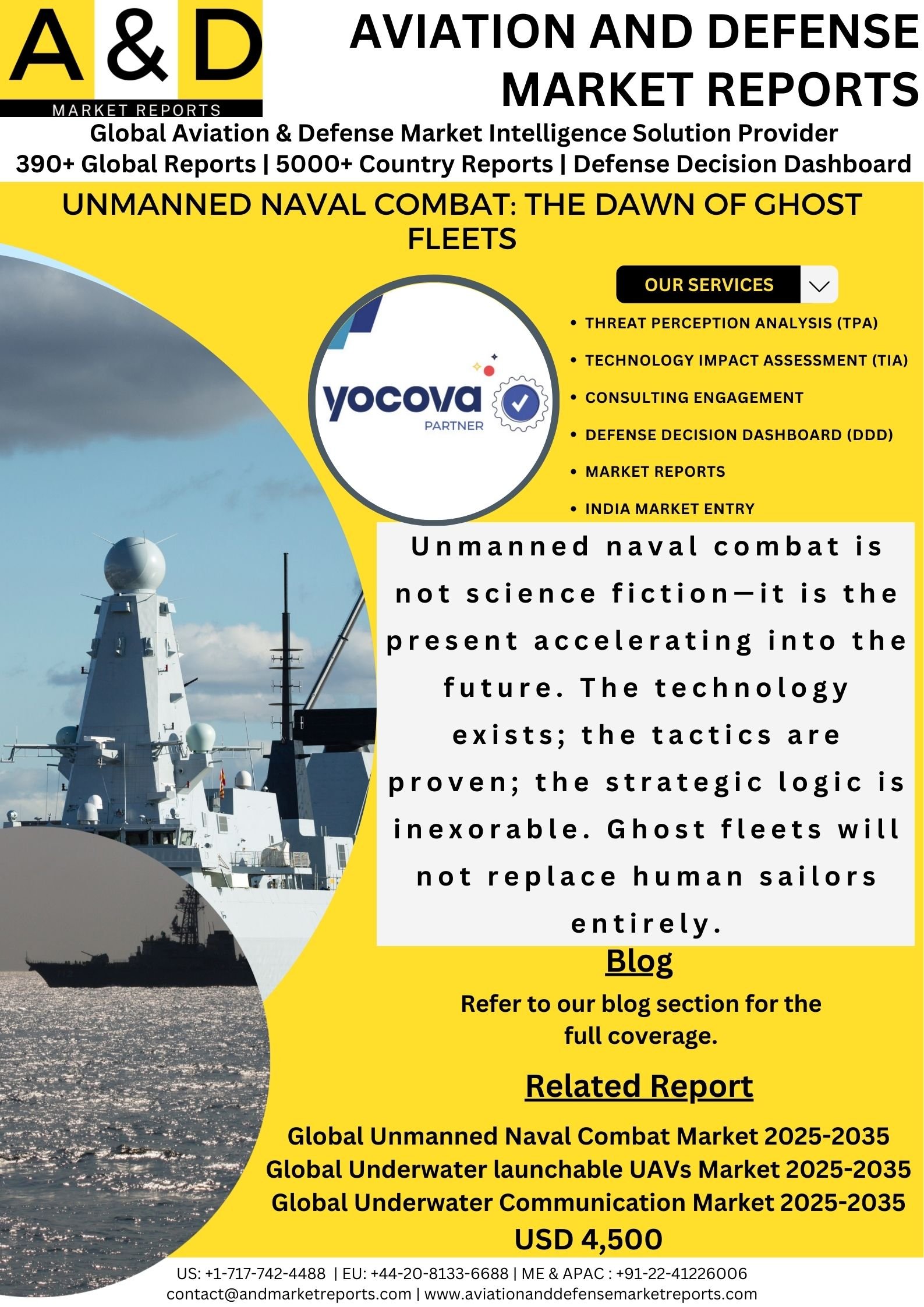
Unmanned naval combat is not science fiction—it is the present accelerating into the future. The technology exists; the strategic logic is inexorable. The ocean has always been a domain of steel and fire, where nations project power through massive hulls bristling with guns and missiles. But the future of naval warfare is increasingly silent, unmanned, and lethal. Unmanned naval combat—encompassing drones on the surface, beneath the waves, and in the air above—is reshaping how sea power is exercised. From small explosive-laden speedboats to autonomous submarines the size of city buses, these systems promise to upend centuries of maritime tradition. This 1000-word exploration examines the technology, tactics, strategic implications, and ethical dilemmas of what the U.S. Navy now calls “ghost fleets.”
The Hardware Revolution
Unmanned surface vessels (USVs) lead the charge. The U.S. Navy’s Sea Hunter, a 132-foot trimaran, can cross oceans autonomously for months at a fraction of a crewed destroyer’s cost. Its diesel-electric propulsion and satellite-linked AI allow it to hunt submarines without a single sailor aboard. In 2022, Sea Hunter completed a 4,000-mile transit from California to Hawaii and back—entirely uncrewed. Its successor, the Medium USV program, will carry vertical-launch missile cells, turning a $20 million drone into a floating arsenal.
Under the surface, unmanned underwater vehicles (UUVs) are even more transformative. Boeing’s Orca XLUUV is a 51-foot, 50-ton torpedo-shaped submarine that can lay mines, launch drones, or stalk enemy ships for weeks on battery power. Unlike crewed subs, Orcas are expendable; losing one costs less than a single F-35. China’s HSU-001 UUV, spotted in 2023, mirrors this design but adds a sail-mounted sensor mast for air-breathing diesel operation—extending range to rival nuclear subs.
Aerial drones complete the triad. The MQ-25 Stingray refuels fighters mid-mission, but its real game-changer is persistent ISR (intelligence, surveillance, reconnaissance). A single Stingray can loiter for 12 hours, feeding targeting data to missile-carrying USVs 500 miles away. Iran’s Shahed-136 drones, adapted for maritime launch in 2024 Red Sea attacks, showed how cheap ($20,000) kamikaze drones can saturate defenses. A swarm of 50 can overwhelm a destroyer’s 96 missile cells in minutes.
Tactical Evolution
Unmanned systems enable “distributed lethality.” Instead of concentrating firepower in a $3 billion carrier, a task force might deploy 200 USVs, each carrying four anti-ship missiles. The math is brutal: an enemy needs 800 missiles to guarantee kills, but the defender only needs to reload drones. This mirrors the “missile age” shift that sank battleships in 1944—only now, the missiles ride disposable hulls.
Swarming is the killer app. In DARPA’s 2023 OFFSET exercise, 250 small USVs coordinated via mesh network to encircle a mock enemy flotilla. When one drone was “destroyed,” the swarm rerouted in 11 seconds—faster than any human commander. Machine learning lets drones share sensor data in real time; a periscope sighting 300 miles away instantly updates targeting for a missile boat in the next ocean basin.
Stealth multiplies effectiveness. The Royal Navy’s Project Vahana USV uses radar-absorbing composites and a waterjet propulsion that leaves no wake. At 20 knots, it’s nearly invisible to sonar and radar. In exercises, Vahana penetrated a carrier strike group’s outer screen undetected—carrying a mock 1,000-pound warhead.
Strategic Implications
Cost asymmetry is the strategic earthquake. A Ford-class carrier costs $13 billion and requires 5,000 crew. A Ranger USV costs $5 million and zero lives. For the price of one carrier, the Navy could field 2,600 Rangers—each capable of launching eight Naval Strike Missiles. Smaller navies can now punch above their weight; the UAE’s 2024 purchase of 100 Turkish Songar USVs instantly made it a Red Sea power.
Great-power competition accelerates adoption. China’s 2025 “Unmanned Great Wall” plan aims for 1,000 USVs by 2030. Their Type 093B nuclear subs now deploy UUVs as forward scouts, extending sensor range by 500 miles. Russia’s Poseidon nuclear torpedo—a 100-megaton city-killer drone sub—represents the extreme: a doomsday weapon that can lurk for years.
Anti-access/area denial (A2/AD) favors drones. In a Taiwan scenario, PLA rocket forces could sink crewed ships within hours. But USVs launched from submerged cargo ships 1,000 miles away could saturate defenses while carriers stay over the horizon. The 2024 Pacific Trident exercise proved this: four Global Autonomous Reconnaissance Craft (GARC) USVs disabled a mock Chinese invasion fleet using only electronic warfare and decoy drones.
The Autonomy Dilemma
Decision latency is the Achilles’ heel. Satellite links have 600-millisecond delays—fatal in a dogfight. True autonomy requires AI that can kill without human input. The U.S. Navy’s 2023 policy allows “human on the loop” for lethal decisions, but Israel’s 2024 Gaza flotilla interception used fully autonomous Harop drones that selected targets based on thermal signatures. The line blurs.
Swarm AI raises escalation risks. In 2022, a Russian Su-27 buzzed a U.S. MQ-9 over the Black Sea; the drone’s autonomy protocol nearly triggered a missile launch before human override. What happens when Chinese and American drone swarms mistake each other in the South China Sea? A single misidentification could spark war.
Legal frameworks lag. The Law of Armed Conflict requires distinguishing combatants from civilians. An AI that mistakes a fishing boat for a Qatari LNG tanker carrying missiles violates proportionality. The 2024 Montreux Convention amendment attempt—to regulate armed USVs in the Black Sea—failed when Turkey vetoed it, fearing Russian drone subs.
Ethical and Workforce Shocks
Crewless ships save lives but gut traditions. The Royal Navy’s 2025 decision to decommission HMS Albion without replacement sparked mutiny rumors among marines. “Ghost fleets” require coders, not deckhands. The U.S. Naval Academy now teaches Python before seamanship. Veterans call it “warfare by spreadsheet.”
Public tolerance for drone losses is higher—until they fail spectacularly. The 2023 Houthi capture of a Saildrone Explorer in the Red Sea showed vulnerabilities: a $3 million asset taken by men in flip-flops. Jamming and spoofing remain unsolved; Russia’s 2024 Black Sea GPS spoofing sent U.S. USVs 40 miles off course.
The Future Fleet
By 2035, hybrid task forces will dominate. A carrier might deploy 50 MQ-25s, 200 small USVs, and 20 Orca UUVs—total cost under $2 billion. Human ships provide command and heavy repair; drones do the dying. The Royal Australian Navy’s 2025 Ghost Shark program envisions submarine-launched UUVs that deploy smaller “mosquito” drones—nesting autonomy like Russian dolls.
Countermeasures evolve in parallel. China’s 2024 laser-equipped Type 055 destroyers can blind drone optics at 10 miles. The U.S. Navy’s 2025 SOLID (System of Systems for Over-the-Horizon Littoral Defense) uses high-power microwaves to fry drone electronics in a 5-mile radius. The race is on: offense versus defense, autonomy versus control.
Conclusion
Unmanned naval combat is not science fiction—it is the present accelerating into the future. The technology exists; the tactics are proven; the strategic logic is inexorable. Ghost fleets will not replace human sailors entirely, but they will redefine risk, cost, and power at sea. The nation that masters distributed, autonomous lethality will rule the waves for the next century. The age of steel is giving way to the age of silicon—and the ocean will never be the same.