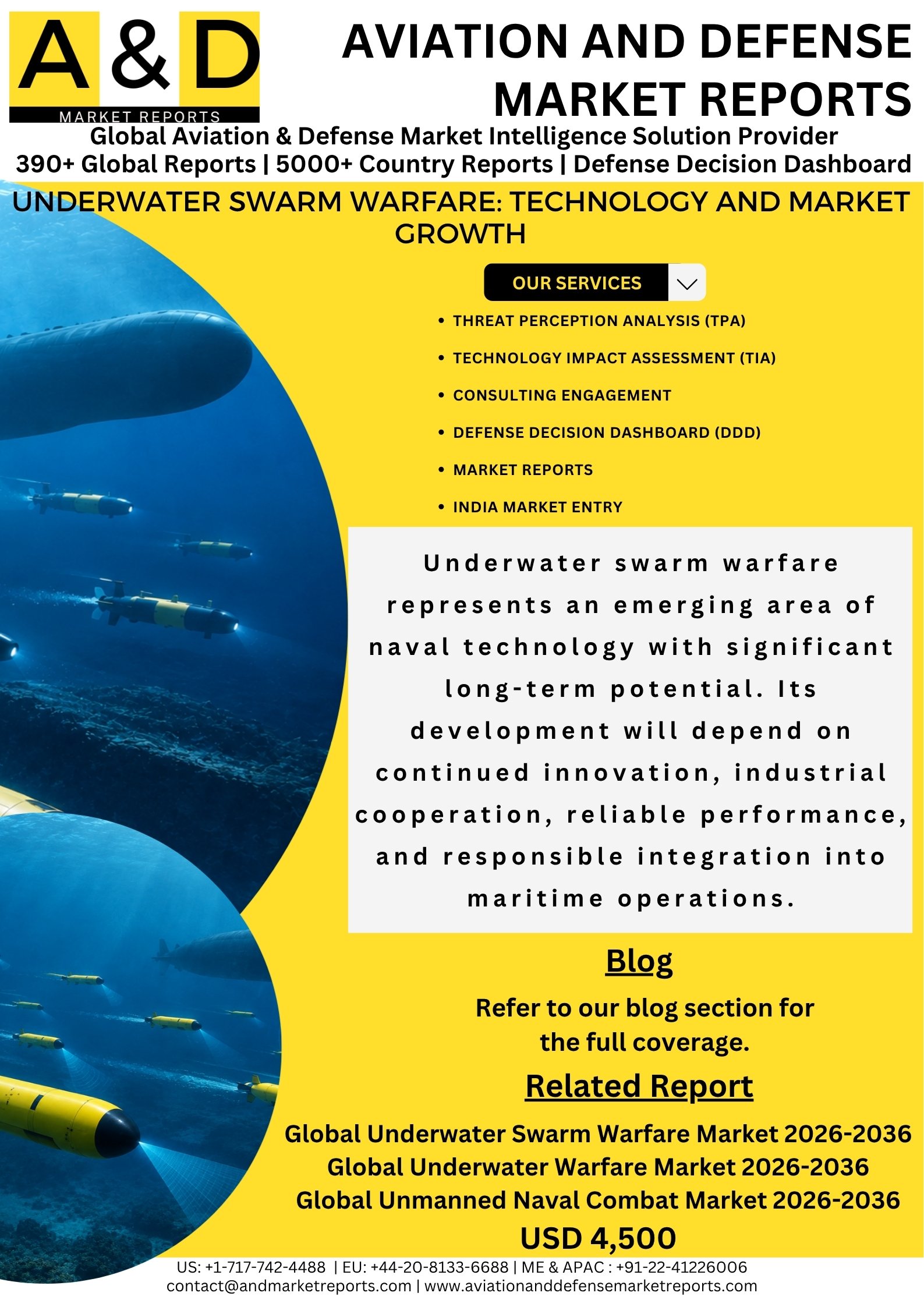
Underwater swarm warfare is an emerging maritime defense concept that uses multiple autonomous or semi-autonomous underwater vehicles (AUVs) and unmanned underwater vehicles (UUVs) to perform coordinated missions. These systems communicate, share information, and cooperate to achieve objectives that may be difficult, expensive, or risky for a single underwater platform to accomplish independently. As naval forces increasingly prioritize autonomous operations, underwater swarm warfare is gaining attention as a potential approach to maritime surveillance, anti-submarine warfare, mine countermeasures, and protection of critical underwater infrastructure.
Unlike conventional underwater systems that depend heavily on individual platforms and centralized control, swarm-based operations emphasize distributed intelligence, coordinated movement, and mission flexibility. Multiple vehicles can cover larger areas, gather information from different locations, and continue operating even if individual units lose communication or become unavailable.
Growing interest in unmanned maritime technologies, combined with advances in artificial intelligence (AI), underwater navigation, sensor integration, and battery systems, is supporting the development of this emerging defense capability.
Evolution of Underwater Swarm Warfare
The evolution of underwater swarm warfare is closely linked to the development of autonomous underwater vehicles and unmanned maritime systems. Early underwater robots were primarily designed for remotely controlled inspection, scientific research, oceanographic surveys, and mine detection. Their operations often depended on human supervision and limited onboard decision-making capabilities.
As computing power, navigation technologies, and autonomous control systems improved, underwater vehicles became increasingly capable of performing missions with reduced human intervention. Naval research programs subsequently began exploring coordinated operations involving multiple unmanned platforms rather than relying on individual vehicles.
Modern developments focus on cooperative autonomy, distributed sensing, and multi-vehicle coordination. Improvements in artificial intelligence and machine learning are enabling underwater platforms to process sensor information, adapt to changing environmental conditions, and coordinate mission activities. Although underwater communication remains challenging, ongoing research into acoustic networking, underwater optical communication, and autonomous decision-making is expanding the possibilities for collaborative maritime operations.
Importance of Underwater Swarm Warfare
Underwater swarm warfare offers several potential advantages for modern naval operations. One of its primary benefits is wider surveillance coverage. Multiple vehicles can collect information across different areas, helping naval forces monitor maritime environments and identify unusual underwater activity more effectively.
Another important advantage is operational flexibility. Swarms can potentially support several mission types, including seabed mapping, mine detection, submarine tracking, port security, and monitoring of undersea cables and pipelines. Their modular design also allows different sensors and mission equipment to be integrated according to operational requirements.
Unmanned underwater systems can reduce the need to expose crewed platforms to dangerous environments. Distributed operations may also improve resilience because the loss or malfunction of one vehicle does not necessarily end the entire mission.
For defense organizations, these capabilities could support more persistent maritime awareness while complementing conventional submarines, surface vessels, maritime patrol aircraft, and fixed underwater surveillance networks.
Key Components of Modern Underwater Swarm Warfare
The effectiveness of underwater swarm warfare depends on the integration of several interconnected technologies.
- Autonomous underwater vehicles: These platforms provide mobility and carry sensors, navigation equipment, communication systems, and mission-specific payloads.
- Artificial intelligence and swarm coordination: Algorithms support collaborative task allocation, navigation, information processing, and decision-making across multiple vehicles.
- Underwater sensors: Sonar, acoustic sensors, inertial navigation systems, and environmental sensors help vehicles detect objects, map the seabed, and understand their surroundings.
- Communication networks: Acoustic modems and other underwater communication technologies enable data exchange, although bandwidth, range, and latency remain important constraints.
- Power and propulsion systems: High-capacity batteries, efficient electric propulsion, and improved energy management support longer mission endurance.
- Command, control, and data analytics: Shore-based facilities, surface vessels, and naval command systems help operators plan missions, monitor performance, and interpret collected information.
The integration of these components determines how effectively a swarm can operate in complex underwater environments.
Technological Advancements Driving Market Growth
Technological innovation is a major factor supporting the development of underwater swarm warfare. AI-enabled autonomy allows unmanned vehicles to interpret sensor data, adjust navigation, and coordinate activities with reduced operator intervention. Machine learning is also improving sonar data analysis and automated target recognition, helping systems distinguish relevant objects from environmental noise.
Advances in battery technology, electric propulsion, compact computing, and sensor miniaturization are improving vehicle endurance and mission flexibility. Digital twins and simulation environments enable developers to evaluate swarm performance under different underwater conditions before conducting sea trials.
Secure communication and interoperability are equally important. Since radio signals do not travel effectively underwater, acoustic communication remains widely used despite limitations in bandwidth and latency. Research into cooperative autonomy helps vehicles maintain coordinated operations when continuous communication is unavailable. NATO’s Centre for Maritime Research and Experimentation is advancing these capabilities through research into autonomous mine countermeasures and anti-submarine warfare.
Growing Underwater Swarm Warfare Production Supporting Market Expansion
The expansion of unmanned maritime manufacturing is creating opportunities for the underwater swarm warfare market. Defense contractors are investing in autonomous vehicle platforms, advanced sonar systems, underwater navigation equipment, and integrated command-and-control technologies. Production strategies increasingly emphasize modular designs that can support different missions through interchangeable payloads and software updates.
Growing manufacturing capacity could help reduce unit costs and make it more practical for naval forces to deploy multiple vehicles rather than relying on a small number of expensive platforms. However, producing operational swarms requires more than manufacturing individual vehicles. Companies must also integrate communications, mission planning, data processing, testing, maintenance, and fleet management capabilities.
Collaboration between defense manufacturers, naval research organizations, electronics suppliers, and software developers is expected to remain important. As systems mature, standardized interfaces and scalable production processes could support wider adoption across naval fleets.
Increasing Demand for Underwater Swarm Warfare and Upgrades
Demand for underwater swarm technologies is being supported by the need to protect maritime infrastructure and improve naval situational awareness. Undersea communication cables, energy pipelines, offshore installations, naval bases, and important shipping routes require reliable monitoring against accidents, unauthorized activity, and potential security threats.
Navies are also exploring unmanned systems for mine countermeasures, seabed surveys, harbor protection, and anti-submarine warfare. Cooperative platforms could improve coverage and reduce the risks associated with sending personnel into hazardous environments.
Modernization requirements are creating opportunities for upgrades to existing underwater vehicles. These may include improved autonomy software, enhanced sonar, better batteries, secure communication equipment, and more advanced data-processing capabilities. Lifecycle support, software updates, and integration with established naval command systems are likely to become important sources of long-term demand.
NATO’s recent research activities demonstrate the operational relevance of coordinated unmanned systems for mine warfare, infrastructure protection, and anti-submarine missions.
Regional Market Developments
North America
North America is an important center for underwater autonomy research, naval modernization, and defense technology investment. The United States is advancing unmanned maritime capabilities through naval research programs and partnerships with defense contractors, universities, and technology companies. Demand is supported by submarine operations, maritime infrastructure security, and interest in distributed sensing.
Europe
European countries are investing in maritime security, autonomous mine countermeasures, and cooperative naval systems. NATO research initiatives are encouraging interoperability and joint experimentation, creating opportunities for manufacturers specializing in underwater robotics, sonar, and autonomous mission management.
Asia-Pacific
The Asia-Pacific region is gaining strategic importance because of extensive maritime trade, contested waters, and growing investment in naval modernization. Countries including China, Japan, South Korea, Australia, and India have incentives to strengthen underwater surveillance and maritime defense capabilities. India’s wider naval modernization and indigenous defense manufacturing efforts may create opportunities for local developers of underwater robotics, sensors, and supporting technologies.
Middle East and Other Emerging Markets
Countries in the Middle East and other emerging maritime regions are increasingly focused on protecting ports, offshore energy infrastructure, and strategic shipping routes. Adoption will depend on defense budgets, technical expertise, local industrial capabilities, and the availability of systems suited to regional operating conditions.
Competitive Landscape of the Market
The competitive landscape includes established defense contractors, specialized underwater robotics manufacturers, autonomous systems developers, and emerging technology companies. Competition is shaped by vehicle endurance, sensor performance, autonomy, communication reliability, system integration, and total lifecycle costs.
Relevant industry participants include HII, Saab, Thales, and General Dynamics. Specialized developers such as Kongsberg Maritime also contribute to the broader underwater vehicle and maritime technology ecosystem.
Not every company in this landscape offers dedicated swarm warfare products. Nevertheless, expertise in autonomous underwater vehicles, sonar, naval systems, and command-and-control technologies can support the development of integrated swarm capabilities.
Strategic partnerships, defense procurement contracts, research collaborations, and investments in testing infrastructure will influence future competition. Companies that combine reliable hardware with adaptable software and effective fleet integration may be well positioned as requirements evolve.
Challenges Affecting Market Growth
Despite its potential, underwater swarm warfare faces technical, operational, and commercial challenges. Underwater communication is constrained by limited bandwidth, signal attenuation, interference, and latency. These factors complicate real-time coordination and information sharing among multiple vehicles.
Navigation is another challenge because satellite-based positioning systems such as GPS are unavailable underwater. Vehicles must rely on inertial navigation, acoustic positioning, and other techniques that can accumulate errors over time.
Other barriers include limited battery endurance, high development and testing costs, harsh operating environments, cybersecurity risks, and difficulties integrating autonomous systems with existing naval infrastructure. Procurement approvals, export controls, interoperability requirements, and concerns about autonomous decision-making can also slow adoption.
Reliable performance must be demonstrated through extensive trials in different water depths, currents, temperatures, and seabed conditions. Establishing clear human oversight, accountability, and safety procedures will remain essential as autonomy increases.
Future Outlook of Underwater Swarm Warfare
The future of underwater swarm warfare will likely be shaped by improvements in collaborative autonomy, sensor fusion, energy efficiency, and resilient communication. Rather than operating as isolated vehicles, future underwater platforms may increasingly function as coordinated networks connected with crewed submarines, surface vessels, maritime patrol aircraft, and seabed monitoring systems.
Growing interest in persistent maritime surveillance and unmanned mine countermeasures is expected to support further research, procurement, and technology upgrades. However, the pace of adoption will depend on operational validation, cost-effectiveness, and the ability to integrate autonomous vehicles into established naval command structures.
For defense manufacturers, opportunities extend beyond vehicle production to include autonomy software, sonar analytics, simulation, maintenance, training, and systems integration. As navies evaluate distributed underwater capabilities, underwater swarm warfare could become an increasingly important element of next-generation maritime defense.
Overall, underwater swarm warfare represents an emerging area of naval technology with significant long-term potential. Its development will depend on continued innovation, industrial cooperation, reliable performance, and responsible integration into maritime operations.