
Description
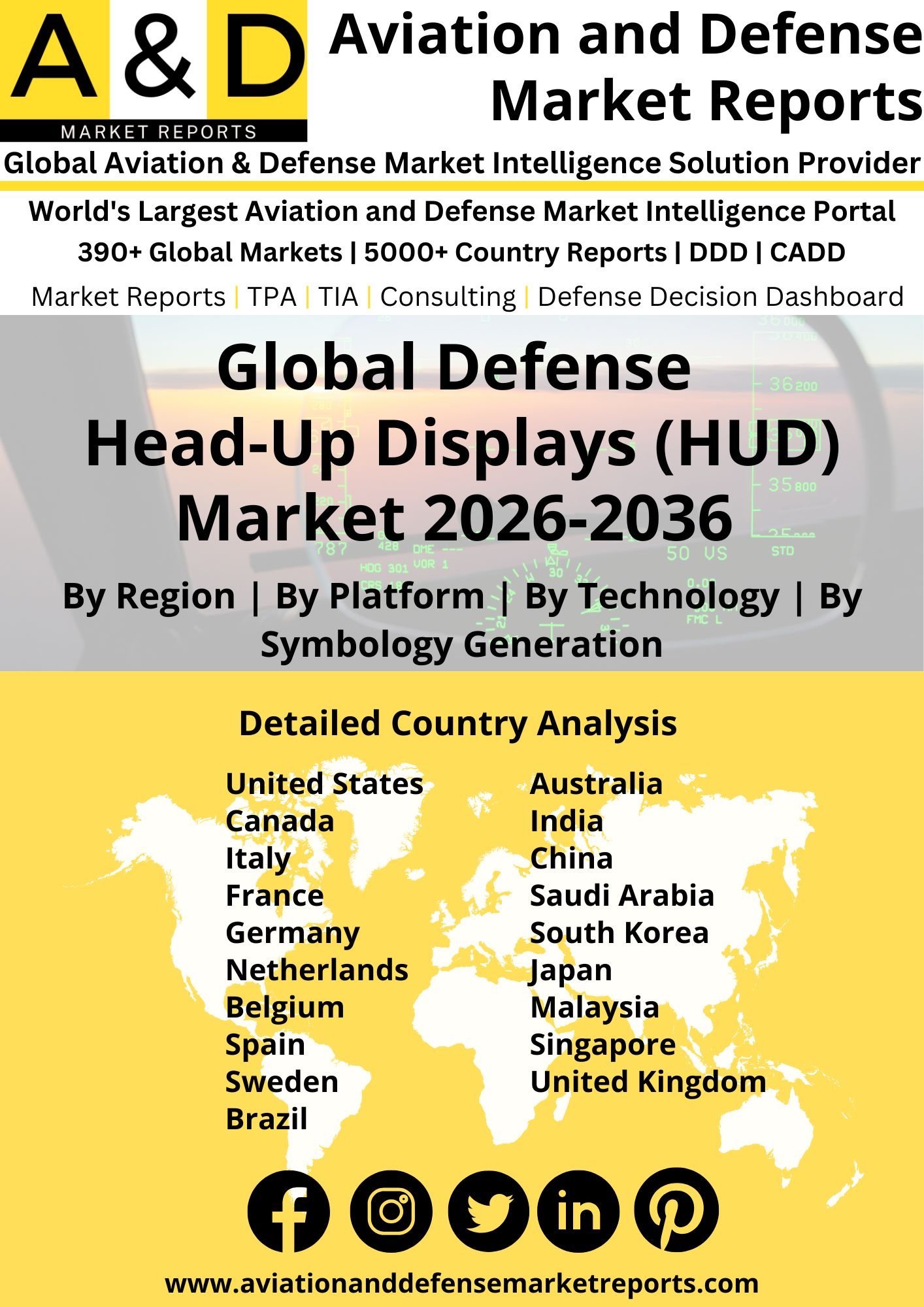
Global Defense Head-Up Displays (HUD) Market: Overview
Global Defense Head-Up Displays (HUD) Market includes advanced visualization technologies used in military platforms such as fighter jets, helicopters, armored vehicles, and helmet-mounted systems for dismounted soldiers. These systems project critical information directly into the operator’s field of view, including flight data, targeting cues, navigation, and sensor feeds. As a result, personnel can focus on the external environment without looking down at instruments.
HUDs enhance situational awareness, speed decision-making, and reduce cognitive workload during high-stakes operations. By providing real-time overlays, they allow pilots and vehicle crews to respond quickly to dynamic threats, navigate complex terrain, and coordinate with allied forces more efficiently. Consequently, these displays improve mission effectiveness while maintaining operator safety.
Growth Drivers
The market is growing due to the modernization of military fleets, rising geopolitical tensions, and the demand for superior battlefield performance. One major driver is the continuous advancement of display technologies. Modern HUDs now feature higher resolution, brighter imagery, wider fields of view, and better sensor integration. This enables clear presentation of data even in challenging conditions such as low visibility, high-speed flight, or intense combat.
Another key driver is the need to improve situational awareness while reducing pilot and crew workload. Defense platforms now incorporate augmented reality (AR) overlays, synthetic vision, and fused sensor data. These features allow operators to process complex information intuitively while keeping their attention outward.
Furthermore, growing investments in next-generation military systems worldwide support market expansion. Nations are upgrading legacy aircraft, vehicles, and soldier systems with advanced HUDs to maintain technological superiority. These displays are critical for precision operations, threat detection, and effective command and control.
Global Defense Head-Up Displays Market: Key Trends
Several trends are shaping the evolution of the market. First, augmented reality and advanced overlay systems are becoming common. HUDs now blend real-world views with digital enhancements, including target markers, terrain data, and threat indicators. This improves accuracy and responsiveness in dynamic combat scenarios.
Second, helmet-mounted and wearable HUDs are gaining traction. Compact, head-worn displays benefit dismounted soldiers, armored vehicle crews, and aviators by offering hands-free access to vital information. They support night vision and networked systems for better team coordination.
Third, multi-sensor fusion and connectivity are accelerating. Modern HUDs combine inputs from radar, infrared, electro-optical sensors, and external networks to provide a unified battlefield picture. This enables faster threat identification and more coordinated engagements.
Finally, lightweight and rugged designs are increasingly important. These displays perform reliably in harsh conditions while minimizing size, weight, and power requirements, enhancing platform agility and soldier mobility.
Global Defense Head-Up Displays Market: Outlook
The market is poised for sustained growth due to ongoing technological innovation and strategic defense priorities. HUDs remain vital for improving situational awareness, targeting precision, and operational resilience. Emerging display and optics solutions deliver sharper imagery, wider fields of view, and seamless integration with vision systems. This allows operators to maintain awareness in adverse conditions and high-threat environments.
Integration with networked and multi-domain capabilities also drives adoption. HUDs increasingly fuse data from multiple sources, supporting joint operations, real-time intelligence sharing, and adaptive tactics across air, land, and other domains.
Moreover, survivability, stealth, and human-machine teaming contribute to demand. Passive, low-signature displays allow operators to access information without compromising their position. Intuitive interfaces reduce fatigue and errors during prolonged missions. As nations prioritize advanced avionics and soldier systems amid evolving threats, HUDs are set to expand alongside broader defense modernization efforts.
Market: Recent Developments
Recent innovations highlight major strides in integration, performance, and versatility. Augmented reality and high-resolution optics now provide richer, more immersive overlays, combining synthetic vision, sensor fusion, and dynamic symbology. This significantly improves operator effectiveness in complex missions.
Helmet-integrated HUDs are also advancing. Lightweight designs now support fighter aircraft, rotary-wing systems, and ground forces, improving night vision, low-light performance, and compatibility with soldier modernization programs.
Multi-sensor and networked integration continues to progress. HUDs can aggregate data from onboard and offboard sources for comprehensive situational awareness, faster targeting, and enhanced coordination in joint and coalition operations.
Finally, developers are improving ruggedness, power efficiency, and modularity. These enhancements ensure reliable operation in extreme conditions while simplifying upgrades to existing fleets. Collectively, these developments solidify HUDs as central to achieving tactical advantages, mission adaptability, and force readiness in modern defense scenarios.