
Description
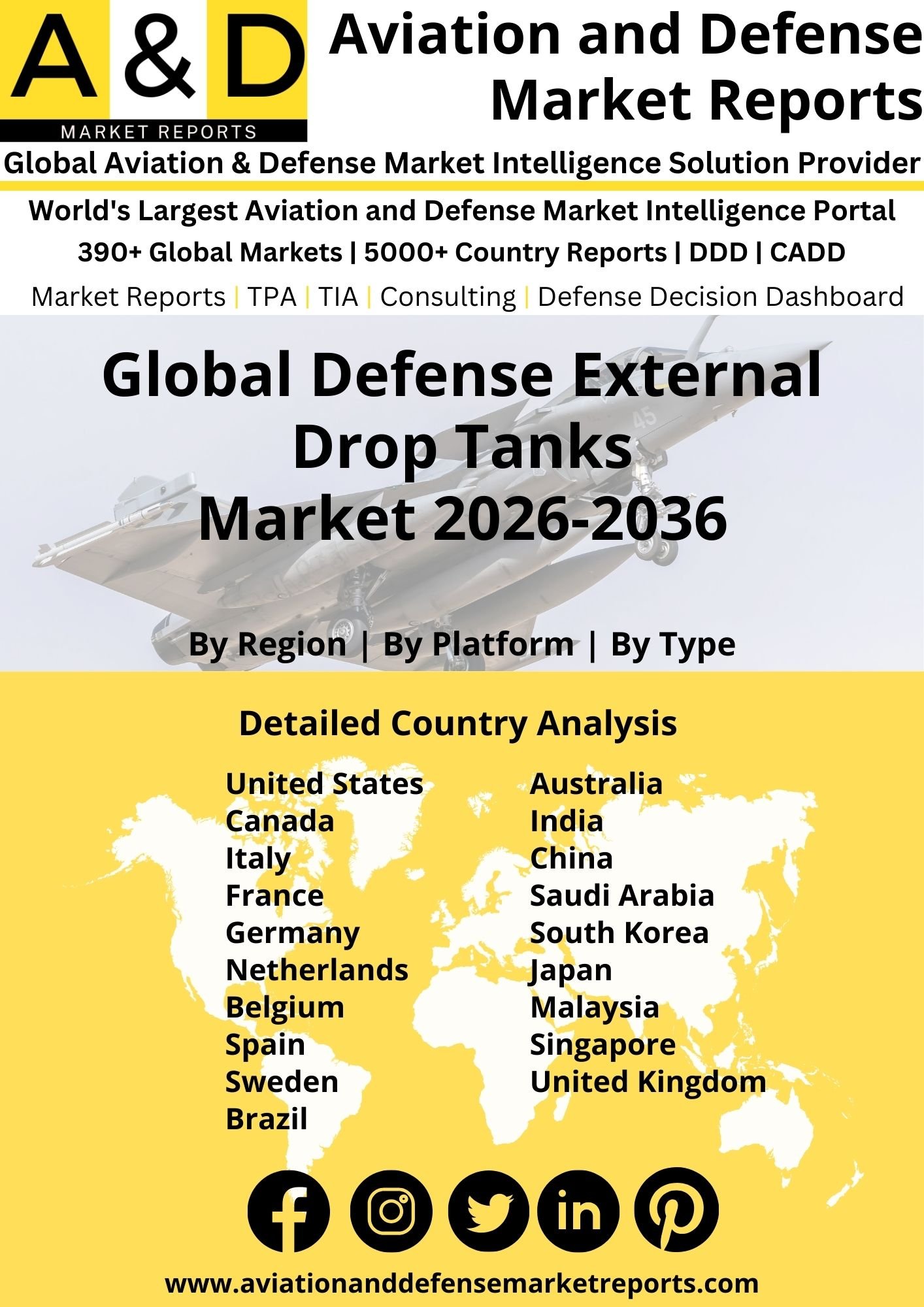
Global Defense External Drop Tanks Market Overview
External drop tanks enhance fighter aircraft range by providing supplementary fuel capacity, detachable mid-mission to restore agility. Essential for air superiority and extended strike missions, they integrate seamlessly with modern jets. Key manufacturers supply conformal and streamlined designs, balancing aerodynamics and payload. The market thrives amid rising geopolitical tensions, spurring procurement by air forces worldwide. Innovations focus on lightweight composites and smart release mechanisms.
Global Defense External Drop Tanks Market Technology Trends
Advancements in materials science drive lighter, stronger drop tanks using carbon fiber composites and advanced alloys, slashing weight while boosting fuel efficiency. Conformal fuel tanks (CFTs) mold to aircraft fuselages, minimizing drag and radar signatures for stealth operations. Smart tank technologies incorporate sensors for real-time fuel monitoring, predictive maintenance, and automated jettison via fly-by-wire systems. Additive manufacturing enables rapid prototyping of custom shapes, reducing production timelines. Integration with AESA radars and mission computers optimizes release timing. Hypersonic-compatible designs emerge for next-gen platforms, with self-sealing tech countering battle damage. Multi-role compatibility expands applications across fighters, bombers, and UAVs, aligning with network-centric warfare demands.
Market Integration Landscape
Drop tanks integrate via standardized pylons and quick-release mechanisms on wing or fuselage hardpoints, compatible with legacy and fifth-generation fighters. Modular designs allow swaps between aircraft types, easing logistics for multinational forces. Avionics links feed fuel data to cockpit displays and flight management systems, enabling precise range calculations. Retrofitting kits upgrade older jets with conformal tanks, preserving airframe life. Collaborative efforts between OEMs like Lockheed Martin and Boeing streamline certification under MIL-STD protocols. Digital twins simulate integration pre-flight, cutting test costs. Challenges include electromagnetic compatibility with EW suites and vibration resistance in high-G maneuvers, addressed through rigorous quals testing.
Drivers of Defense External Drop Tanks Market Growth
Geopolitical instability fuels demand as nations modernizes air forces for power projection and deterrence. Extended-range missions in contested airspace necessitate drop tanks for loiter time and deep strikes without mid-air refueling vulnerabilities. Budget reallocations prioritize cost-effective range extensions over pricier tankers. Export deals to emerging powers accelerate production ramps. Technological leaps in composites lower costs, broadening adoption. Interoperability mandates in alliances drive standardized designs. Rising UAV and drone swarms require scaled-down tanks for endurance. Supply chain resilience post-disruptions spurs domestic manufacturing. Climate policies push low-emission materials, aligning with green procurement trends.
Market Future Outlook
Next-decade growth hinges on sixth-gen fighters demanding hypersonic-rated, stealth-optimized tanks with embedded electronics. AI-driven predictive jettison and fuel optimization will dominate. Hybrid electric-fuel systems may integrate auxiliary power units in tanks. Proliferating drone carriers expand mini-tank markets. Sustainability mandates favor recyclable composites and biofuels. Asia-Pacific and Middle East procurements lead expansion amid regional rivalries. Collaborative R&D under frameworks like AUKUS accelerates innovations. Supply chain diversification mitigates risks. Overall, the market evolves toward smarter, greener, multi-domain solutions, underpinning air dominance strategies.