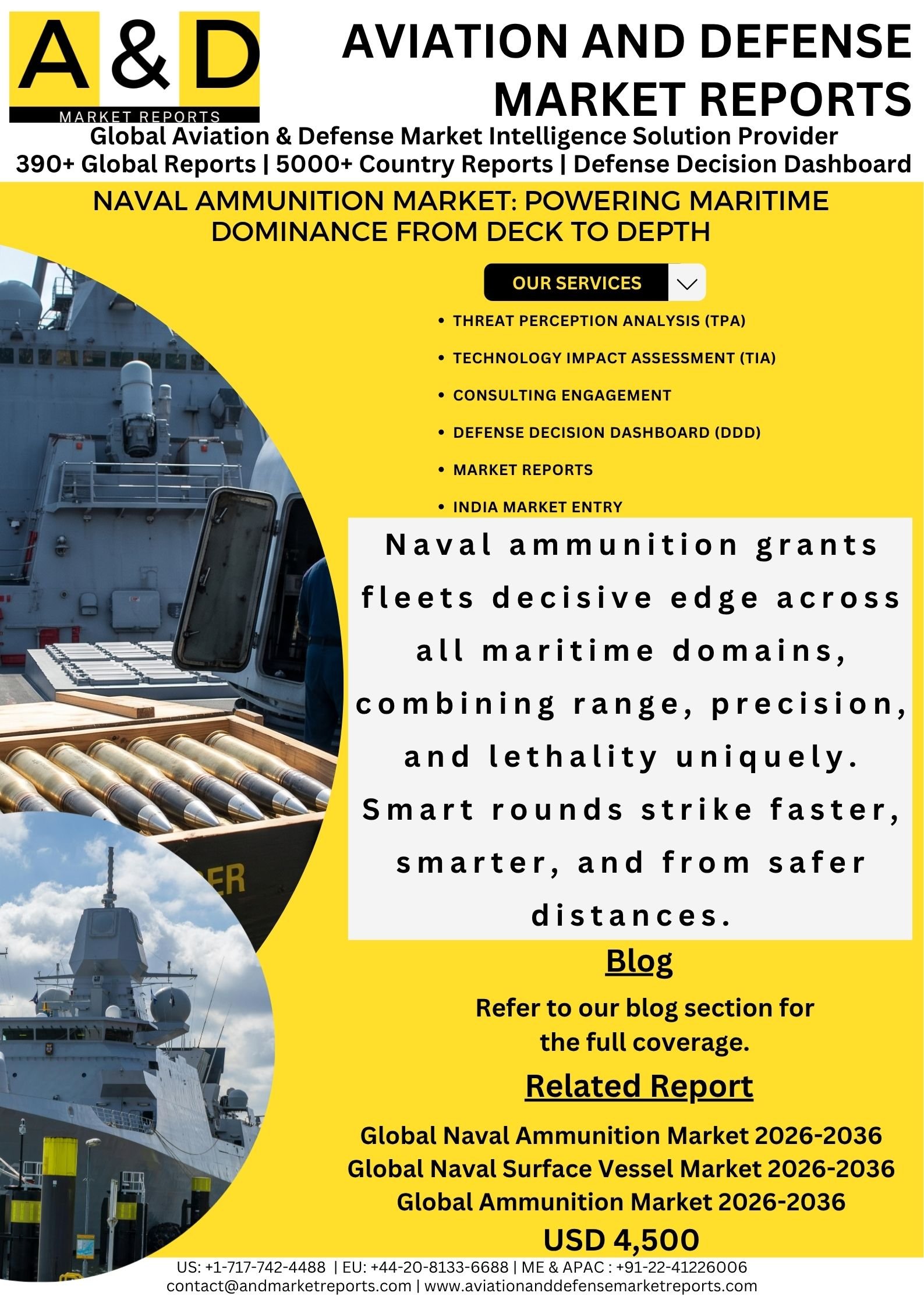
The naval ammunition market serves as the critical backbone of modern maritime warfare, supplying the explosive ordnance that enables ships, submarines, and aircraft to project power across oceans. From high-caliber gun rounds for close-in defense to long-range cruise missiles striking land targets hundreds of miles away, naval ammunition encompasses a vast spectrum of munitions designed for every threat scenario. As naval forces worldwide modernize fleets amid rising geopolitical tensions in maritime hotspots, demand for advanced, reliable, and versatile ammunition surges. Nations invest heavily in stockpiling diverse ordnance that ensures readiness for anti-submarine warfare, anti-surface engagements, land attack missions, and air defense operations.
Core Categories Defining the Market
Naval ammunition divides into distinct categories based on delivery method and target type. Gun ammunition remains foundational for shipboard cannons ranging from twenty millimeter close-in weapons to one hundred fifty millimeter main batteries. These rounds include high-explosive shells for surface targets, armor-piercing variants for fortified structures, and illumination rounds for night operations. Modern guns fire programmable airburst munitions that detonate at precise distances to maximize damage against drones or small boats.
Missile systems dominate long-range engagement, with surface-to-air missiles defending against aircraft and cruise missiles, anti-ship missiles targeting enemy vessels, and land-attack cruise missiles striking deep inland objectives. Vertical launch systems house these missiles in compact cells ready for immediate deployment. Torpedoes represent the submarine’s primary weapon, seeking enemy ships through acoustic homing or wire-guided precision. Rocket artillery provides rapid saturation fire against coastal targets, while electronic warfare munitions jam enemy sensors and communications.
Specialized ammunition addresses emerging threats, including anti-drone rounds with proximity fuses and kinetic interceptors designed to destroy hypersonic missiles mid-flight.
Evolution from Black Powder to Smart Munitions
Naval artillery traces back to centuries-old cannonades firing solid shot at wooden hulls. The Industrial Revolution introduced explosive shells that could pierce steel armor. World War I saw massive battleships exchanging thousand-pound shells across horizons, while World War II refined radar-guided gunfire for unprecedented accuracy.
Post-1945 jet propulsion and missile technology shifted focus from guns to rockets, yet guns persisted for cost-effective defense against fast attack crafts. The Cold War birthed guided missiles with inertial navigation, evolving into today’s GPS-enhanced precision strikes. Digital fire control systems calculate trajectories in milliseconds, compensating for ship motion, wind, and target movement.
Smart munitions now dominate, incorporating microprocessors that adjust flight paths mid-air. Programmable rounds detonate optimally based on target type, while self-forging fragments maximize lethality against armor.
Technological Innovations Transforming Lethality
Guidance systems revolutionize accuracy, with laser designation, radar homing, and infrared seekers enabling first-shot kills. GPS integration allows strikes within meters of intended coordinates, reducing collateral damage. Lofted trajectories let missiles climb high before diving steeply, evading radar coverage.
Exotic propulsion concepts emerge, including railgun-launched projectiles reaching hypersonic speeds without explosives, relying purely on kinetic energy. Directed-energy weapons complement traditional munitions, lasing drones from the sky silently.
Advanced explosives like insensitive high explosives resist accidental detonation, enhancing safety during storage and transport. Nano-materials strengthen casing while reducing weight, extending range without sacrificing payload.
Swarm munitions deploy multiple micro-drones from a single launcher, overwhelming defenses through saturation.
Operational Demands Driving Procurement
Naval forces require ammunition that withstands harsh maritime environments—saltwater corrosion, extreme humidity, and temperature fluctuations. Sealed packaging prevents moisture ingress, while corrosion-resistant coatings protect critical components. Rapid reload systems minimize downtime between engagements, ensuring continuous fire capability.
Interoperability across allied navies simplifies logistics, with standardized calibers and interfaces enabling shared stockpiles. Mobilization exercises test readiness, revealing gaps in supply chains that demand immediate correction.
Asymmetric threats from insurgent boat swarms or drone hordes necessitate cost-effective countermeasures. Cheap ammunition defeats expensive threats, preserving fleet resources for high-value targets.
Market Drivers Fueling Expansion
Geopolitical flashpoints in contested seas accelerate ammunition procurement. Territorial disputes in maritime zones spur nations to bulking anti-ship missile inventories. Naval modernization programs replace aging ordnance with next-generation smart munitions.
Export markets expand as allied nations seek turnkey solutions with technology transfer agreements. Regional powers develop indigenous production to reduce foreign dependency, fostering domestic defense industries.
Budget allocations prioritize ammunition stockpiles over platform purchases, recognizing that weapons without rounds render fleets inert. Training consumption drives demand, with live-fire exercises burning thousands of rounds annually.
Technological spillovers from commercial sectors accelerate innovation. Commercial GPS chips enhance missile guidance, while aerospace composites lighten warhead casings.
Regional Dynamics and Capabilities
North America leads advanced missile development, with integrated systems linking ships to airborne sensors. Europe collaborates through multinational consortia standardizing calibers across allied fleets. Asia-Pacific nations scale domestic production amid island tensions and maritime disputes.
Middle Eastern forces prioritize desert-hardened ammunition resistant to salt corrosion. African navies focus on lightweight, affordable solutions for coastal patrols against smuggling. Latin American countries emphasize mobility for anti-drug operations.
China expands hypersonic missile stockpiles, challenging traditional naval dominance. Russia modernizes submarine torpedoes with新型 acoustic seekers.
Leading Manufacturers Shaping Supply
Major defense contractors dominate naval ammunition production. Lockheed Martin crafts cruise missiles with precision guidance. Raytheon develops surface-to-air missiles defending fleets. Boeing integrates anti-ship missiles with shipboard radars.
Luxembourg-based MBDA produces exocet missiles globally. Northrop Grumman advances railgun projectiles. Strategies blend acquisitions of agile startups with internal R&D, accelerating deployment cycles.
Certification programs ensure interoperability across allied forces, reducing logistical friction during joint operations.
Sustainability and Safety Priorities
Environmental regulations mandate reduced toxic residues from spent munitions. Bio-degradable casings minimize ocean pollution, while insensitive explosives prevent accidental detonations during transport. Recycling programs recover metals from retired rounds, repurposing them for new stock.
Predictive maintenance algorithms minimize spare parts waste. Digital twins simulate lifetimes pre-build, optimizing material usage. Additive manufacturing prints custom components on demand, reducing inventory overhead.
Training ranges implement eco-friendly practices, capturing shrapnel for recycling and neutralizing hazardous runoff.
Emerging Frontiers Unleashed
Quantum sensors detect submarines through magnetic anomalies, guiding torpedoes with unprecedented accuracy. Hypersonic projectiles outpace traditional defenses, requiring lightweight countermeasures. Bio-inspired designs mimic fish movements for silent torpedo propulsion.
Neural interfaces fuse operator intuition with machine precision, enabling intuitive command of swarm tactics. Self-healing composites repair micro-cracks autonomously, extending service life indefinitely.
Directed-energy munitions laser drones silently, conserving energy for repeated strikes. Electromagnetic railguns launch projectiles at Mach six without explosives, relying on kinetic punch.
Unmatched Maritime Supremacy
Naval ammunition grants fleets decisive edge across all maritime domains, combining range, precision, and lethality uniquely. Smart rounds strike faster, smarter, and from safer distances.
They dominate the seas decisively.
Markets propel this ordnance revolution forward, munitions reshaping naval combat. From decks to depths, naval ammunition secures ocean supremacy. Embrace the power—voltage sails deep.