Introduction
The Global AESA Radar Market has emerged as one of the most significant segments within the defense and aerospace industry, driven by the increasing demand for advanced surveillance, target detection, electronic warfare, and air defense capabilities. Active Electronically Scanned Array (AESA) radar technology represents a major leap over conventional mechanically scanned radar systems by offering superior tracking accuracy, faster scanning speeds, enhanced reliability, and greater resistance to electronic jamming.
Modern military operations require real-time situational awareness across land, air, sea, and space domains. AESA radars have become an essential component in next-generation fighter aircraft, naval vessels, airborne early warning systems, missile defense platforms, ground-based surveillance systems, and unmanned aerial vehicles. Their ability to simultaneously detect, track, and engage multiple targets has transformed military surveillance and combat operations.
Governments worldwide continue investing in defense modernization programs, network-centric warfare capabilities, and indigenous radar development initiatives. These investments are accelerating the adoption of AESA radar systems across developed and emerging economies. Furthermore, technological advancements in semiconductor materials, digital signal processing, artificial intelligence, and electronic warfare integration continue to expand the capabilities of AESA radar solutions.
As geopolitical tensions, border security concerns, and modernization initiatives increase globally, the AESA radar market is expected to witness sustained demand across multiple defense platforms over the coming years.
What is AESA Radar?
Active Electronically Scanned Array (AESA) radar is an advanced radar technology that utilizes hundreds or thousands of independent transmit/receive (T/R) modules instead of a single transmitter. Each module independently emits radio frequency energy, allowing the radar beam to be electronically steered without physically moving the antenna.
Unlike traditional mechanically scanned radars, AESA systems can perform multiple functions simultaneously, including:
- Air surveillance
- Surface surveillance
- Missile tracking
- Fire control
- Target identification
- Electronic attack
- Electronic support measures
- Weather monitoring
The absence of moving mechanical parts significantly improves reliability while reducing maintenance requirements. AESA radars also offer faster beam steering, lower probability of interception, improved target discrimination, and enhanced operational flexibility.
Key Market Drivers
Rising Defense Modernization Programs
Many countries are investing heavily in upgrading aging military equipment with next-generation technologies. Fighter aircraft, naval destroyers, frigates, submarines, armored vehicles, and integrated air defense systems increasingly incorporate AESA radar technology to improve operational effectiveness.
Defense modernization initiatives across North America, Europe, Asia-Pacific, and the Middle East continue creating long-term procurement opportunities for radar manufacturers.
Growing Demand for Multi-Mission Radar Systems
Military organizations prefer radar systems capable of performing multiple operational roles simultaneously.
Modern AESA radars can conduct:
- Air-to-air surveillance
- Air-to-ground mapping
- Maritime patrol
- Missile guidance
- Electronic warfare
- Target tracking
This multi-functionality reduces platform weight, improves mission flexibility, and lowers lifecycle costs.
Increasing Geopolitical Tensions
Border disputes, maritime security challenges, and regional conflicts have significantly increased investments in advanced surveillance technologies.
Countries are strengthening:
- Integrated air defense networks
- Coastal surveillance
- Missile defense systems
- Naval combat capabilities
- Long-range surveillance infrastructure
AESA radar has become central to these national security initiatives.
Growth of Fifth-Generation and Sixth-Generation Fighter Aircraft
Modern fighter aircraft rely extensively on AESA radar technology for:
- Long-range target detection
- Simultaneous tracking
- Electronic attack
- Synthetic aperture imaging
- Beyond visual range engagement
As several countries continue expanding their advanced combat aircraft fleets, demand for high-performance airborne AESA radars continues to rise.
Advancements in Semiconductor Technology
Recent developments in Gallium Nitride (GaN) and Gallium Arsenide (GaAs) semiconductor technologies have substantially improved radar performance.
These technologies enable:
- Higher transmission power
- Better thermal efficiency
- Reduced energy consumption
- Longer operational lifespan
- Improved detection ranges
GaN-based AESA radars are increasingly replacing older radar architectures across defense applications.
Technology Trends Transforming the AESA Radar Market
Artificial Intelligence Integration
Artificial intelligence is increasingly being integrated into radar systems for:
- Automated threat identification
- Adaptive signal processing
- Intelligent target classification
- Reduced false alarms
- Predictive maintenance
AI-driven radar solutions significantly improve battlefield decision-making.
Digital Beamforming
Digital beamforming enables multiple independent radar beams to operate simultaneously.
Benefits include:
- Higher tracking accuracy
- Enhanced surveillance coverage
- Improved clutter suppression
- Faster target acquisition
This technology is becoming standard in advanced military radar systems.
Electronic Warfare Capabilities
Modern AESA radars can simultaneously function as electronic warfare systems by:
- Detecting hostile emissions
- Jamming enemy radar
- Protecting friendly aircraft
- Supporting electronic intelligence missions
This convergence of radar and electronic warfare enhances battlefield survivability.
Network-Centric Warfare
Today’s defense forces increasingly operate interconnected combat networks.
AESA radars support:
- Secure data sharing
- Real-time battlefield awareness
- Sensor fusion
- Multi-platform coordination
These capabilities improve operational efficiency during complex military missions.
Applications of AESA Radar
The versatility of AESA radar has expanded its adoption across multiple defense domains.
Airborne Platforms
Modern fighter aircraft utilize AESA radar for air superiority missions, precision targeting, reconnaissance, and electronic warfare operations.
Naval Platforms
Destroyers, frigates, aircraft carriers, and patrol vessels employ AESA radar for maritime surveillance, missile defense, and target tracking.
Ground-Based Air Defense
Ground surveillance radars support:
- Airspace monitoring
- Missile detection
- Border surveillance
- Counter-UAV operations
Missile Defense Systems
AESA radar plays an essential role in tracking ballistic missiles, cruise missiles, and hypersonic threats.
Unmanned Systems
Military drones increasingly integrate lightweight AESA radar for reconnaissance, surveillance, and intelligence gathering.
Regional Market Insights
North America
North America remains a leading market due to continuous defense investments, advanced military research, and the presence of major radar manufacturers. Ongoing modernization of fighter aircraft, naval fleets, and missile defense systems continues to drive adoption.
Europe
European countries are strengthening regional defense cooperation while upgrading airborne surveillance, naval capabilities, and integrated air defense networks. Collaborative defense initiatives further support the demand for advanced radar technologies.
Asia-Pacific
Asia-Pacific represents one of the fastest-growing markets owing to increasing defense budgets, indigenous fighter aircraft programs, maritime security concerns, and border surveillance requirements. Several countries are actively developing and deploying AESA radar systems across multiple military platforms.
Middle East
The Middle East continues investing in sophisticated air defense systems, advanced combat aircraft, and naval modernization to address evolving regional security challenges.
Latin America and Africa
Emerging economies are gradually adopting modern radar technologies for border security, coastal surveillance, and military modernization initiatives, creating new growth opportunities.
Competitive Landscape
The Global AESA Radar Market is characterized by continuous technological innovation and strategic collaborations. Leading defense companies are focusing on:
- Development of Gallium Nitride-based radar systems
- Lightweight radar architectures
- Software-defined radar platforms
- Artificial intelligence integration
- Advanced electronic warfare capabilities
- Indigenous manufacturing initiatives
- Strategic defense partnerships
- Export opportunities
Competition increasingly centers on performance, power efficiency, modularity, and interoperability with next-generation combat systems.
Challenges Facing the Market
Despite strong growth prospects, several challenges remain:
- High development and procurement costs
- Complex integration with legacy platforms
- Export regulations and defense policies
- Rapid technological evolution
- Cybersecurity concerns
- Supply chain disruptions for semiconductor components
Manufacturers continue investing in research and development to overcome these challenges while improving affordability and operational performance.
Emerging Opportunities
Several factors are expected to create new opportunities within the Global AESA Radar Market:
- Expansion of unmanned combat systems
- Counter-drone surveillance solutions
- Hypersonic missile detection technologies
- Space-based surveillance programs
- Artificial intelligence-enabled radar analytics
- Multi-domain battlefield management systems
- Indigenous defense manufacturing initiatives
- Software-defined radar upgrades
As defense forces increasingly prioritize integrated sensor networks, AESA radar technology will remain central to future military capabilities.
Future Outlook
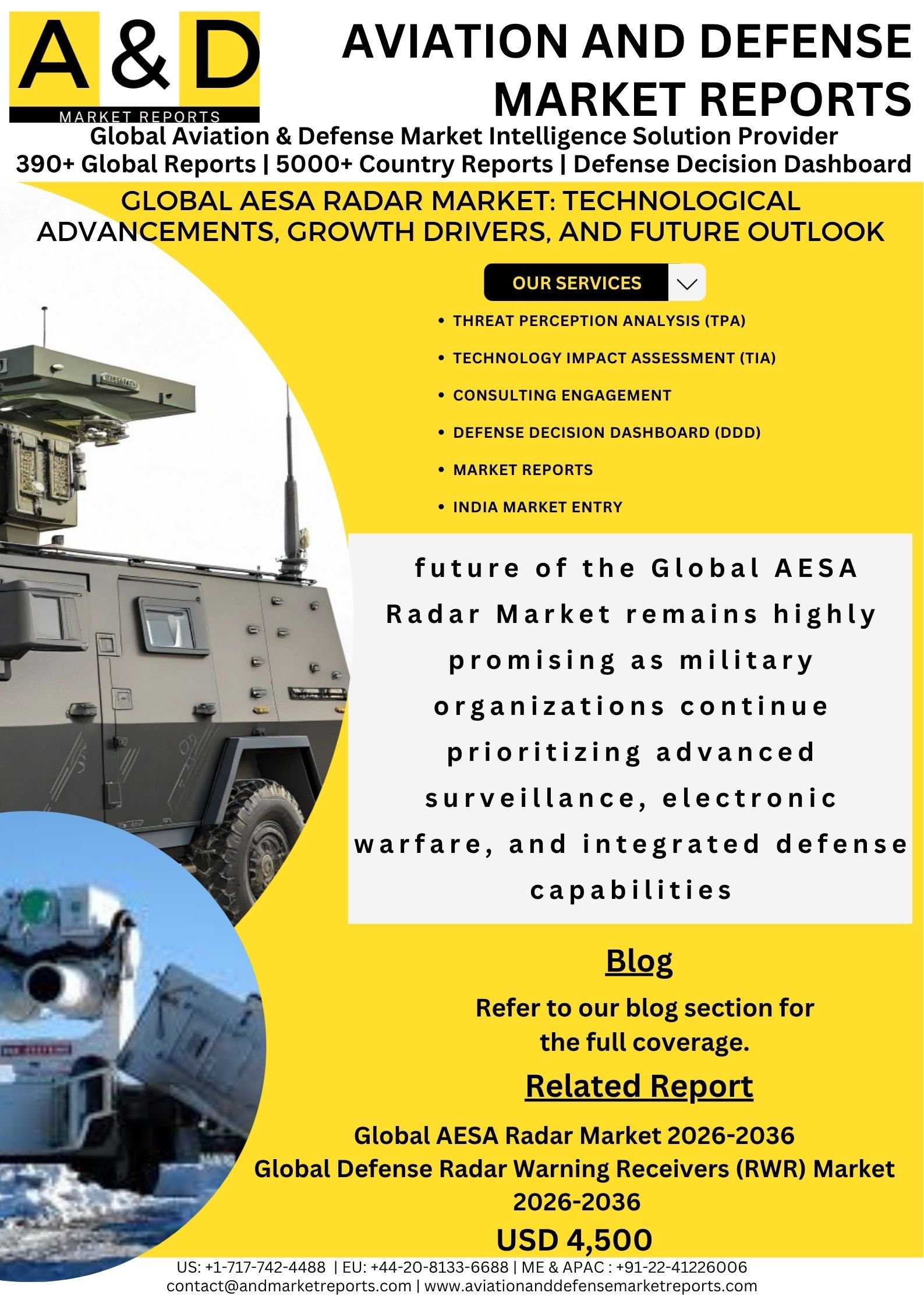
The future of the Global AESA Radar Market remains highly promising as military organizations continue prioritizing advanced surveillance, electronic warfare, and integrated defense capabilities. Continuous innovation in semiconductor technologies, artificial intelligence, digital beamforming, and network-centric warfare will further enhance the operational effectiveness of AESA radar systems.
Growing investments in fifth-generation and emerging sixth-generation combat aircraft, naval modernization programs, missile defense networks, and autonomous military platforms are expected to sustain long-term market demand. Additionally, the increasing emphasis on indigenous defense production and strategic collaborations among governments and industry players will further accelerate technological advancements.
As modern warfare becomes increasingly data-driven and multidomain, AESA radar will continue serving as a critical force multiplier, providing superior situational awareness, precision tracking, and mission flexibility. The market is therefore well positioned for sustained expansion, driven by evolving defense requirements, rapid technological progress, and the global focus on strengthening national security infrastructures.