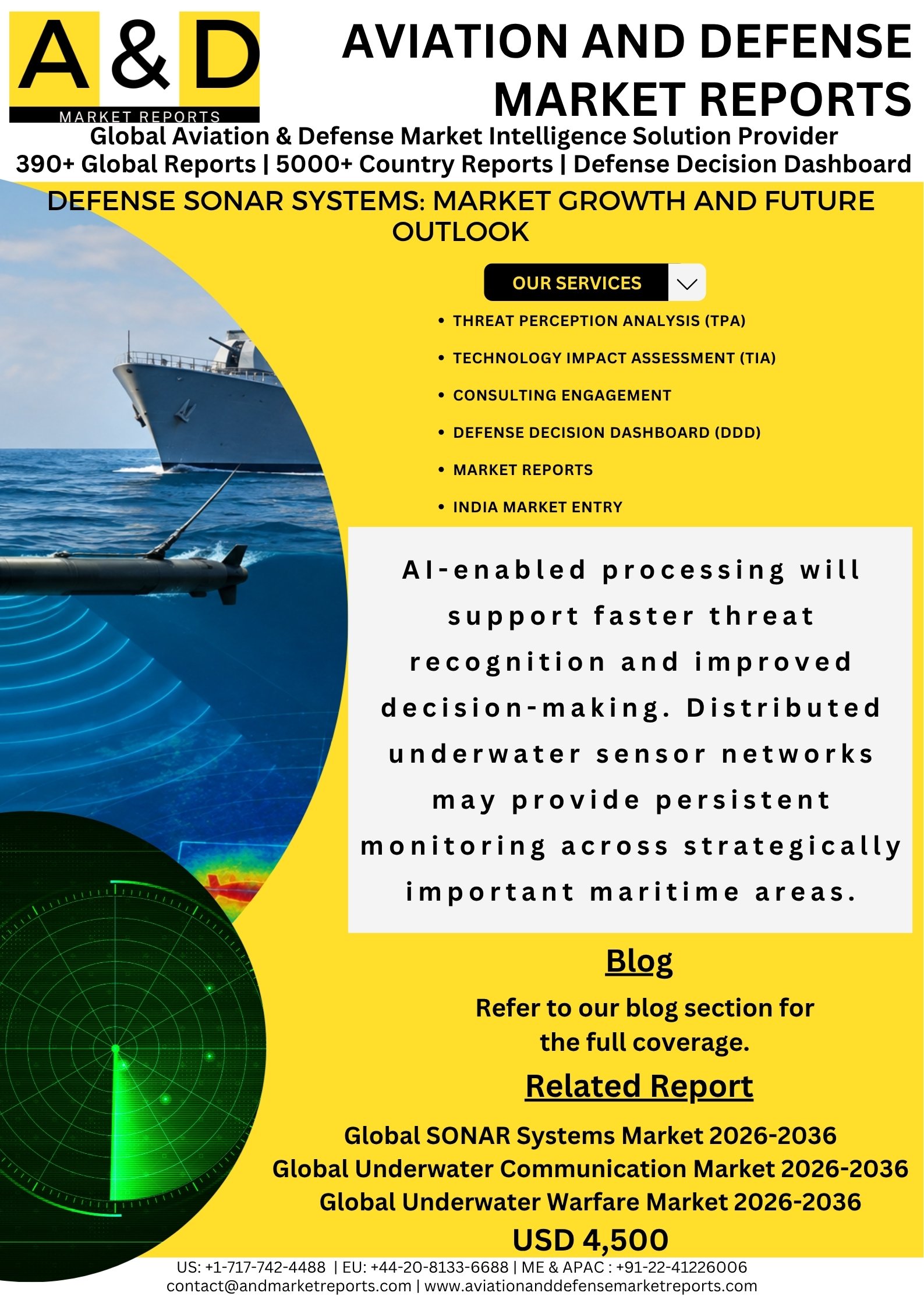
Defense SONAR systems are essential underwater sensing technologies used to detect, identify, track, and classify objects beneath the water’s surface. SONAR, or Sound Navigation and Ranging, uses sound waves to locate submarines, underwater vehicles, mines, and other submerged threats. Since radio waves lose effectiveness underwater, acoustic technology remains one of the most reliable methods for underwater surveillance and maritime security.
Modern defense SONAR systems support naval forces in anti-submarine warfare, mine detection, underwater navigation, intelligence gathering, and seabed monitoring. They are deployed on submarines, surface warships, helicopters, maritime patrol aircraft, unmanned underwater vehicles, and fixed underwater surveillance networks. Increasing maritime competition, submarine modernization, and the growing use of unmanned underwater platforms are supporting demand for advanced SONAR solutions.
Evolution of Defense SONAR Systems
The development of defense SONAR systems began during the early twentieth century, when navies searched for reliable methods to detect submarines. Early systems were relatively simple and mainly provided basic underwater ranging information. Their performance was affected by ocean conditions, background noise, and limited signal-processing capabilities.
During the Second World War, SONAR technology advanced significantly as naval forces required improved submarine detection and tracking. Passive SONAR systems, which listen for sound generated by underwater objects, became important for covert surveillance. Active SONAR systems, which transmit acoustic signals and analyze returning echoes, were used to determine the location and distance of submerged targets.
The Cold War accelerated the development of long-range submarine detection, towed-array SONAR, low-frequency active SONAR, and advanced underwater communication systems. Digital signal processing later improved target classification, noise reduction, and data integration. Today, artificial intelligence, distributed sensor networks, and unmanned platforms are transforming SONAR from an individual sensor into a connected underwater intelligence system.
Importance of Defense SONAR Systems
Defense SONAR systems play a central role in protecting naval assets and maintaining underwater situational awareness. Their importance is increasing as submarines become quieter, underwater drones become more capable, and maritime trade routes face growing security risks.
SONAR systems help naval forces detect hostile submarines before they approach high-value vessels or coastal infrastructure. They also support the identification of underwater mines, which can threaten warships, commercial shipping, ports, and offshore energy facilities.
In addition, SONAR technology enables safe navigation in deep and shallow waters. It can support seabed mapping, underwater obstacle detection, search-and-rescue operations, and the monitoring of critical underwater infrastructure such as pipelines and communication cables. By combining SONAR data with radar, electro-optical sensors, satellite information, and combat management systems, naval forces can develop a more complete maritime operating picture.
Key Components of Modern Defense SONAR Systems
Modern defense SONAR systems consist of several integrated components. The transducer array is one of the most important elements because it converts electrical energy into acoustic signals and receives returning echoes. Arrays may be mounted inside a ship’s hull, installed in a towed body, or deployed on a submarine or unmanned underwater vehicle.
The transmitter generates acoustic pulses for active SONAR operations, while the receiver captures and processes underwater sound. Signal-processing units analyze acoustic data to identify target characteristics, estimate range and bearing, and reduce interference caused by marine life, shipping activity, and ocean noise.
Other important components include beamforming systems, acoustic processors, displays, operator consoles, navigation interfaces, and data links. Modern systems may also include automated target recognition, electronic support measures, environmental sensors, and interfaces with naval combat management systems.
Towed-array SONAR systems provide long-range detection by placing acoustic sensors away from the vessel’s own machinery noise. Variable-depth SONAR systems can operate at different underwater depths to improve performance in complex ocean environments. Deployable and unmanned SONAR systems offer additional flexibility for missions in dangerous or restricted waters.
Technological Advancements Driving Market Growth
Technological innovation is one of the major factors supporting the defense SONAR systems market. Digital signal processing enables systems to analyze large volumes of acoustic information more quickly and accurately. Advanced algorithms can separate potential threats from background noise and improve target classification.
Artificial intelligence and machine learning are increasingly being used to recognize acoustic patterns and support operator decision-making. These technologies can help identify different classes of submarines, underwater vehicles, and mines while reducing the workload of sonar operators.
Low-frequency active SONAR is also advancing, offering improved detection ranges in certain underwater conditions. Synthetic aperture SONAR provides high-resolution seabed imagery and is particularly valuable for mine countermeasures and underwater mapping.
The integration of SONAR with unmanned surface vehicles and autonomous underwater vehicles is another important development. These platforms can conduct persistent surveillance in areas that may be too risky or difficult for crewed vessels. Networked underwater sensors and secure data links are also enabling distributed maritime surveillance.
Growing Defense SONAR Systems Production Supporting Market Expansion
Increasing production of defense SONAR systems is closely linked to naval fleet modernization programs. Governments are investing in new submarines, frigates, destroyers, maritime patrol aircraft, and unmanned underwater platforms. These platforms require advanced acoustic systems for detection, navigation, and underwater warfare.
Domestic production is also becoming a strategic priority. Countries are seeking to reduce dependence on foreign suppliers by developing indigenous transducers, acoustic processors, sonar arrays, and underwater communication technologies. Local manufacturing supports supply-chain security, creates specialized engineering capabilities, and enables systems to be customized for regional maritime conditions.
Manufacturers are increasingly offering modular SONAR architectures that can be upgraded throughout a platform’s service life. This approach allows naval forces to improve processing power, software, sensors, and data integration without replacing the entire system.
Increasing Demand for Defense SONAR Systems and Upgrades
Demand for defense SONAR systems is being driven by the expansion of submarine fleets, rising underwater threats, and the need to protect maritime infrastructure. Quiet diesel-electric submarines, nuclear-powered submarines, autonomous underwater vehicles, and underwater mines are creating new operational challenges for naval forces.
Many existing naval platforms are also undergoing mid-life upgrades. These upgrades may include improved transducer arrays, modern processors, advanced displays, enhanced classification software, and integration with unmanned systems. Demand is also growing for compact and lightweight SONAR systems suitable for helicopters, small vessels, and unmanned platforms.
The protection of ports, naval bases, offshore energy installations, and undersea communication cables is creating additional opportunities for fixed and mobile underwater surveillance systems.
Regional Market Developments
North America remains an important market because of continued investment in submarine warfare, maritime surveillance, and advanced naval platforms. The region is also focusing on unmanned underwater systems and networked acoustic sensors.
Europe is strengthening its underwater defense capabilities in response to changing maritime security conditions. Countries are investing in submarine modernization, mine countermeasure systems, and protection of critical underwater infrastructure.
The Asia-Pacific region is expected to experience strong demand due to naval expansion, territorial disputes, submarine acquisition programs, and increasing maritime activity. Countries are developing indigenous shipbuilding and underwater technology capabilities while procuring advanced SONAR systems for new platforms.
The Middle East is also showing interest in maritime surveillance and coastal security, particularly for protecting ports, offshore facilities, and strategic waterways.
Competitive Landscape of the Market
The defense SONAR systems market includes major defense contractors, naval electronics manufacturers, underwater technology specialists, and emerging unmanned-system companies. Competition is based on detection performance, acoustic processing, reliability, platform compatibility, lifecycle cost, and upgrade capability.
Companies are focusing on strategic partnerships, technology licensing, local manufacturing, and long-term maintenance contracts. Software development and data analytics are becoming as important as hardware production because modern naval forces require integrated and automated underwater intelligence.
Challenges Affecting Market Growth
Despite strong demand, the market faces several challenges. Underwater acoustic conditions vary significantly with temperature, salinity, depth, seabed characteristics, and marine traffic. These factors can reduce detection performance and make target classification difficult.
High development and procurement costs can also limit adoption, especially among countries with restricted defense budgets. SONAR systems require specialized testing facilities, trained operators, and regular maintenance. Integration with older naval platforms may be technically complex.
Environmental concerns related to high-intensity active SONAR are another challenge. Manufacturers and naval forces must consider the potential impact of acoustic emissions on marine ecosystems while maintaining operational effectiveness.
Future Outlook of Defense SONAR Systems
The future of defense SONAR systems will be shaped by automation, artificial intelligence, miniaturization, and network-centric operations. Autonomous underwater vehicles are expected to become more widely used for surveillance, mine detection, seabed mapping, and anti-submarine missions.
AI-enabled processing will support faster threat recognition and improved decision-making. Distributed underwater sensor networks may provide persistent monitoring across strategically important maritime areas. Advanced materials, improved batteries, low-power electronics, and compact transducer arrays will support the development of smaller and more capable systems.
As naval forces seek greater underwater awareness, defense SONAR systems will remain a critical part of maritime security. Their integration with unmanned platforms, combat management systems, and other intelligence technologies will create new opportunities for manufacturers and strengthen the long-term growth prospects of the global defense SONAR systems market.