Introduction
Radar technology has remained one of the most critical components of military operations for decades, serving as the backbone of surveillance, target detection, tracking, and missile guidance systems. As modern warfare evolves with the emergence of hypersonic weapons, stealth aircraft, unmanned aerial vehicles (UAVs), and electronic warfare capabilities, defense forces worldwide are investing heavily in advanced radar systems to strengthen situational awareness and battlefield dominance.
The global defense radar market is experiencing significant growth due to increasing defense expenditures, rising geopolitical tensions, border security concerns, and rapid technological advancements. Modern radar systems now incorporate artificial intelligence (AI), digital signal processing, gallium nitride (GaN) technology, and multi-function capabilities, enabling military forces to detect and neutralize threats with unprecedented accuracy and speed.
Understanding Defense Radar Systems
Defense radar systems utilize radio waves to detect, identify, track, and classify airborne, maritime, and ground-based threats. These systems are deployed across various military platforms, including fighter aircraft, naval vessels, armored vehicles, missile defense batteries, and fixed surveillance installations.
Military radars perform multiple missions such as:
- Airspace surveillance
- Missile detection and tracking
- Target acquisition
- Fire control
- Battlefield reconnaissance
- Early warning operations
- Counter-drone detection
- Coastal and maritime surveillance
The growing complexity of modern threats has transformed radar systems from simple detection tools into sophisticated networked sensors that form an integral part of integrated air and missile defense architectures.
Defense radar systems – Key Market Drivers
Rising Global Defense Spending
Countries across North America, Europe, Asia-Pacific, and the Middle East are increasing military budgets to modernize defense capabilities. Escalating geopolitical conflicts and territorial disputes have accelerated investments in advanced surveillance and air defense infrastructure.
Governments are prioritizing radar procurement programs to improve early-warning capabilities and strengthen national security against conventional and asymmetric threats.
Growing Threat of Hypersonic Weapons
The development of hypersonic missiles by major military powers has created a demand for next-generation radar systems capable of detecting fast-moving and maneuverable targets. Conventional radar architectures often struggle to track hypersonic threats effectively, prompting defense organizations to invest in high-frequency and long-range radar technologies.
Expansion of Air and Missile Defense Programs
Modern air defense systems rely heavily on radar networks for target detection and engagement. Countries are deploying layered air defense architectures that integrate multiple radar systems capable of tracking aircraft, cruise missiles, ballistic missiles, and drones simultaneously.
This trend is significantly boosting demand for advanced surveillance and fire-control radars.
Increasing Use of Unmanned Systems
The widespread adoption of drones and loitering munitions has created new security challenges. Small UAVs often possess low radar signatures, making them difficult to detect using traditional systems.
As a result, defense organizations are investing in specialized counter-UAV radar systems capable of identifying and tracking small aerial threats in complex operational environments.
Emerging Technologies Shaping the Market
Active Electronically Scanned Array (AESA) Radars
AESA radar technology has become a cornerstone of modern military sensor systems. Unlike mechanically scanned radars, AESA systems use electronically controlled beams, allowing faster target tracking, greater reliability, and improved resistance to electronic warfare attacks.
AESA radars are increasingly being integrated into fighter aircraft, naval warships, and ground-based surveillance platforms.
Gallium Nitride (GaN) Technology
GaN semiconductors are revolutionizing radar performance by enabling higher power output, improved efficiency, and greater detection ranges. Compared with traditional gallium arsenide (GaAs)-based systems, GaN radar modules offer enhanced thermal management and operational reliability.
Many next-generation military radar programs now incorporate GaN technology to improve performance while reducing system size and maintenance requirements.
Artificial Intelligence and Machine Learning
AI-powered radar systems are enhancing threat identification and decision-making capabilities. Machine learning algorithms can analyze vast amounts of sensor data, distinguish between friendly and hostile objects, and reduce false alarms.
These capabilities are becoming increasingly important in contested environments where operators must process large volumes of information in real time.
Multi-Function Radar Systems
Modern military forces are seeking radar solutions that can perform multiple tasks simultaneously, including surveillance, tracking, target acquisition, and missile guidance.
Multi-function radar systems reduce operational costs, simplify logistics, and improve battlefield efficiency, making them an attractive option for defense modernization programs.
Market Segmentation
By Platform
Ground-Based Radar
Ground-based radar systems account for a significant share of the market due to their widespread use in air defense, border surveillance, and missile warning operations. These systems provide long-range coverage and serve as key components of national security infrastructure.
Naval Radar
Naval forces rely on radar systems for maritime surveillance, navigation, target tracking, and missile defense. The increasing construction of advanced warships and frigates is driving demand for sophisticated naval radar solutions.
Airborne Radar
Airborne radar systems installed on fighter jets, surveillance aircraft, helicopters, and UAVs provide critical intelligence and targeting capabilities. The modernization of combat aircraft fleets continues to generate strong demand in this segment.
By Frequency Band
Defense radar systems operate across multiple frequency bands, including:
- L-Band
- S-Band
- C-Band
- X-Band
- Ku-Band
- Ka-Band
Each frequency band offers unique advantages depending on operational requirements such as range, resolution, and target detection capability.
Defense radar systems – Regional Market Outlook
North America
North America remains the largest defense radar market, driven primarily by extensive military modernization efforts and advanced research programs. The region benefits from strong investments in missile defense, space surveillance, and next-generation sensor technologies.
Europe
European nations are increasing defense spending in response to evolving security challenges. Several countries are procuring new air defense systems, naval platforms, and radar networks to strengthen regional security.
Asia-Pacific
Asia-Pacific is expected to witness the fastest growth during the forecast period. Rising military modernization initiatives in countries such as India, China, Japan, South Korea, and Australia are driving significant radar procurement activities.
Growing territorial disputes and maritime security concerns further contribute to market expansion.
Middle East
The Middle East continues to invest heavily in integrated air and missile defense systems to address regional security threats. Demand for advanced surveillance radars and counter-drone technologies remains particularly strong across the region.
Competitive Landscape
The defense radar market is characterized by intense competition among leading defense contractors and technology providers. Major companies are focusing on research and development, strategic partnerships, and product innovation to strengthen their market positions.
Key industry participants are investing in:
- AI-enabled radar solutions
- Long-range surveillance systems
- Counter-hypersonic detection technologies
- Multi-domain sensor integration
- Advanced electronic warfare resilience
The growing emphasis on network-centric warfare is encouraging companies to develop radar systems capable of seamlessly integrating with broader defense ecosystems.
Future Outlook Defense radar systems
The future of the defense radar market will be shaped by increasing demand for advanced surveillance, integrated air and missile defense, and multi-domain battlefield awareness. Emerging technologies such as AI, GaN semiconductors, digital beamforming, and space-based sensing platforms are expected to redefine radar capabilities over the coming decade.
As military forces prepare for increasingly complex threat environments, radar systems will continue to play a vital role in ensuring operational superiority, force protection, and national security. With sustained investments in defense modernization worldwide, the global defense radar market is poised for robust growth and technological transformation in the years ahead.
Conclusion
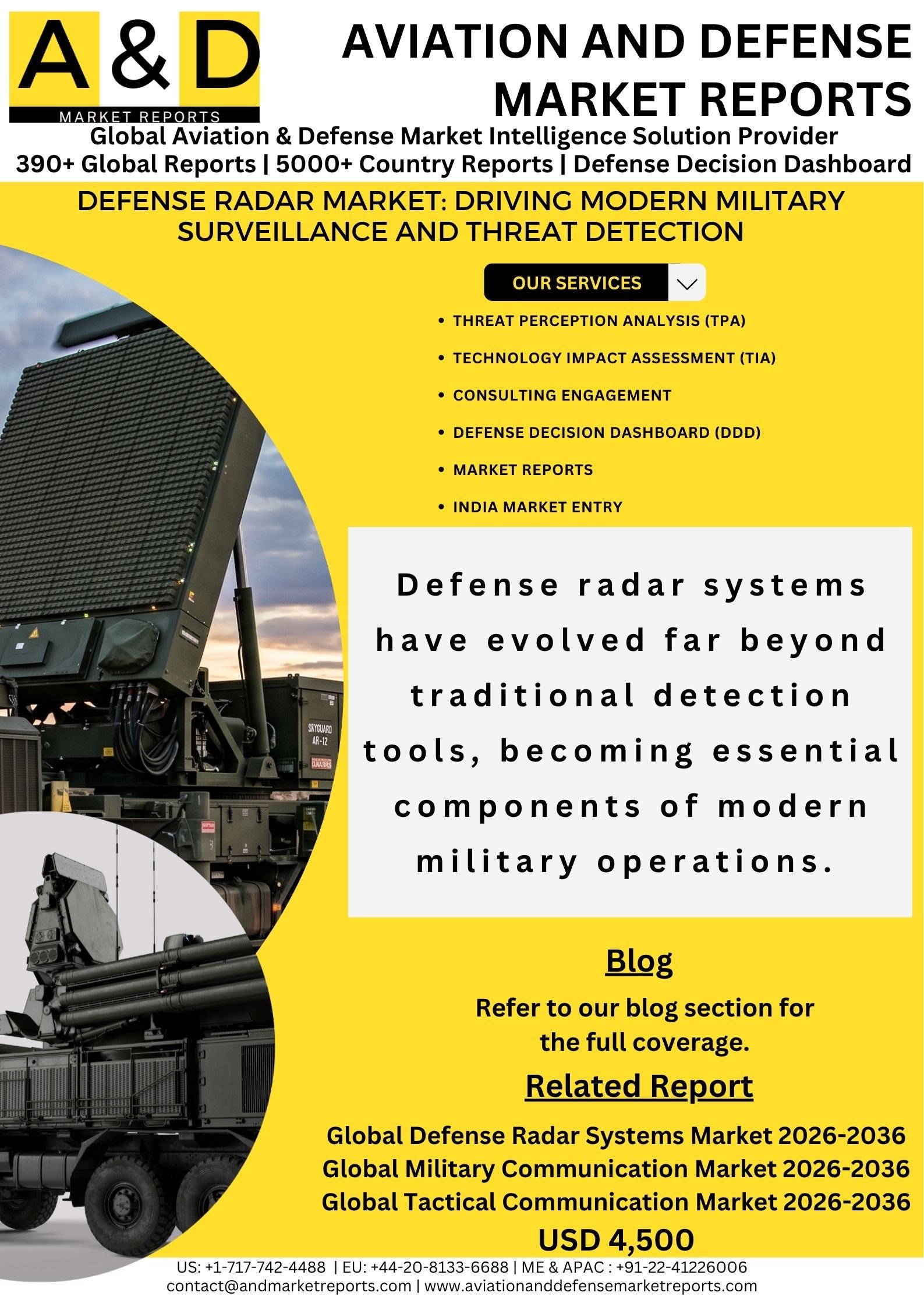
Defense radar systems have evolved far beyond traditional detection tools, becoming essential components of modern military operations. Rising geopolitical tensions, evolving aerial threats, and technological advancements are fueling demand for sophisticated radar solutions across land, sea, air, and space domains.
As nations prioritize situational awareness and integrated defense capabilities, the defense radar market is expected to remain a key growth sector within the global defense industry, driving innovation and shaping the future of military surveillance and threat detection.