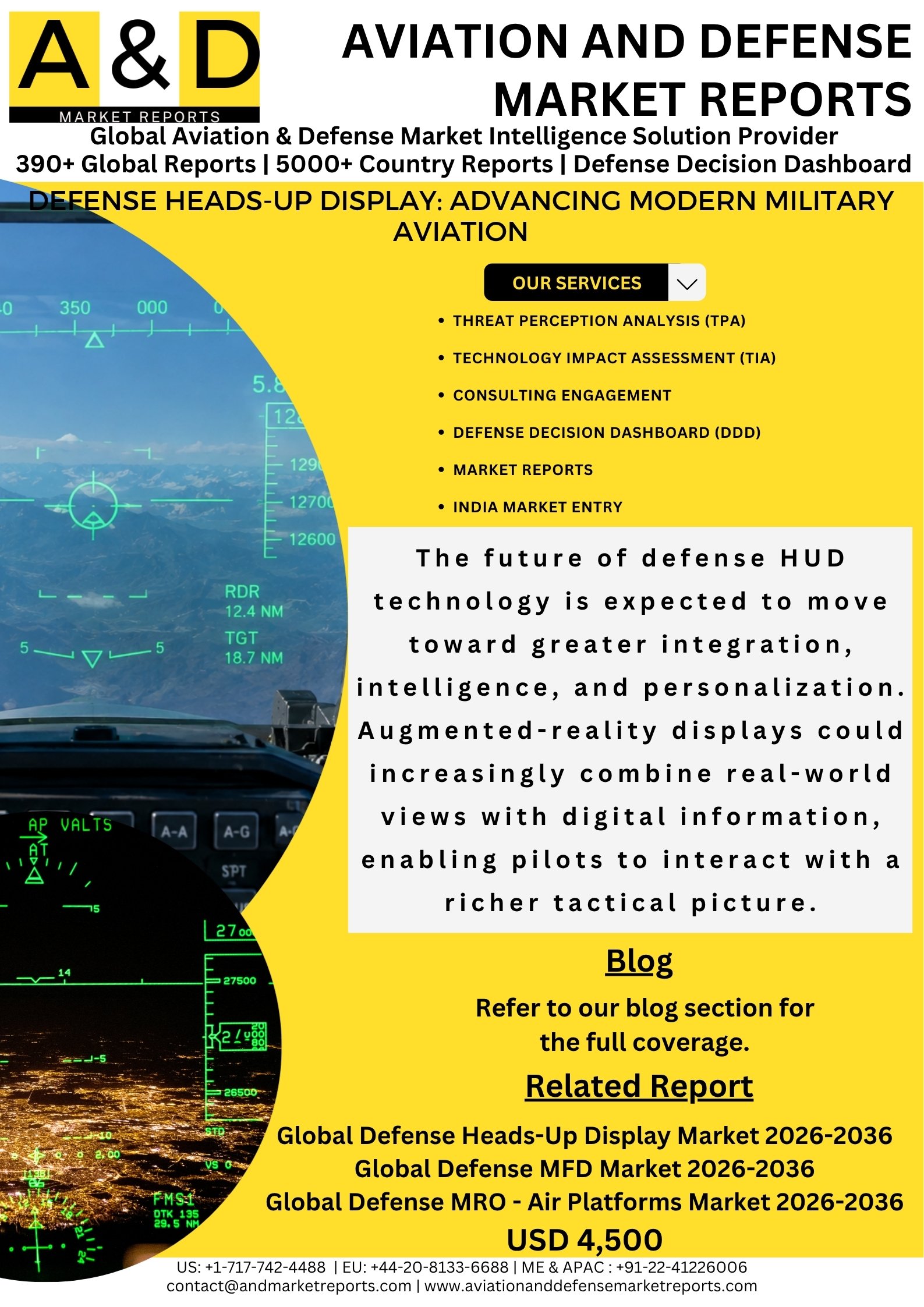
Defense Heads-Up Displays (HUDs) have become an important technology in modern military aviation, enabling pilots to access critical flight and mission information without diverting their attention from the external environment. A defense HUD projects essential data such as altitude, airspeed, heading, targeting information, navigation cues, weapon status, and aircraft warnings directly into the pilot’s field of view.
Unlike conventional cockpit instruments that require pilots to look down at displays, HUD technology supports faster decision-making by presenting information within the pilot’s line of sight. This capability is particularly valuable during high-speed flight, low-altitude operations, air combat, precision strikes, and challenging weather conditions.
Modern defense HUD systems are increasingly integrated with aircraft avionics, sensors, weapons, navigation systems, and mission computers. As military platforms become more digitally connected, the role of HUDs is expanding from basic flight-data projection toward an integrated interface for situational awareness and combat operations.
Evolution of Defense Heads-Up Display
The evolution of defense HUD technology has been closely linked to advances in military aircraft and avionics. Early systems were primarily designed to display basic flight parameters, including airspeed, altitude, attitude, and heading. Over time, HUDs incorporated navigation, weapon-aiming, targeting, and aircraft-status information.
The development of digital avionics significantly improved HUD functionality. Digital processing allowed systems to display more information while improving accuracy, reliability, and flexibility. Modern HUDs can receive data from multiple onboard sources and present it in a unified format.
The technology has also evolved beyond traditional fixed displays. Helmet-mounted displays and cueing systems now complement cockpit HUDs by allowing pilots to access information while looking away from the aircraft’s central display area. These systems are particularly relevant to close-range air combat, where rapid target acquisition and engagement are critical.
The transition toward glass cockpits, advanced mission computers, sensor fusion, and network-centric warfare has further transformed HUDs into sophisticated human-machine interfaces.
Importance of Defense Heads-Up Display
The primary importance of a defense HUD is its ability to improve pilot situational awareness while reducing the need to shift visual attention between the outside environment and cockpit instruments. By placing critical information within the pilot’s forward field of view, HUDs can support faster interpretation of flight and mission data.
HUDs are especially valuable during take-off, landing, low-level flight, aerial combat, precision weapon delivery, and emergency situations. Weapon-related information can include target designation, weapon status, aiming references, and engagement cues, allowing pilots to make decisions with greater speed.
Modern HUDs also support mission effectiveness by combining information from navigation systems, radar, electro-optical sensors, electronic warfare systems, and weapons. This integration can provide pilots with a more comprehensive operational picture.
For military forces, HUD technology can also support aircraft modernization programs. Upgrading cockpit interfaces and display systems can extend the operational relevance of legacy aircraft without requiring complete platform replacement.
Key Components of Modern Defense Heads-Up Display
A modern defense HUD consists of several integrated components designed to collect, process, and project information. The optical display unit is responsible for presenting symbols and imagery within the pilot’s viewing area. Depending on the design, this may involve a combiner, optical elements, projection technology, or advanced display modules.
A processing unit manages information received from the aircraft’s avionics and mission systems. It determines which information should be displayed and converts data into readable symbols, graphics, and targeting cues.
Input interfaces connect the HUD with flight-control systems, navigation equipment, radar, sensors, weapons systems, and mission computers. Accurate inertial and navigation data are essential for ensuring that flight and targeting information is correctly presented.
Modern systems may also incorporate night-vision compatibility, digital image generation, high-resolution symbology, augmented-reality capabilities, and advanced display technologies. Together, these components allow HUDs to function as an important interface between the pilot and the aircraft’s digital combat systems.
Technological Advancements Driving Market Growth
Technological advancements are creating new opportunities in the defense HUD market. Digital processing, advanced optical systems, high-resolution displays, augmented reality, artificial intelligence, and sensor fusion are improving the capabilities of modern systems.
One significant development is the integration of HUDs with synthetic and enhanced vision technologies. These capabilities can help pilots interpret terrain, obstacles, navigation information, and other mission data under difficult visibility conditions.
Helmet-mounted display systems are also expanding the broader military display ecosystem. By providing targeting and sensor information directly through helmet-mounted interfaces, these technologies complement conventional HUDs and improve pilot interaction with aircraft systems.
Artificial intelligence and machine learning could further influence future HUD development by prioritizing mission information and reducing unnecessary data overload. Instead of presenting every available data point, intelligent systems could highlight information that is most relevant to the pilot’s immediate task.
Growing Production and Demand for Defense HUD Upgrades
Increasing defense spending, aircraft modernization programs, and demand for advanced combat aircraft are supporting the production of military HUD systems. New fighter aircraft, helicopters, trainers, transport platforms, and unmanned systems are creating opportunities for display technology suppliers.
At the same time, modernization of existing fleets represents another important source of demand. Many military aircraft remain operational for decades, creating requirements for upgraded avionics, digital cockpits, improved displays, and compatible mission systems.
Defense forces are increasingly seeking modular and scalable solutions that can be integrated with different aircraft architectures. This creates opportunities for manufacturers capable of delivering lightweight, ruggedized, and interoperable HUD technologies.
The growing use of precision-guided weapons and advanced sensors is also increasing the importance of accurate targeting and cueing information, further supporting demand for advanced pilot-display systems.
Regional Market Developments and Competitive Landscape
North America remains an important market for defense display technologies because of its large fleet of advanced military aircraft, extensive modernization programs, and high defense technology investment. The United States continues to develop advanced cockpit, helmet-mounted display, sensor-fusion, and augmented-reality capabilities.
Europe is also witnessing demand driven by fighter modernization and multinational programs. Next-generation combat aircraft initiatives are encouraging development of advanced human-machine interfaces capable of integrating information from increasingly complex sensor networks.
Asia-Pacific represents another significant growth region as countries invest in new fighter aircraft, helicopters, trainers, and indigenous aerospace programs. Increasing domestic aircraft production and modernization initiatives are creating opportunities for HUD manufacturers and avionics suppliers.
The competitive landscape includes established aerospace and defense companies as well as specialized avionics and display technology providers. Companies are focusing on lightweight architectures, improved optical performance, digital interfaces, augmented reality, helmet-mounted systems, and compatibility with next-generation aircraft.
Challenges Affecting Market Growth
Despite strong technological potential, the defense HUD market faces several challenges. High development and integration costs can make advanced systems expensive, particularly when they must be customized for specific aircraft platforms.
System integration is another challenge. HUDs must communicate reliably with aircraft avionics, sensors, weapons, navigation systems, and mission computers. Compatibility issues can increase development time and certification requirements.
Reliability and ruggedization are also critical because military HUDs must operate under vibration, shock, temperature variations, electromagnetic interference, and other demanding conditions. Excessive information can additionally create cognitive overload, making interface design and information prioritization important considerations.
Cybersecurity is becoming increasingly relevant as display systems become connected to digital mission architectures. Protecting data integrity and preventing unauthorized manipulation of displayed information will remain essential.
Future Outlook of Defense Heads-Up Display
The future of defense HUD technology is expected to move toward greater integration, intelligence, and personalization. Augmented-reality displays could increasingly combine real-world views with digital information, enabling pilots to interact with a richer tactical picture.
Artificial intelligence, sensor fusion, advanced imaging, and network connectivity are expected to support more adaptive displays. HUDs may increasingly present mission information based on the aircraft’s location, threat environment, pilot workload, and operational objectives.
The distinction between traditional HUDs and helmet-mounted displays may also continue to narrow as both technologies become interconnected. Future military cockpits could provide pilots with a continuous information environment spanning fixed displays, HUDs, helmets, and other wearable interfaces.
As defense forces modernize aircraft fleets and invest in next-generation combat platforms, demand for advanced heads-up display technologies is expected to remain closely linked to broader trends in avionics, aerospace electronics, human-machine interfaces, and network-centric warfare. The evolution of Defense Heads-Up Display technology will therefore remain an important factor in improving pilot awareness, mission effectiveness, and the operational capabilities of future military aircraft.