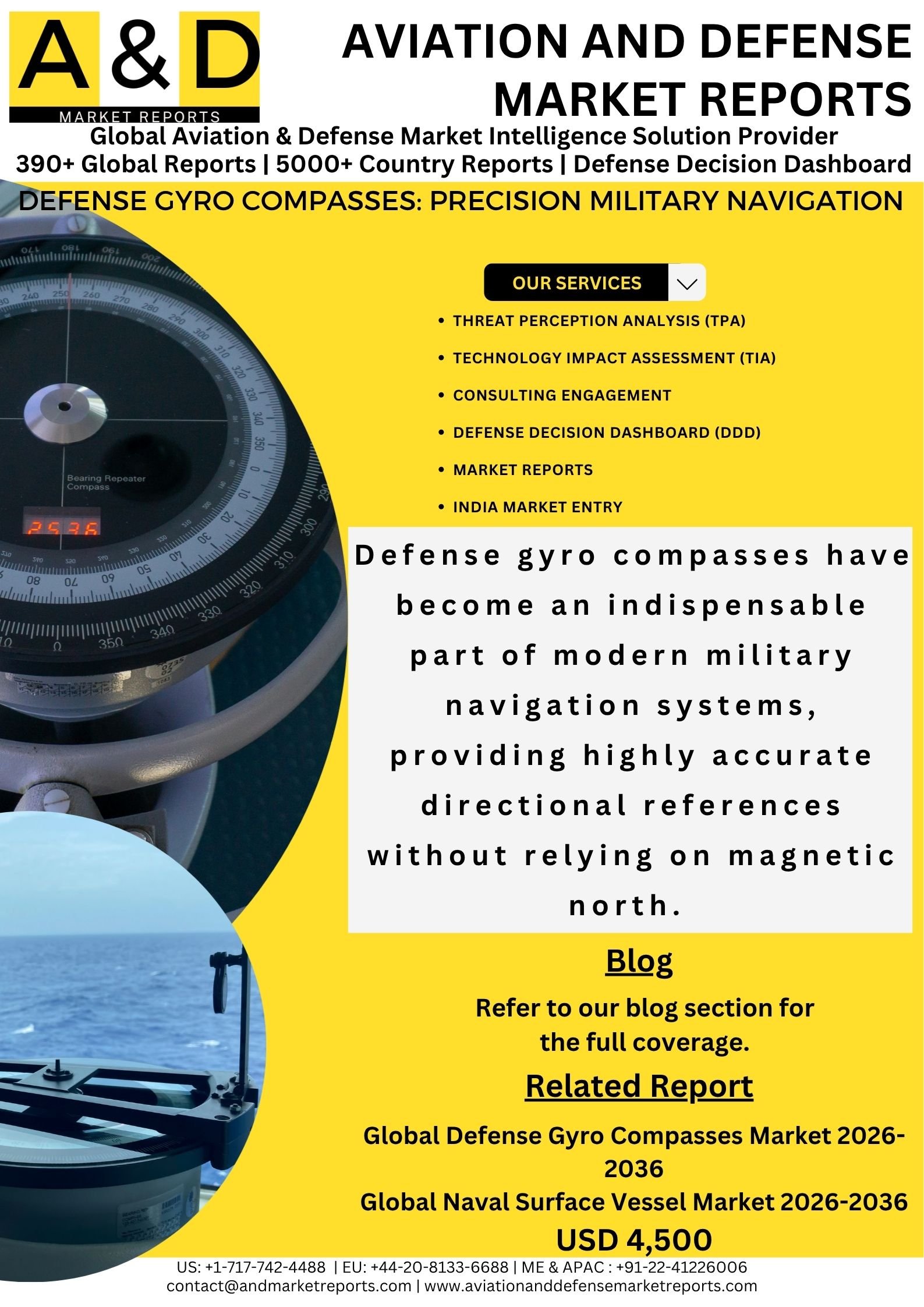
Defense gyro compasses have become an indispensable part of modern military navigation systems, providing highly accurate directional references without relying on magnetic north. Unlike conventional magnetic compasses, gyro compasses determine true north by utilizing the Earth’s rotation, making them highly reliable even in environments where magnetic interference is significant. As armed forces increasingly deploy sophisticated naval vessels, submarines, armored vehicles, and autonomous defense platforms, the demand for advanced gyro compass technology continues to rise.
Modern defense operations require precision navigation across diverse operational environments, including contested maritime zones, harsh polar regions, and electronic warfare scenarios where GPS signals may be degraded or denied. Consequently, defense gyro compasses have evolved into highly integrated navigation solutions that support mission planning, weapon guidance, surveillance systems, and autonomous operations. Their growing role in next-generation defense platforms is driving significant technological innovation and market expansion worldwide.
Evolution of Defense Gyro Compasses
The development of gyro compasses dates back to the early twentieth century when naval forces sought alternatives to magnetic compasses that were vulnerable to magnetic anomalies and interference from steel warships. Early mechanical gyro compasses significantly improved navigation accuracy, particularly for naval fleets operating across long distances.
Over the decades, technological advancements transformed bulky mechanical systems into compact and highly reliable digital navigation instruments. The introduction of ring laser gyroscopes (RLG), fiber optic gyroscopes (FOG), and advanced inertial navigation systems dramatically enhanced precision while reducing maintenance requirements. These technologies eliminated many moving mechanical components, improving durability and operational lifespan.
Today, defense gyro compasses are integrated with advanced navigation suites, satellite navigation systems, radar platforms, combat management systems, and autonomous vehicle controls. Their evolution reflects the growing need for accurate positioning in increasingly complex military operations.
Importance of Defense Gyro Compasses
Defense gyro compasses play a critical role in maintaining accurate heading information for military platforms operating under challenging conditions. Since they provide true north rather than magnetic north, they remain unaffected by magnetic disturbances, making them ideal for naval vessels, submarines, and armored vehicles.
Modern missile systems, naval guns, torpedo launchers, and fire-control systems depend on highly accurate heading data generated by gyro compasses. Even slight directional errors can significantly impact weapon accuracy, especially during long-range engagements.
Gyro compasses also contribute to mission safety by enabling reliable navigation during adverse weather, low-visibility operations, and GPS-denied environments. Military aircraft, unmanned surface vessels, underwater drones, and autonomous ground vehicles increasingly rely on these systems to maintain stable navigation without external references.
Furthermore, as military operations become more network-centric, gyro compasses provide essential orientation data that supports battlefield awareness, coordinated fleet movements, and synchronized multi-domain operations.
Key Components of Modern Defense Gyro Compasses
Modern defense gyro compasses combine multiple precision technologies to deliver exceptional navigation accuracy. At their core are high-performance gyroscopes that continuously measure rotational movement and determine true north using Earth’s rotational characteristics.
Advanced inertial measurement units (IMUs) integrate gyroscopes with precision accelerometers to provide comprehensive motion sensing capabilities. High-speed digital processors analyze sensor data in real time while compensating for vessel motion, vibration, and environmental disturbances.
Navigation software algorithms further improve accuracy by filtering sensor noise and continuously correcting heading calculations. Many systems also include redundant sensors, automatic fault detection mechanisms, and self-calibration capabilities to ensure uninterrupted performance during critical military missions.
Modern defense gyro compasses are typically integrated with GPS receivers, inertial navigation systems, radar, sonar, electronic chart systems, and combat management platforms, creating a unified navigation architecture for military operations.
Technological Advancements Driving Market Growth
Rapid technological innovation remains one of the primary drivers of the defense gyro compasses market. Fiber optic gyroscope technology has gained widespread adoption due to its exceptional accuracy, compact design, low maintenance requirements, and resistance to mechanical wear. Similarly, ring laser gyroscopes continue to provide extremely precise navigation for high-performance military platforms.
Artificial intelligence and machine learning are beginning to improve navigation accuracy through predictive error correction and adaptive calibration techniques. These intelligent algorithms help compensate for environmental changes, mechanical vibrations, and sensor drift during extended operations.
Miniaturization is another significant advancement. Modern gyro compasses are becoming smaller, lighter, and more energy efficient, allowing integration into unmanned aerial vehicles, autonomous underwater vehicles, unmanned surface vessels, and compact military vehicles.
Additionally, cybersecurity has become an important focus area as navigation systems become increasingly connected. Manufacturers are incorporating secure communication protocols, encrypted data transmission, and resilient software architectures to protect navigation systems against cyber threats.
Growing Defense Gyro Compasses Production Supporting Market Expansion
Defense manufacturers are increasing production capacity to meet rising global demand for advanced navigation equipment. Military modernization programs across North America, Europe, Asia-Pacific, and the Middle East are generating substantial procurement opportunities for gyro compass manufacturers.
Naval fleet expansion remains one of the strongest production drivers. Countries are investing in new frigates, destroyers, submarines, patrol vessels, amphibious ships, and autonomous naval platforms, each requiring highly reliable gyro compass systems.
Growing production of armored vehicles, tactical trucks, artillery systems, missile launchers, and integrated battlefield platforms is also contributing to increased manufacturing volumes. Many governments are encouraging domestic production through defense industrial policies aimed at reducing dependence on foreign suppliers while strengthening national defense capabilities.
Increasing Demand for Defense Gyro Compasses and Upgrades
The global demand for defense gyro compasses continues to grow due to expanding military budgets, fleet modernization programs, and increasing geopolitical tensions. Many armed forces are replacing legacy mechanical systems with digital gyro compasses that offer improved reliability, greater precision, and seamless integration with modern combat systems.
Upgrade programs represent a major market opportunity. Existing naval fleets and armored vehicle inventories require modernization to remain operational for several decades. Replacing outdated navigation equipment with advanced gyro compass technology significantly improves mission effectiveness while extending platform service life.
The increasing adoption of autonomous defense systems is creating additional demand. Unmanned maritime platforms, underwater vehicles, autonomous logistics vehicles, and robotic combat systems require continuous and highly accurate heading information for independent operation.
Regional Market Developments
North America remains a leading market for defense gyro compasses due to continuous investments in advanced naval capabilities, missile defense systems, and next-generation military platforms. The region benefits from strong defense research programs and established navigation technology manufacturers.
Europe continues to invest heavily in naval modernization, submarine development, and multinational defense cooperation programs. Several European countries are upgrading their fleets with integrated navigation systems featuring advanced gyro compass technologies.
Asia-Pacific is experiencing the fastest market growth as countries expand naval capabilities, strengthen maritime security, and develop indigenous defense manufacturing industries. Rising regional security concerns are accelerating investments in advanced navigation technologies.
The Middle East is also witnessing increasing procurement activity driven by naval expansion, coastal defense modernization, and investments in sophisticated military platforms. Meanwhile, Latin America and Africa are gradually modernizing selected defense assets, contributing to steady market growth.
Competitive Landscape of the Market
The defense gyro compasses market is characterized by strong competition among established navigation technology providers and specialized defense electronics manufacturers. Companies compete by developing highly accurate, compact, and integrated navigation solutions capable of operating in demanding military environments.
Competitive strategies increasingly focus on research and development, digital innovation, software integration, artificial intelligence, and partnerships with defense platform manufacturers. Long-term government contracts, defense modernization initiatives, and export opportunities continue to shape competitive dynamics.
Manufacturers are also emphasizing lifecycle support services, software upgrades, predictive maintenance, and modular system architectures to strengthen customer relationships and maintain long-term revenue streams.
Challenges Affecting Market Growth
Despite favorable growth prospects, several challenges continue to affect the defense gyro compasses market. The high cost of advanced navigation technologies can limit procurement, particularly for countries with constrained defense budgets.
Stringent military certification requirements increase product development timelines and testing costs. Manufacturers must meet demanding reliability, environmental, and cybersecurity standards before systems can be deployed on operational platforms.
Supply chain disruptions affecting precision optical components, semiconductors, and specialized electronic materials can delay production schedules. Additionally, export regulations and geopolitical restrictions may limit international sales opportunities for certain advanced navigation technologies.
Rapid technological change also requires continuous investment in research and development, increasing competitive pressure on manufacturers.
Future Outlook of Defense Gyro Compasses
The future of defense gyro compasses appears highly promising as military forces continue investing in precision navigation technologies for next-generation combat platforms. The growing deployment of autonomous systems, integrated battlefield networks, and GPS-resilient navigation solutions will further increase the strategic importance of gyro compasses.
Future innovations are expected to include quantum sensing technologies, enhanced fiber optic gyroscopes, artificial intelligence-assisted navigation, improved cybersecurity, and tighter integration with multi-domain command and control systems. These advancements will enable even greater navigation accuracy, operational resilience, and mission effectiveness.
As global defense modernization continues, gyro compasses will remain a foundational technology supporting naval fleets, submarines, military vehicles, aircraft, and autonomous defense platforms. Their ability to provide dependable and highly accurate navigation in the most challenging operational environments will ensure sustained market growth and continued technological evolution throughout the coming decade.