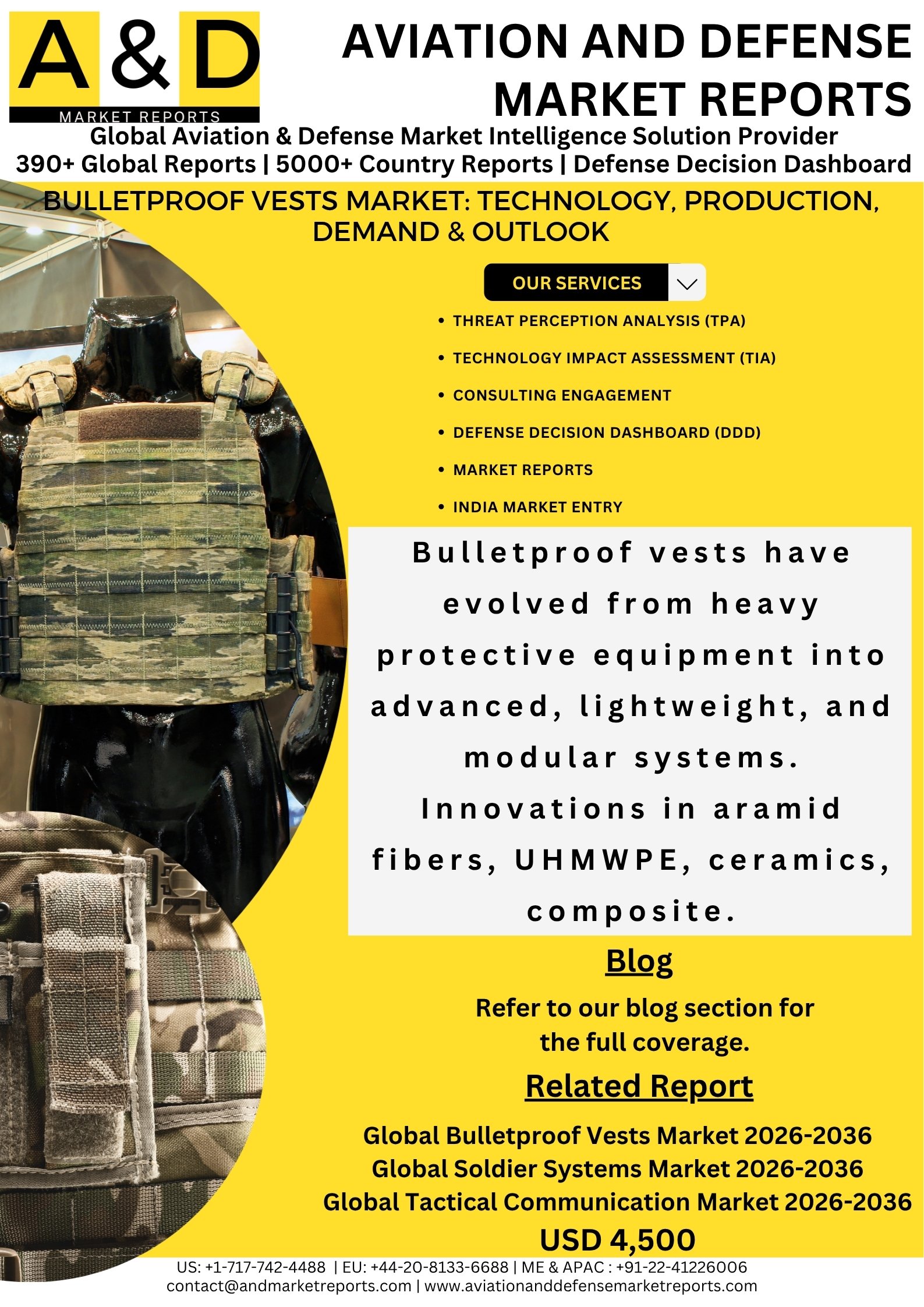
Bulletproof vests are essential personal protective equipment used by military personnel, law enforcement agencies, security forces, and other high-risk professionals. These protective systems are designed to reduce the impact of ballistic threats and provide protection to vital areas of the body.
Modern bulletproof vests have evolved beyond traditional heavy armor. Manufacturers now use advanced fibers, ceramics, polyethylene, and composite materials to develop lighter and more flexible protection. Growing security concerns, military modernization programs, and investments in soldier protection are supporting demand for advanced body armor.
The bulletproof vests market is also benefiting from developments in material science, modular armor systems, and lightweight protective technologies.
Evolution of Bulletproof Vests
The development of bulletproof vests has progressed significantly over the past century. Early body armor relied mainly on metal plates and other heavy materials. Although these systems provided protection, their weight restricted mobility and caused fatigue during extended operations.
The introduction of synthetic ballistic fibers transformed body armor design. Aramid fibers provided a combination of strength, flexibility, and relatively low weight. Later, ultra-high-molecular-weight polyethylene (UHMWPE) and advanced ceramics further improved the protection-to-weight ratio.
Modern systems can combine soft armor with rigid plates. Modular designs allow users to adjust protection according to operational requirements. This evolution reflects the industry’s growing focus on balancing protection, mobility, comfort, and weight.
Importance of Bulletproof Vests
Bulletproof vests play an important role in protecting personnel from ballistic and fragmentation hazards. For military forces, body armor can provide additional protection during combat and other high-risk missions.
Law enforcement agencies also use body armor to protect officers during operations involving firearms and other threats. Security personnel working in high-risk environments may similarly require ballistic protection.
Beyond protection, modern body armor must support mobility. Personnel often carry weapons, communication devices, medical equipment, ammunition, and other mission equipment. Lightweight and ergonomic armor can help reduce physical strain while maintaining the required level of protection.
Key Components of Modern Bulletproof Vests
Modern bulletproof vests consist of several components designed to work together.
Ballistic panels form the primary protective layer in soft armor. These panels may use aramid fibers, UHMWPE, or other specialized materials to absorb and distribute ballistic energy.
Armor plates provide additional protection in systems requiring higher ballistic resistance. Ceramic and composite plates are widely used in modern protective systems.
Outer carriers hold ballistic panels and plates in position. They may include adjustable straps and modular attachment systems.
Trauma-reducing layers can help manage the energy transferred to the wearer during an impact.
Modern designs may also include modular attachment points for carrying mission equipment. This creates an integrated platform that combines protection and equipment management.
Technological Advancements Driving Market Growth
Technology is one of the major factors shaping the bulletproof vests market. Material innovation is enabling manufacturers to develop lighter and more efficient armor systems.
Advanced aramid fibers and UHMWPE can help reduce weight while maintaining ballistic performance. Ceramic and composite technologies are also improving rigid armor solutions.
Manufacturers are increasingly exploring advanced manufacturing techniques to optimize material structures and improve consistency. Ergonomic design is another area of innovation, with companies developing armor systems that distribute weight more effectively.
Smart body armor is an emerging technology area. Future systems could incorporate sensors, communications equipment, health-monitoring functions, or other electronic capabilities. These developments could transform body armor from passive protection into a more integrated component of the modern soldier system.
Growing Bulletproof Vest Production Supporting Market Expansion
Increasing demand for personal protection is encouraging manufacturers to expand production capabilities. Defense modernization programs and replacement requirements are creating opportunities for established body armor manufacturers and specialized suppliers.
Production expansion is also being supported by investments in advanced materials and domestic defense manufacturing. Several countries are seeking to strengthen local production capabilities to reduce dependence on imported protective equipment.
Manufacturers are focusing on scalable production while maintaining material quality, ballistic performance, and compliance with relevant testing requirements.
As defense forces upgrade their personal protective equipment, production of lightweight and modular body armor is expected to remain an important area of the defense manufacturing industry.
Increasing Demand for Bulletproof Vests and Upgrades
Demand for bulletproof vests is influenced by military modernization, law enforcement requirements, security concerns, and replacement cycles.
Military organizations regularly upgrade body armor to improve protection and reduce equipment weight. Older systems may be replaced by modular armor with improved materials and ergonomic features.
Demand is also expanding beyond traditional military applications. Border security, special operations, private security, and critical infrastructure protection can create additional opportunities for advanced body armor.
The growing emphasis on soldier modernization is another important factor. Modern military forces increasingly view body armor as part of a broader soldier system that includes communications, sensors, navigation equipment, and other technologies.
Regional Market Developments
North America remains an important market for advanced body armor due to established defense industries, military modernization programs, and strong investment in personal protective equipment.
Europe is also focusing on upgrading military equipment and strengthening defense capabilities. Rising defense spending and modernization initiatives are supporting demand for advanced protective systems.
The Asia-Pacific region represents a significant growth opportunity. Military modernization, border security requirements, domestic defense manufacturing, and increasing investments in soldier protection are contributing to market development.
Countries in the Middle East are also investing in military and security equipment, creating opportunities for body armor manufacturers. Meanwhile, emerging markets in Latin America and other regions are generating demand through law enforcement and security modernization programs.
Competitive Landscape of the Market
The bulletproof vests market includes established defense companies, specialized armor manufacturers, material suppliers, and emerging technology companies.
Competition is increasingly based on protection levels, weight, durability, material technology, modularity, comfort, customization, and cost.
Manufacturers are investing in research and development to improve ballistic materials and introduce next-generation protective systems. Partnerships between armor manufacturers and advanced-material companies can also support innovation.
Government contracts and military procurement programs remain important competitive factors. Companies with strong manufacturing capabilities, testing infrastructure, certification experience, and established defense relationships can have an advantage in major procurement programs.
Challenges Affecting Market Growth
Despite strong opportunities, the bulletproof vests market faces several challenges. One of the primary challenges is achieving higher protection without significantly increasing weight.
Advanced materials can improve performance but may also increase manufacturing costs. This can make sophisticated body armor less accessible to organizations with limited procurement budgets.
Durability is another concern. Body armor can be exposed to heat, humidity, moisture, abrasion, and repeated use. Manufacturers must ensure that protective performance remains reliable throughout the expected service life.
Strict testing and certification requirements can also increase development time and costs. In addition, supply-chain disruptions affecting specialized fibers, ceramics, polymers, and other materials can influence production.
Future Outlook of Bulletproof Vests
The future of the bulletproof vests market will be shaped by the continued development of lightweight materials, advanced composites, modular designs, and smart protective technologies.
Manufacturers are likely to focus on improving the protection-to-weight ratio while making armor more comfortable and adaptable. Advanced polymers, ceramics, engineered fibers, and composite materials could support these developments.
Smart armor could become another important growth area. Integrated sensors and communication technologies may allow protective equipment to become part of a connected soldier ecosystem.
Customization is also expected to gain importance. Advances in digital design and manufacturing could support body armor tailored to individual users and mission requirements.
Overall, military modernization, increasing security requirements, technological innovation, and replacement demand are expected to support continued development of the global bulletproof vests market.
Conclusion
Bulletproof vests have evolved from heavy protective equipment into advanced, lightweight, and modular systems. Innovations in aramid fibers, UHMWPE, ceramics, composites, and smart technologies are reshaping the industry.
Growing defense budgets, military modernization programs, law enforcement requirements, and demand for improved soldier protection are creating opportunities for manufacturers. At the same time, weight, cost, durability, testing requirements, and material availability remain important challenges.
As defense forces increasingly integrate personal protection with broader soldier modernization programs, next-generation bulletproof vests are expected to become lighter, stronger, more adaptable, and increasingly technology-enabled, supporting long-term growth and innovation in the global defense industry.