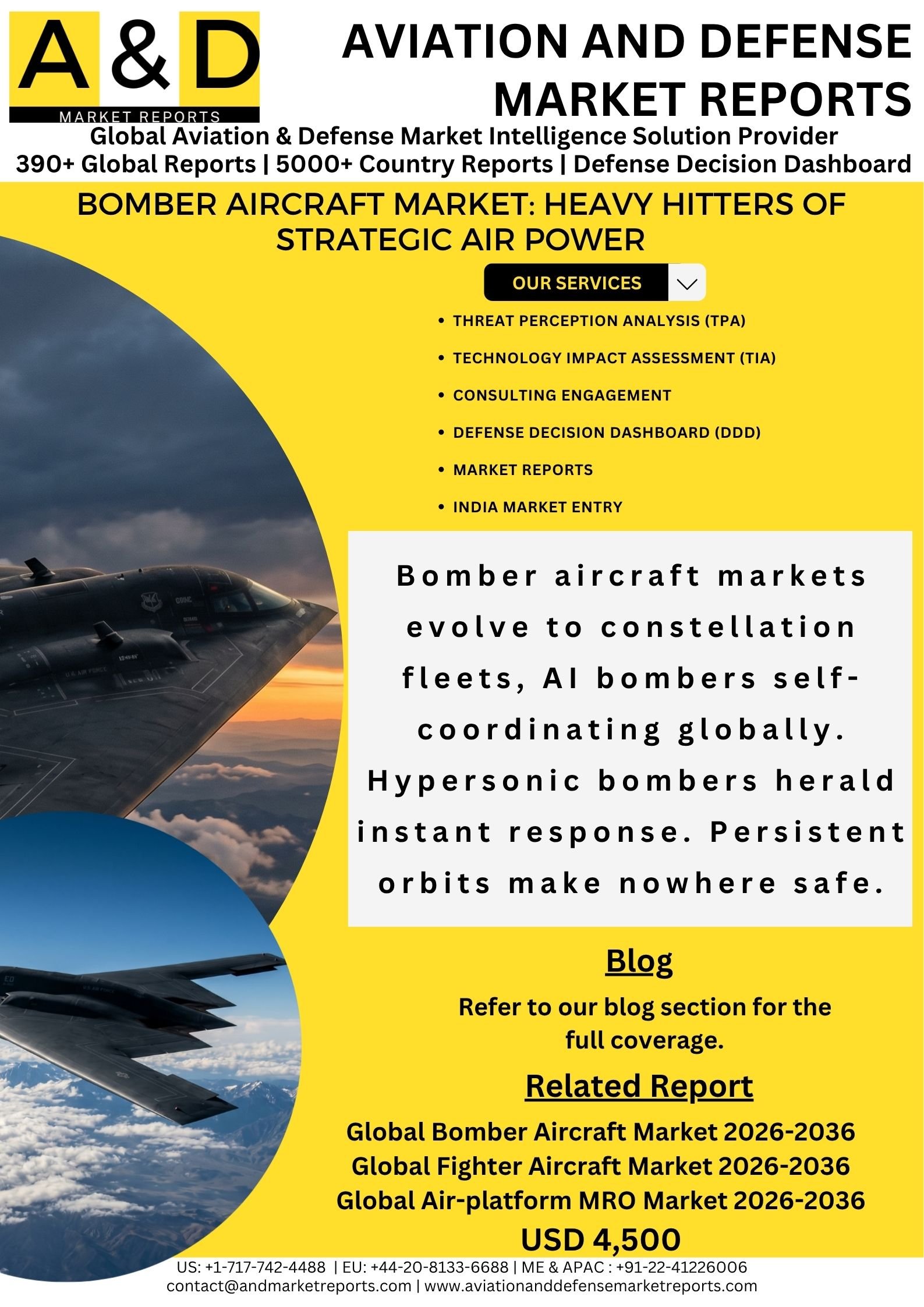
Bomber aircraft serve as the long-arm of aerial dominance, delivering massive payloads over intercontinental distances to strike high-value targets, deter adversaries, and support joint operations with precision and persistence. These versatile platforms range from stealthy penetrating bombers evading air defenses to standoff launchers firing missiles from safety, blending massive fuel capacity, advanced avionics, and survivable designs for nuclear or conventional missions. The market reflects escalating global tensions, fueling upgrades to legacy fleets alongside next-generation programs that integrate hypersonics, AI autonomy, and open architectures for multi-domain warfare.
Anatomy of Modern Bombers
Strategic bombers feature high-bypass turbofans for global reach without refueling, blended wing-bodies minimizing radar signatures while maximizing bomb bays. Fly-by-wire controls ensure stability hauling smart munitions from cruise missiles to glide bombs. Defensive suites include towed decoys, directed-energy jammers, and infrared countermeasures blinding missiles.
Cockpits fuse augmented reality helmet cues with holographic mission displays, pilots orchestrating drone wingmen via voice or gestures. Composite skins shrug off radar while gallium nitride radars paint ground targets through weather. Rotary launchers spin hypersonic weapons internally, preserving stealth.
Subsonic cruisers prioritize loiter time, supersonic dashers evade interceptors.
Evolution from Propellers to Stealth Penetrators
World War II heavies like B-17s daylight-raided factories, evolving through Cold War nuclear giants with jet propulsion crossing oceans nonstop. Post-1991 precision munitions shrank fleets, but stealth B-2 Spirits redefined penetration against layered defenses.
Modern programs birth dual-capable platforms interchangeably conventional or nuclear-armed, network-centric fuselages sharing tracks via satellite links. Legacy modernizations extend B-52s indefinitely with new engines, while B-1s pivot to hypersonic carriers.
Sixth-generation bombers promise unmanned loyal wingmen swarming ahead.
Strategic Missions Shaping Demand
Penetration strikes dismantle integrated air defenses, bombers slipping SAM belts to crater runways. Maritime campaigns launch anti-ship missiles saturating carrier groups. Nuclear deterrence patrols racetracks silently, ready to respond globally.
Tactical support seeds battlefields with loitering munitions guided by onboard sensors. ISR variants vacuum signals intelligence over denied areas. Rapid global strikes showcase power projection without bases nearby.
Bombers bridge tactical immediacy with strategic reach uniquely.
Market Forces Fueling Expansion
Geopolitical flashpoints demand credible deterrence beyond fighters’ legs. Aging fleets mandate recapitalization amid rising threats. Export restrictions loosen for allies, offset deals bundling bombers with munitions.
Hypersonic races accelerate standoff integrations. Multi-role mandates expand roles to EW or drone control. Budgets prioritize dual-use platforms maximizing taxpayers.
Coalition interoperability standardizes cockpits.
Technical Innovations Dropping Payloads
Low-observable coatings evolve radar-absorbent nanomaterials self-healing scratches. Adaptive engines cycle supersonic sprints from subsonic loiters efficiently. AI co-pilots optimize routes dodging threats dynamically.
Open mission computers swap software payloads mid-flight. Laser weapons fry incoming missiles silently. Quantum-resistant links secure nuclear command unjammably.
Swappable bays configure strikes pre-takeoff.
Deployment Challenges Overcome
Logistics strain global basing, forward tanks extend unrefueled legs. Crew fatigue plagues long missions, automation rotates watches. Maintenance devours readiness, modular lines slash turnarounds.
Cyber vulnerabilities harden with air-gapped backups. Extreme climates test composites, thermal barriers endure.
Drop tests validate bomb-bay clearances.
Leading Innovators and Ecosystem
Northrop Grumman crafts Raider stealth successors. Boeing sustains B-52 fleets eternally. Lockheed integrates Skunk Works concepts.
Russia’s Tupolev modernizes Blackjack supersonic. China’s Xian unveils H-20 subsonic ghosts. Supply chains weave composites to software houses.
Farnborough demos rack hypersonics live.
Regional Power Projections
North America leads modernization with Raider fleets. Asia-Pacific scales indigenous heavies amid island tensions. Europe collaborates multinational bombers.
Russia patrols Arctic frontiers. Middle East acquires standoff for deep strikes.
Emerging Trends Bombing Forward
Unmanned bomber swarms overwhelm defenses cheaply. Hypersonic carriers outrun interceptors. Loyal wingmen extend manned reach autonomously.
Blockchain logs munitions chains immutably.
Operational Supremacy Delivered
Bombers grant global reach unchallenged, striking ere foes react. Persistence denies safe havens anywhere. Versatility flips campaigns solo.
They deter through inescapable threat.
Sustainability Skyward
Efficient engines slash fuel thirst. Recyclable composites replace exotics. Predictive maintenance minimizes scraps.
Future Heavyweights
Bomber aircraft markets evolve to constellation fleets, AI bombers self-coordinating globally. Hypersonic bombers herald instant response. Persistent orbits make nowhere safe.
This market rains restrained power, heavy platforms holding hot peace. From bunkers to bombers, they balance world weighing on wings.