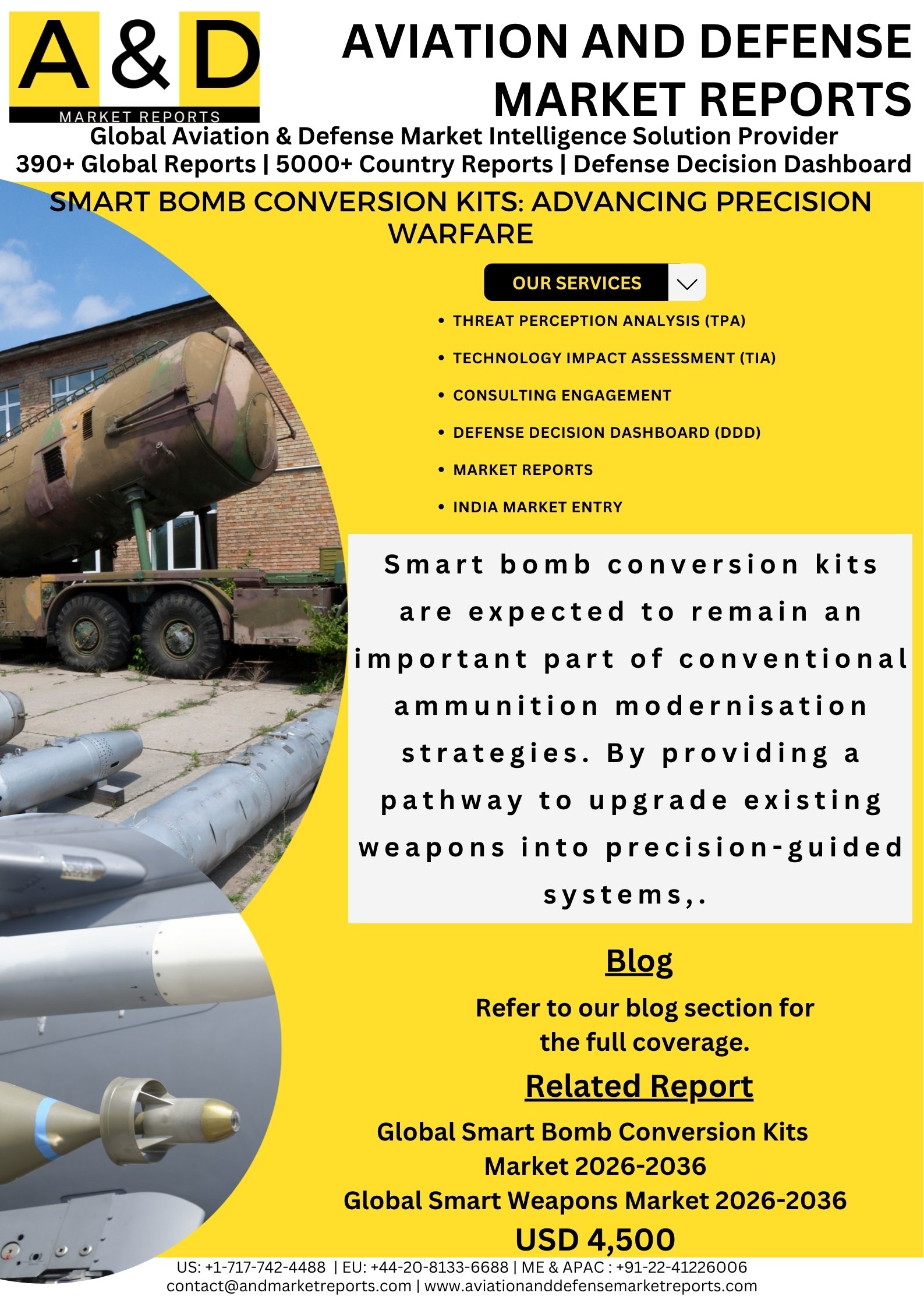
Smart bomb conversion kits are playing an increasingly important role in modern defence capabilities by transforming conventional unguided bombs into precision-guided munitions. These systems enable military forces to improve weapon accuracy, reduce collateral damage and enhance operational effectiveness without necessarily replacing their existing inventories of conventional aerial bombs.
A smart bomb conversion kit typically consists of guidance, navigation, and control components that can be integrated with compatible general-purpose bombs. Depending on the system design, these kits may incorporate satellite navigation, inertial navigation, laser guidance or other targeting technologies. Once integrated, conventional bombs gain the ability to follow a more controlled flight path towards designated targets.
The growing importance of precision strikes, cost-effective defence procurement and modernisation of existing military inventories is driving interest in these technologies. Countries are increasingly investing in precision-guided ammunition to strengthen air combat capabilities while improving the efficiency of their existing weapons stockpiles.
Evolution of Smart Bomb Conversion Kits
The development of smart bomb conversion kits emerged from the need to improve the accuracy of conventional aerial weapons. Earlier air-to-ground operations primarily relied on unguided bombs, which required favourable release conditions and often involved multiple aircraft sorties to achieve mission objectives.
The introduction of laser-guided bombs marked an important development in precision strike capabilities. These weapons used laser designation to guide munitions towards illuminated targets, improving accuracy compared with conventional bombing systems.
Subsequently, the development of satellite-based navigation and inertial navigation technologies enabled the introduction of GPS-guided conversion kits. These systems expanded the operational flexibility of precision-guided weapons by allowing conventional bombs to engage designated coordinates with greater accuracy.
Modern conversion kits increasingly incorporate advanced navigation, improved control systems and compatibility with multiple aircraft platforms. Their evolution reflects the defence industry’s broader transition towards precision-based operations, digital weapon integration and cost-effective military modernisation.
Importance of Smart Bomb Conversion Kits in Modern Defence
Smart bomb conversion kits provide military forces with an opportunity to upgrade existing conventional ammunition into precision-guided weapons. This capability can reduce the requirement to procure entirely new guided bomb inventories, offering a potentially more economical approach to weapons modernisation.
One of their major advantages is improved targeting accuracy. Precision guidance can help reduce unintended damage and improve the effectiveness of air-to-ground operations, particularly when military forces operate in environments with complex targeting requirements.
These systems also support operational flexibility by allowing compatible aircraft to carry upgraded conventional bombs. Depending on the conversion kit, weapons may be employed using satellite navigation, inertial guidance or laser designation.
Additionally, conversion kits can contribute to inventory modernisation and logistics efficiency. Defence forces can extend the operational relevance of existing ammunition stocks while gradually introducing more advanced precision-guided capabilities.
Key Components of Modern Smart Bomb Conversion Kits
Modern smart bomb conversion kits integrate several technological subsystems that collectively provide guidance and control capabilities. Their configuration varies according to the manufacturer, weapon type and intended operational requirements.
Guidance and Navigation Systems: Satellite navigation receivers and inertial navigation systems provide positioning information and support the weapon’s navigation functions. Some configurations also incorporate laser guidance technologies.
Control and Actuation Systems: These components manage the weapon’s flight-control functions and support adjustments to its trajectory.
Aerodynamic Components: Depending on the design, conversion kits may incorporate external aerodynamic surfaces that provide additional flight-control or range-extension capabilities.
Electronic Control Units: Onboard electronic systems process navigation and guidance information and coordinate the operation of different subsystems.
Power and Data Systems: Electrical power sources and associated electronic interfaces support onboard equipment and communication between integrated components.
Together, these technologies enable conventional bombs to operate as precision-guided munitions, subject to platform compatibility, integration and qualification requirements.
Technological Advancements Driving Market Growth
Technological innovation is expanding the capabilities of smart bomb conversion kits and supporting the development of more advanced precision-guided ammunition.
Improvements in satellite navigation and inertial navigation technologies are enhancing positioning reliability and supporting operations under challenging conditions. Multi-mode guidance architectures are also receiving attention as defence forces seek greater flexibility across different mission environments.
The integration of advanced electronics, improved sensors and digital weapon interfaces is further supporting compatibility with modern combat aircraft. These developments are particularly relevant as air forces upgrade their existing aircraft fleets and introduce new-generation platforms.
Another important area is the development of guidance solutions designed to improve resilience against electronic interference. As electronic warfare capabilities become increasingly sophisticated, manufacturers are focusing on navigation technologies that can maintain operational reliability in contested environments.
Advancements in manufacturing, electronic components and modular system architecture are also creating opportunities to improve production efficiency, maintainability and long-term support.
Growing Smart Bomb Conversion Kit Production Supporting Market Expansion
Increasing defence expenditure and the modernisation of conventional ammunition inventories are encouraging manufacturers to expand precision-guided weapon production capabilities.
Countries are seeking scalable approaches to strengthen their air-to-ground capabilities while managing procurement costs. Converting compatible conventional bombs into guided weapons provides an alternative to acquiring entirely new precision-guided ammunition inventories.
Manufacturers are responding through investments in production infrastructure, electronics manufacturing, system integration and testing capabilities. Domestic production initiatives are also becoming increasingly important as governments seek to strengthen defence supply chain resilience and reduce dependence on foreign suppliers.
The expansion of local defence manufacturing ecosystems, particularly across Asia-Pacific, Europe and the Middle East, is creating additional opportunities for smart bomb conversion kit suppliers.
Increasing Demand for Smart Bomb Conversion Kits and Upgrades
Demand for smart bomb conversion kits is being supported by the growing emphasis on precision strike capabilities and the need to modernise existing military equipment.
Air forces operating large inventories of conventional bombs are exploring conversion technologies to improve weapon accuracy and extend the usefulness of existing ammunition. This approach can support fleet modernisation while helping defence organisations manage procurement budgets.
The increasing adoption of advanced combat aircraft, unmanned combat aerial vehicles and network-enabled military systems is also influencing demand for compatible precision-guided weapons.
Furthermore, geopolitical tensions, regional security requirements and the growing importance of precision engagement are encouraging countries to strengthen their guided munitions inventories.
Demand for upgrades is also expected to increase as defence forces seek improved navigation reliability, electronic protection, platform compatibility and extended operational capabilities.
Regional Market Developments
North America remains an important market for precision-guided weapon technologies, supported by substantial defence investment, established aerospace manufacturers and ongoing military modernisation programmes. The United States continues to invest in guided munitions, weapon integration and advanced navigation technologies.
Europe is strengthening its defence industrial capabilities through investments in ammunition production, precision-guided weapons and domestic manufacturing. Regional security developments and the modernisation of air forces are supporting interest in advanced weapon systems.
Asia-Pacific represents an important growth opportunity due to rising defence expenditure and increasing demand for modern combat aircraft and precision-guided ammunition. Countries such as India, South Korea, Japan and Australia are investing in domestic defence capabilities and advanced military technologies.
The Middle East is also witnessing continued interest in precision-guided weapons as countries modernise their air forces and strengthen operational capabilities. Meanwhile, growing defence manufacturing initiatives are creating opportunities for regional suppliers to participate in the precision munitions supply chain.
Competitive Landscape of the Smart Bomb Conversion Kit Market
The competitive landscape includes established defence contractors, aerospace manufacturers and specialised precision-guided weapon developers. Companies are focusing on technological innovation, platform compatibility, production capacity and long-term defence procurement relationships.
Major industry participants include Boeing, RTX, Lockheed Martin, BAE Systems, L3Harris Technologies and Elbit Systems. Their broader guided weapon and defence electronics portfolios contribute to developments in precision-guided munitions and associated technologies.
Competition is increasingly influenced by the ability to deliver reliable guidance solutions, meet military qualification requirements and support integration with different aircraft and conventional bomb inventories.
Partnerships between defence manufacturers, government agencies and domestic suppliers are also becoming important for technology development, manufacturing localisation and lifecycle support.
Challenges Affecting Market Growth
Despite increasing demand, the smart bomb conversion kit market faces several technical, operational and commercial challenges.
High development costs, qualification requirements and extensive testing procedures can affect product development timelines. Manufacturers must demonstrate system reliability, safety and compatibility with specific weapon configurations and aircraft platforms.
Electronic warfare threats also present challenges for navigation-dependent systems. GPS interference and spoofing can affect the reliability of satellite-guided weapons, increasing the importance of alternative navigation technologies.
Supply chain constraints involving advanced electronic components, sensors and specialised materials can influence manufacturing costs and production schedules. Export restrictions and defence trade regulations may further complicate international procurement and technology transfer.
Additionally, competition from purpose-built precision-guided weapons and alternative strike technologies can influence procurement decisions among defence organisations.
Future Outlook of the Smart Bomb Conversion Kit Market
The future of smart bomb conversion kits will be shaped by advancements in navigation, guidance electronics, electronic warfare resilience and precision weapon integration. Defence forces are expected to continue exploring cost-effective methods of upgrading conventional ammunition inventories while strengthening their precision strike capabilities.
Growing investments in domestic defence manufacturing, modular weapon architectures and advanced electronics are likely to support further technological development. Manufacturers will increasingly focus on reliability, compatibility, production scalability and lifecycle support.
The expansion of modern combat aircraft fleets and the growing emphasis on precision-guided munitions will create additional opportunities for the industry. At the same time, evolving electronic warfare environments will encourage continued development of more resilient navigation and guidance technologies.
Overall, smart bomb conversion kits are expected to remain an important part of conventional ammunition modernisation strategies. By providing a pathway to upgrade existing weapons into precision-guided systems, they will continue to contribute to the evolution of modern air combat capabilities and the global defence industry’s precision munitions ecosystem.