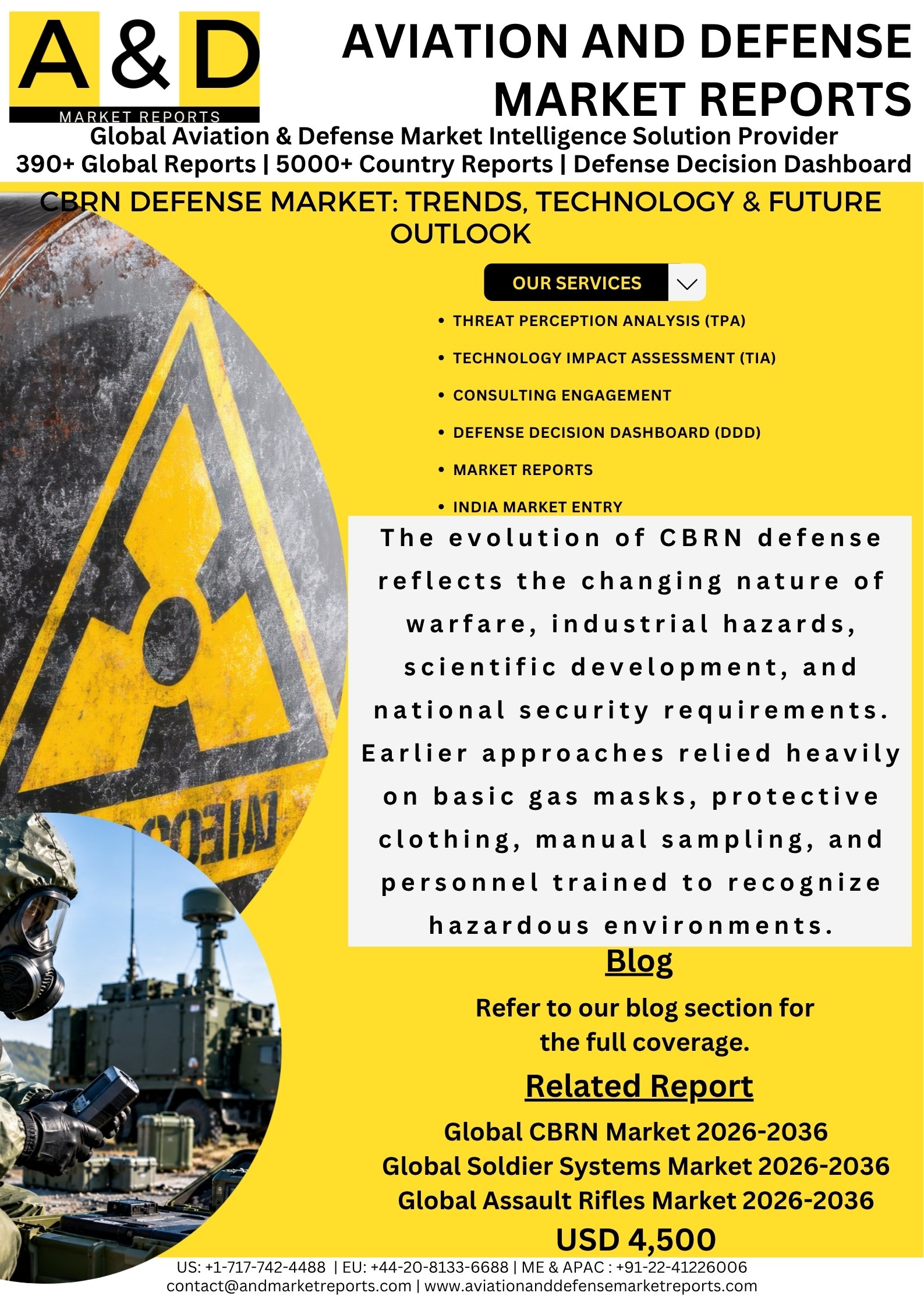
Chemical, Biological, Radiological, and Nuclear (CBRN) defense represents a critical capability within the modern defense and homeland security ecosystem. It encompasses the technologies, equipment, procedures, and specialized training required to detect, identify, monitor, and mitigate hazards associated with chemical agents, biological threats, radioactive materials, and nuclear incidents. CBRN defense systems are designed to protect military personnel, civilians, critical infrastructure, and essential operations from hazardous environments.
The growing complexity of security threats has increased the importance of advanced CBRN protection across military and civilian applications. Modern armed forces require reliable detection systems, protective clothing, respiratory equipment, decontamination solutions, medical countermeasures, and integrated monitoring technologies to operate safely in potentially contaminated environments.
Evolution of CBRN
The evolution of CBRN defense reflects the changing nature of warfare, industrial hazards, scientific development, and national security requirements. Earlier approaches relied heavily on basic gas masks, protective clothing, manual sampling, and personnel trained to recognize hazardous environments. Although these measures remain relevant, contemporary operations require faster detection, improved accuracy, greater mobility, and better coordination between field units and command centers.
During the later stages of the twentieth century, advances in chemical detection, radiation monitoring, biological analysis, and protective materials helped improve military preparedness. Portable instruments and specialized reconnaissance vehicles expanded the ability of armed forces to identify hazards and operate in contaminated areas.
In the modern era, CBRN defense has evolved toward interconnected systems that combine sensors, digital communications, analytical software, specialized medical support, and automated warning mechanisms. Research into improved filtration materials, remote sensing, molecular diagnostics, and radiation detection is further expanding operational capabilities.
The focus has also broadened beyond battlefield protection. Industrial accidents, hazardous-material releases, public health emergencies, and threats to transportation networks and critical infrastructure have demonstrated the importance of coordinated civilian and military preparedness.
Importance of CBRN
CBRN defense is essential for protecting personnel, sustaining military operations, and reducing the consequences of hazardous incidents. Chemical exposure, infectious biological agents, radioactive contamination, and nuclear emergencies can create serious risks for human health, equipment, infrastructure, and operational continuity.
For defense organizations, effective CBRN capabilities support several important objectives:
- Personnel protection: Protective ensembles, respirators, and filtration systems help safeguard military personnel operating in hazardous environments.
- Early detection and warning: Chemical sensors, biological detection technologies, and radiation monitors enable faster hazard identification and support timely protective action.
- Operational readiness: Preparedness, training, and suitable equipment help forces maintain their capabilities during contaminated or restricted operations.
- Critical infrastructure protection: CBRN preparedness supports the protection of military facilities, transportation networks, energy infrastructure, and public services.
- Emergency response and recovery: Decontamination systems, medical countermeasures, and coordinated response procedures help manage the consequences of hazardous incidents.
NATO emphasizes prevention, protection, and recovery as complementary elements of CBRN defense. This approach highlights why procurement of individual protective products must be accompanied by training, medical capabilities, information sharing, and effective response planning.
Key Components of Modern CBRN
The modern CBRN defense ecosystem includes several interconnected technology and equipment categories.
Detection and monitoring systems: Chemical agent detectors, biological monitoring instruments, radiological survey equipment, radiation identification technologies, and environmental sensors support the identification of potential threats.
Personal protective equipment: Protective suits, gloves, boots, respirators, gas masks, and specialized filtration systems help limit personnel exposure to hazardous substances.
Collective protection systems: Protected vehicles, shelters, filtration installations, and building protection solutions provide controlled environments for personnel and sensitive equipment.
Decontamination technologies: Specialized cleaning systems, decontamination agents, and equipment treatment solutions help reduce contamination on personnel, vehicles, infrastructure, and operational equipment.
Medical countermeasures: Diagnostic capabilities, exposure assessment, emergency medical response, and appropriate preventive or therapeutic interventions are important for managing CBRN-related health risks.
Command, control, and training: Warning networks, incident reporting software, simulation environments, and communication systems improve situational awareness and coordination between operational units and emergency responders.
In India, the Defence Research and Development Organisation (DRDO) identifies technologies including chemical agent sensors, biological aerosol detection, portable biological identification, decontamination agents, protective clothing, and radiological exposure assessment.
Technological Advancements Driving Market Growth
Technological innovation is an important factor shaping the CBRN defense market. Defense organizations increasingly seek detection and protection systems that offer improved accuracy, portability, reliability, and compatibility with existing operational equipment.
Artificial intelligence and data analytics may help interpret sensor readings, identify anomalous patterns, and prioritize alerts when integrated with validated detection systems. Their effectiveness, however, depends on reliable data, appropriate testing, and human oversight.
Advances in sensor miniaturization and materials science are supporting the development of more compact detection instruments and improved protective equipment. Molecular and immunological diagnostic techniques can strengthen biological identification, while spectroscopy and other analytical methods offer additional approaches to chemical and biological detection.
Remote monitoring, autonomous inspection platforms, and unmanned systems may also support reconnaissance in hazardous areas without exposing personnel unnecessarily. Digital command systems can combine information from field sensors, surveillance units, and emergency responders to improve situational awareness.
NATO’s CBRN policy identifies advances in detection, identification, decontamination, personal protection, medical management, and knowledge management as important opportunities for strengthening defensive capabilities. These developments are encouraging manufacturers to invest in research, testing, system integration, and next-generation products.
Growing CBRN Production Supporting Market Expansion
Growing investment in CBRN preparedness is supporting demand for detection instruments, protective clothing, filtration equipment, decontamination solutions, and specialized response systems. Governments are focusing on equipment availability, replacement cycles, domestic production capabilities, and reliable supply chains to strengthen operational readiness.
For market context, Grand View Research estimates that the global CBRN protection equipment market was valued at approximately US$8.63 billion in 2025 and could reach US$14.14 billion by 2033, representing a projected compound annual growth rate of 5.9% from 2026 to 2033. These figures relate specifically to the protection equipment market; estimates for the broader CBRN security industry may differ because of variations in market definitions and included product categories.
Production growth is being supported by procurement of modern detection equipment, upgrades to existing systems, and development of locally manufactured components. Domestic manufacturing can improve access to spare parts, simplify lifecycle support, and help reduce dependence on overseas suppliers.
India provides a practical example of this trend. In February 2025, the Indian Army signed a contract with Larsen & Toubro for 223 Automatic Chemical Agent Detection and Alarm systems worth ₹80.43 crore. The Ministry of Defence reported that more than 80% of the components and subsystems would be sourced locally under the Buy Indian (IDDM) category. This illustrates how public procurement and indigenous design can support the domestic CBRN supply chain.
Increasing Demand for CBRN and Upgrades
Demand for CBRN defense equipment is influenced by military modernization, evolving threat assessments, industrial safety requirements, and the need to maintain effective emergency-response capabilities.
Defense organizations must periodically replace aging protective equipment, detection instruments, and filtration systems. New operational requirements may also require improved sensitivity, faster identification, better ergonomics, and integration with command-and-control networks.
Modernization programs increasingly emphasize complete defensive capabilities rather than isolated purchases. A detection instrument, for example, must be supported by suitable training, maintenance, calibration, communications, and procedures for interpreting results.
Demand also extends to emergency response teams, specialized public safety units, and critical infrastructure operators. These users may require portable radiation monitors, protective ensembles, contamination assessment tools, and equipment designed for industrial or transportation-related incidents.
In India, DRDO opened a CBRN Field Training and Demonstration Centre at Burari, Delhi, on 6 May 2026. According to the Ministry of Defence, the centre includes radiological and nuclear test facilities, emergency medical response capabilities, and real-time field response units. The initiative highlights the continuing importance of training infrastructure alongside equipment procurement.
Regional Market Developments
North America: North America remains an important market for CBRN protection equipment, supported by established defense research programs, military modernization, specialized emergency-response organizations, and investment in detection and protective technologies. United States defense programs include research, development, testing, evaluation, and procurement of chemical and biological defense capabilities.
Europe: European demand is influenced by defense readiness, critical infrastructure protection, emergency preparedness, and cooperation among allied nations. Manufacturers are developing protective equipment, detection systems, decontamination technologies, and integrated response capabilities to meet operational requirements.
Asia-Pacific: Countries across Asia-Pacific are investing in domestic defense manufacturing, military modernization, emergency preparedness, and protective technologies. India is advancing indigenous CBRN technologies through DRDO research and procurement programs, while regional demand creates opportunities for equipment suppliers and systems integrators.
Middle East: Security requirements, protection of strategically important infrastructure, and investment in emergency-response capabilities contribute to interest in CBRN detection, protective equipment, and decontamination systems.
Other emerging markets: Governments in other regions may expand CBRN capabilities through international procurement, specialized training, and infrastructure improvements. Actual investment levels vary according to national budgets, perceived risks, technical requirements, and procurement priorities.
Grand View Research identifies North America as the largest regional market for CBRN protection equipment in 2025 and Asia-Pacific as the region expected to grow fastest over its 2026–2033 forecast period. These findings apply to that specific market definition, rather than every segment of the broader CBRN industry.
Competitive Landscape of the Market
The CBRN defense industry includes specialized protective equipment manufacturers, analytical instrument developers, defense contractors, research organizations, and systems integration companies. Competition is shaped by product performance, regulatory compliance, operational reliability, lifecycle costs, manufacturing capability, and access to government procurement programs.
Companies active in different segments of the market include Smiths Detection, Teledyne FLIR, Bruker Corporation, Thales Group, Rheinmetall, Chemring Group, Avon Protection, Dräger, and QinetiQ. Their individual product portfolios and areas of specialization vary across detection, analysis, protection, decontamination, and integrated defense systems.
Manufacturers increasingly compete through product innovation, system integration, specialist partnerships, and domestic production. Lightweight protective ensembles, improved sensor performance, connected monitoring systems, and easier maintenance can provide differentiation.
In addition, companies seeking government contracts must demonstrate compliance with applicable standards, rigorous testing, dependable delivery, and ongoing technical support. Collaboration among defense primes, specialist suppliers, laboratories, and domestic manufacturing partners can help meet complex program requirements.
For emerging manufacturers, opportunities may exist in sensor components, filtration materials, protective textiles, decontamination systems, detection software, and training solutions.
Challenges Affecting Market Growth
Despite promising demand, the CBRN defense market faces several challenges.
High development and procurement costs: Advanced detection systems and specialized protective equipment require investment in research, validation, manufacturing, and ongoing maintenance.
Complex testing and certification: Equipment must demonstrate suitable performance under defined operating conditions. Meeting military specifications and regulatory requirements can lengthen development and procurement cycles.
Rapidly changing threats: Defense systems must adapt to changing hazard profiles while maintaining reliable detection and adequate protection. This creates continuing demands for research, testing, and upgrades.
Supply chain constraints: Specialized sensors, electronic components, protective materials, and other critical inputs may have limited supplier bases. Disruptions can affect production schedules and equipment availability.
Integration and interoperability: Combining equipment from different manufacturers and ensuring compatibility with command systems, vehicles, protective infrastructure, and response procedures can be technically challenging.
Training and lifecycle support: Sophisticated systems provide limited operational value without trained personnel, maintenance programs, spare parts, calibration, and appropriate response procedures.
Addressing these barriers will require sustained investment, close coordination between users and manufacturers, effective quality assurance, and cooperation across defense research and procurement ecosystems.
Future Outlook of CBRN
The future of the CBRN defense market will be shaped by continued modernization, advances in sensing technologies, improved protective materials, and stronger integration between military and civilian emergency-response systems.
Artificial intelligence-assisted analysis, portable diagnostics, remote monitoring, autonomous inspection, and improved decontamination technologies could contribute to more responsive and efficient defensive operations. Progress will depend on rigorous testing, reliable performance, manageable lifecycle costs, and successful integration into established procedures.
Domestic manufacturing is also likely to remain a priority in countries seeking resilient supply chains and greater control over critical defense technologies. In India, continued research and procurement involving chemical detection, biological sensing, protective equipment, decontamination, and radiological preparedness could create opportunities for domestic technology developers and industrial partners.
At the same time, effective CBRN defense will require more than new equipment. Training, medical preparedness, international cooperation, information sharing, system maintenance, and infrastructure resilience will remain central to long-term readiness.
For defense manufacturers, the strongest opportunities are likely to emerge from solutions that combine dependable protection, accurate detection, ease of operation, and sustainable lifecycle support. As military and civilian organizations strengthen their preparedness, CBRN defense will continue to occupy an important position within the global defense technology ecosystem.
Conclusion
CBRN defense is evolving from a collection of specialized protective products into a broader capability built around detection, protection, decontamination, medical response, and integrated situational awareness. Technological innovation, modernization programs, indigenous production, and preparedness requirements are supporting market development. However, long-term success will depend on cost-effective innovation, proven reliability, supply chain resilience, and the ability to translate advanced technologies into practical defensive capabilities.