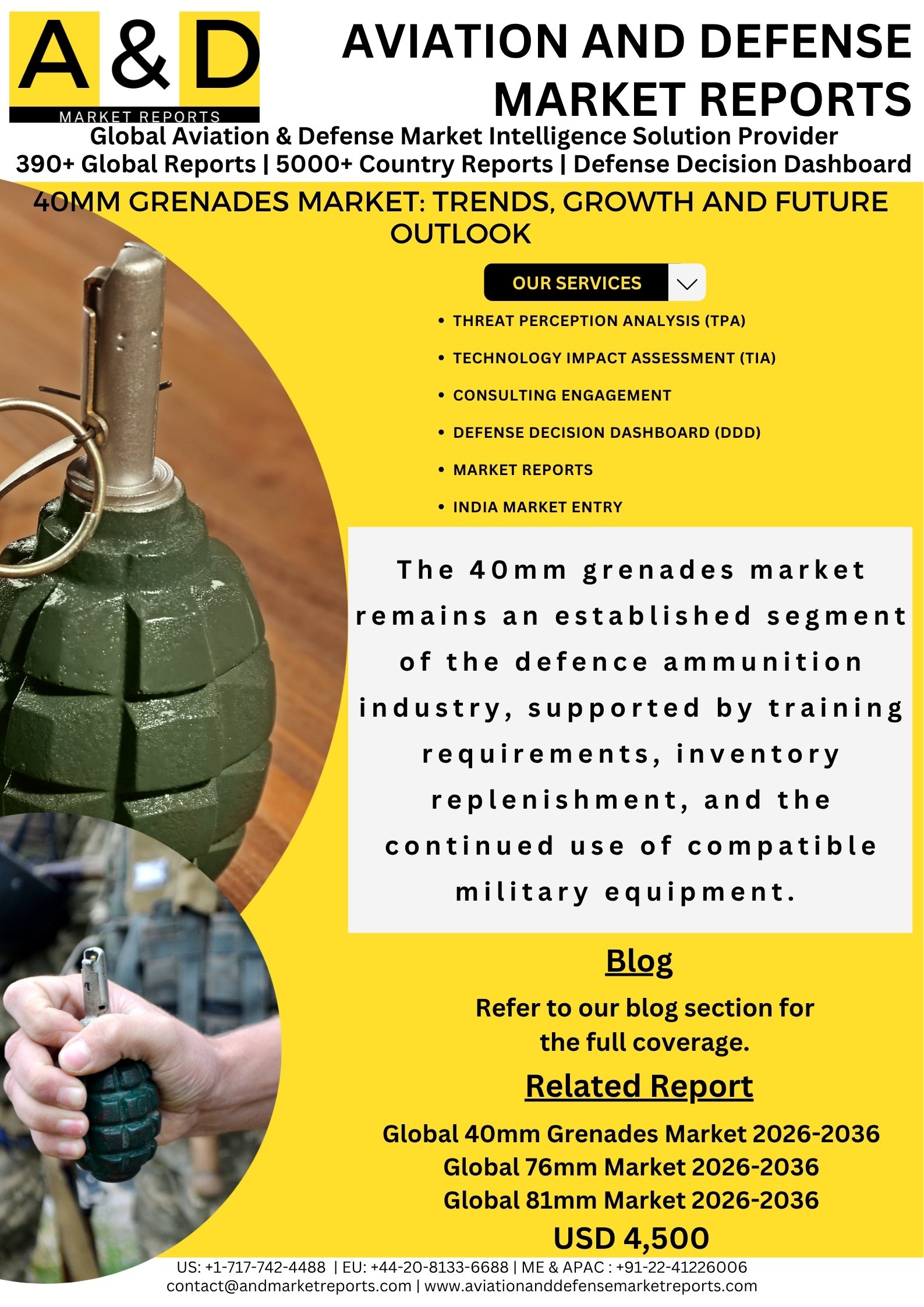
40mm grenades are an established category of military ammunition used by armed forces and law enforcement agencies for specialised operational requirements. Designed for compatibility with dedicated grenade launchers, these munitions are available in multiple configurations for different military applications, including training, signalling, and other mission-specific roles. Their relatively compact format and compatibility with established launcher platforms have contributed to their continued use in defence inventories worldwide.
The 40mm ammunition category includes different types of low-velocity and high-velocity rounds, developed according to specific launcher requirements and operational needs. Modernisation programmes, military procurement initiatives, and investments in ammunition manufacturing are influencing the development of this market.
As defence organisations seek reliable ammunition supplies and improved manufacturing efficiency, the 40mm grenades market continues to attract attention from defence manufacturers, component suppliers, and military procurement agencies.
Evolution of 40mm Grenades
The development of 40mm grenades reflects broader changes in infantry equipment, ammunition engineering, and military requirements. Early systems established a standardised ammunition format that allowed infantry units to use dedicated launchers alongside their conventional weapons.
Over time, manufacturers introduced different ammunition configurations to meet changing operational and training requirements. Improvements in materials, manufacturing processes, quality control, and ammunition compatibility have contributed to the evolution of modern 40mm systems.
Another important development has been the diversification of ammunition types. Contemporary inventories may include training rounds, practice ammunition, signalling rounds, and other specialised variants. These options allow defence organisations to procure ammunition suited to different training and operational requirements.
Modernisation efforts increasingly focus on reliability, consistency, shelf life, environmental performance, and compatibility with existing equipment. Manufacturers are also working to improve production processes and maintain consistent quality across large procurement programmes.
Importance of 40mm Grenades in Defence Operations
40mm grenade systems remain relevant because they provide armed forces with a dedicated ammunition option for specialised infantry applications. Their established use across military organisations supports continued demand for compatible launchers, ammunition supplies, training resources, and maintenance services.
One important consideration is platform compatibility. Standardised ammunition formats can simplify inventory planning and support the continued use of established launcher systems, provided the ammunition meets the applicable technical specifications.
Training and readiness also influence demand. Armed forces require appropriate practice and training ammunition to maintain personnel proficiency while managing the cost and availability of operational supplies.
Logistics and supply-chain management are additional factors. Defence organisations need dependable procurement arrangements, consistent quality assurance, secure storage, and reliable distribution to maintain ammunition availability.
Furthermore, the availability of multiple ammunition categories enables military procurement agencies to address different requirements through established supply channels. These factors help sustain the broader market for 40mm ammunition and associated defence equipment.
Key Components of Modern 40mm Grenades
Modern 40mm ammunition consists of multiple engineered components that must meet stringent safety, compatibility, and quality requirements. Their design varies according to ammunition type and intended use.
The principal component categories generally include the casing or cartridge body, the projectile assembly, the propulsion-related elements, and the ignition or initiation components where applicable. Training and inert variants may use different internal arrangements from operational ammunition.
Materials and manufacturing quality are essential considerations. Components must satisfy applicable dimensional, structural, and environmental requirements to support safe handling, storage, transport, and compatibility with approved equipment.
Quality assurance and inspection are equally important. Manufacturers use established inspection procedures, traceability systems, and controlled production processes to verify that products meet the relevant military specifications.
Modern production facilities increasingly rely on automated inspection, digital documentation, and statistical quality-control methods to improve manufacturing consistency. These capabilities can help reduce defects, strengthen accountability, and support compliance with defence procurement standards.
Technological Advancements Driving Market Growth
Technological developments across defence manufacturing are influencing the wider 40mm ammunition market. Although the basic ammunition format remains established, improvements in production, inspection, materials management, and inventory monitoring can improve manufacturing efficiency and product consistency.
Automation is an important trend in ammunition manufacturing. Automated production equipment and inspection systems can support repeatable processes, reduce manual handling, and improve production monitoring when implemented with appropriate safety controls.
Digital quality-management systems are also gaining importance. They can help manufacturers maintain production records, monitor component traceability, document inspection results, and identify recurring quality issues.
Advances in materials science and protective packaging may contribute to improved durability and storage performance, depending on the ammunition type and applicable qualification requirements.
In parallel, digital inventory systems are helping defence organisations monitor stock levels, manage storage conditions, and plan replenishment. Together, these developments create opportunities for manufacturers specialising in defence manufacturing equipment, inspection technologies, packaging, and ammunition lifecycle management.
Growing Production Supporting Market Expansion
The expansion of domestic defence manufacturing is an important factor shaping ammunition supply chains. Governments are increasingly interested in strengthening local production capabilities, diversifying suppliers, and reducing vulnerabilities associated with excessive dependence on external sources.
For 40mm ammunition, production capacity depends on qualified facilities, reliable component sourcing, trained personnel, testing infrastructure, and compliance with stringent safety requirements. Manufacturers must also maintain consistent quality while meeting procurement schedules.
Long-term supply agreements can provide greater visibility into demand and help producers plan investments in facilities, equipment, and workforce development. However, actual production expansion depends on confirmed contracts, regulatory approvals, qualification requirements, and available funding.
Small and medium-sized enterprises may participate in supporting activities such as precision manufacturing, packaging, inspection equipment, industrial automation, and approved material supply. Their involvement depends on customer qualification requirements and the ability to demonstrate consistent quality and traceability.
Increasing Demand for 40mm Grenades and Upgrades
Demand for 40mm ammunition is influenced by defence budgets, training requirements, ammunition replenishment programmes, and the continued service life of compatible launcher platforms.
Military organisations may require additional supplies to support routine training, replace ageing inventory, or maintain readiness across existing equipment fleets. These requirements can sustain demand even when there are limited purchases of new launcher systems.
Equipment modernisation also affects procurement decisions. Defence agencies may evaluate compatibility, reliability, lifecycle costs, storage requirements, and the availability of qualified suppliers when updating their ammunition inventories.
However, demand is not uniform across regions or ammunition categories. Procurement priorities vary according to national defence strategies, military inventories, budget constraints, and the availability of alternative systems.
For manufacturers, understanding these differences is important when assessing market opportunities and planning long-term investment.
Regional Market Developments
Regional developments in the 40mm grenades market reflect differences in defence spending, industrial capabilities, procurement policies, and military modernisation programmes.
North America benefits from an established defence industrial base, advanced manufacturing infrastructure, and ongoing military training and equipment sustainment requirements. Procurement decisions are influenced by budget priorities, product qualification, and established supply contracts.
Europe is shaped by defence modernisation, ammunition availability, multinational cooperation, and efforts to strengthen industrial resilience. Regulatory compliance and supplier qualification remain important considerations for manufacturers seeking to participate in regional procurement programmes.
Asia-Pacific includes countries investing in defence manufacturing, military modernisation, and domestic ammunition supply chains. Demand varies considerably between national markets according to procurement budgets and existing equipment inventories.
The Middle East presents opportunities associated with defence procurement and inventory replenishment, although individual market conditions depend on national priorities, purchasing arrangements, and applicable export controls.
Across all regions, market growth is influenced by procurement transparency, manufacturing capacity, supply-chain reliability, and regulatory requirements.
Competitive Landscape of the Market
The competitive landscape includes established ammunition manufacturers, defence contractors, specialised component suppliers, and companies providing manufacturing and quality-control technologies. Competition is shaped by product qualification, production capacity, reliability, compliance, and the ability to meet contractual requirements.
Established defence suppliers can benefit from existing customer relationships, approved manufacturing facilities, and experience managing government procurement contracts. New market participants may face barriers associated with certification, capital investment, safety requirements, and lengthy qualification processes.
Companies also compete through manufacturing efficiency, delivery reliability, technical support, and lifecycle services. Partnerships with qualified suppliers and investments in modern production infrastructure may help manufacturers strengthen their position.
For defence procurement agencies, supplier diversification can improve supply-chain resilience, but it must be balanced against the need for consistent technical standards and rigorous quality assurance.
Challenges Affecting Market Growth
Despite continuing defence requirements, the 40mm grenades market faces several challenges.
Regulatory compliance is a major consideration because ammunition manufacturing, storage, transportation, and international trade are subject to strict national and international requirements.
Manufacturing costs can increase due to specialised equipment, controlled facilities, testing requirements, and the need for qualified personnel. These expenses may affect smaller manufacturers disproportionately.
Supply-chain constraints can also disrupt production schedules when essential materials or components become difficult to source. Maintaining qualified suppliers and reliable inventory management is therefore important.
Procurement uncertainty presents another challenge. Changes in defence budgets, contract schedules, and national priorities can influence demand and production planning.
Finally, manufacturers must maintain stringent safety standards throughout production and storage. Investments in training, traceability, inspection, and risk management are essential for sustainable operations.
Future Outlook of 40mm Grenades
The future of the 40mm grenades market will depend on military ammunition requirements, inventory replenishment, manufacturing investment, and the continued operation of compatible launcher platforms.
Production automation, digital quality assurance, improved traceability, and more efficient supply-chain management are likely to remain important industry priorities. These developments can help manufacturers improve consistency and delivery performance while meeting demanding defence procurement standards.
Domestic manufacturing initiatives may also create opportunities for qualified suppliers in established and emerging defence markets. However, the scale of future growth will depend on actual procurement contracts, available funding, regulatory conditions, and regional security priorities.
Manufacturers that prioritise safety, quality, compliance, and reliable delivery are likely to be better positioned to respond to changing customer requirements.
Conclusion
The 40mm grenades market remains an established segment of the defence ammunition industry, supported by training requirements, inventory replenishment, and the continued use of compatible military equipment. Advances in manufacturing automation, digital quality management, and supply-chain traceability are influencing how ammunition producers operate and compete.
Although regulatory requirements, production costs, and procurement uncertainty present challenges, investments in qualified manufacturing capabilities and reliable supply chains may create opportunities for established defence contractors and specialised suppliers.
Going forward, the market’s development will be shaped by defence modernisation priorities, domestic manufacturing initiatives, and the ability of industry participants to deliver compliant, consistent, and dependable products.