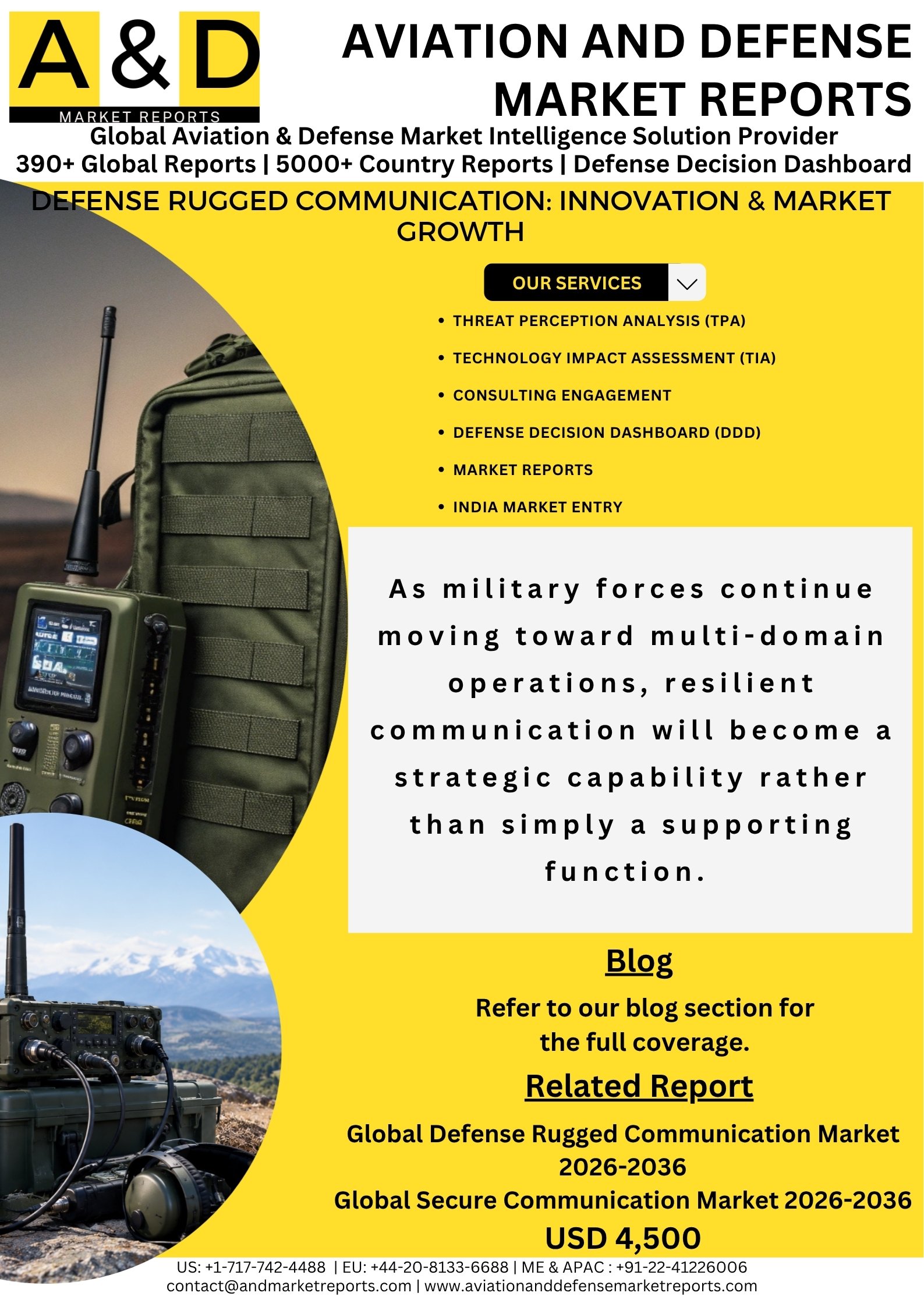
Defense rugged communication refers to specialized communication equipment and systems engineered to maintain reliable connectivity in demanding military environments. Unlike conventional communication devices, rugged systems are designed to withstand extreme temperatures, shock, vibration, dust, moisture, electromagnetic interference and other harsh battlefield conditions. These solutions include rugged radios, tactical communication terminals, secure smartphones, computers, networking equipment, displays and data communication systems.
Modern military operations increasingly depend on continuous information exchange between soldiers, vehicles, command centres, aircraft, ships and unmanned platforms. Defense rugged communication provides the resilient connectivity required to transmit voice, video, sensor data, targeting information and mission-critical intelligence. As armed forces transition toward network-centric and multi-domain operations, reliable communication infrastructure has become an essential component of combat effectiveness.
Evolution of Defense Rugged Communication
Defense communication has evolved significantly from traditional wired field telephones and basic tactical radios. Early military communication systems primarily supported voice transmission and were often limited by range, mobility and vulnerability to interception. The introduction of secure radio systems, digital communications and satellite links gradually improved battlefield connectivity.
The emergence of software-defined radios marked another major transformation by allowing communication systems to operate across multiple frequencies and waveforms. Digital encryption, frequency hopping and advanced networking further improved security and interoperability.
Today, defense rugged communication is moving toward interconnected, software-defined and IP-based architectures. Modern systems can combine terrestrial radio, satellite communications, cellular networks and tactical data links, allowing information to move across different platforms and operational domains. This evolution is supporting the development of connected battlefields where commanders can access and distribute information in near real time.
Importance of Defense Rugged Communication
Reliable communication is fundamental to military command and control. During combat operations, communication failures can delay decision-making, disrupt coordination and reduce situational awareness. Rugged communication systems are designed to remain operational even when exposed to battlefield stresses.
Security is another critical requirement. Military communications may carry sensitive operational information, including troop locations, intelligence, targeting data and mission plans. Encryption, authentication, anti-jamming technologies and secure network architectures help protect these communications from interception and disruption.
Rugged systems also support interoperability among different military units and platforms. A common communication architecture allows ground forces, naval units, aircraft, unmanned systems and command centres to exchange information more efficiently. This capability is increasingly important as modern warfare becomes more distributed and network-centric.
Key Components of Modern Defense Rugged Communication
Modern rugged communication ecosystems consist of multiple interconnected components. Tactical radios remain one of the most important elements, providing secure voice and data communication for soldiers and military units. Software-defined radios offer greater flexibility by supporting multiple waveforms and communication standards.
Rugged computers, tablets and handheld devices provide personnel with access to mission applications, maps, intelligence and operational data. Vehicle-mounted communication systems connect military platforms with command networks, while rugged servers and networking equipment support data processing and distribution.
Satellite communication terminals provide connectivity in remote areas where conventional infrastructure is unavailable. Antennas, encryption modules, secure gateways, power systems and tactical data links complete the broader communication architecture.
Technological Advancements Driving Market Growth
Several technological developments are accelerating the adoption of defense rugged communication systems. Artificial intelligence is increasingly being incorporated into military networks to support automated data analysis, network management and threat detection. AI-enabled communication systems can potentially identify network anomalies and optimise bandwidth allocation in complex environments.
5G and advanced wireless technologies are also creating opportunities for higher-speed tactical communications. These technologies can support the rapid transfer of large volumes of sensor, video and operational data.
Software-defined networking and edge computing are further transforming battlefield communications. Processing information closer to where it is generated reduces dependence on central infrastructure and can improve response times.
Meanwhile, anti-jamming technologies, frequency agility, advanced encryption and resilient waveforms are becoming increasingly important as electronic warfare capabilities evolve. The integration of satellite communications with terrestrial and tactical networks is also contributing to more resilient multi-layered communication architectures.
Growing Defense Rugged Communication Production Supporting Market Expansion
Rising defence budgets and military modernisation programmes are encouraging manufacturers to expand production of rugged communication equipment. Governments are increasingly investing in domestic communication technologies to reduce dependence on foreign suppliers and strengthen supply-chain security.
The production ecosystem extends beyond complete communication devices. It includes semiconductor components, secure processors, radio-frequency modules, antennas, batteries, displays, encryption technologies and rugged enclosures. Increased local manufacturing can therefore generate opportunities across the broader defence electronics industry.
The growing adoption of open architectures and modular systems is also allowing manufacturers to develop upgradeable communication equipment. This creates recurring demand for software updates, new modules and replacement components throughout the operational life of military platforms.
Increasing Demand for Defense Rugged Communication and Upgrades
The demand for rugged communication is being driven by the need to modernise ageing military communication infrastructure. Many armed forces are replacing legacy radios and analogue systems with digital, secure and network-enabled equipment.
The increasing use of unmanned aerial vehicles, unmanned ground vehicles and autonomous systems is creating additional communication requirements. These platforms depend on secure data links to transmit sensor information and receive mission instructions.
Military operations are also becoming increasingly data-intensive. High-resolution imagery, real-time video, battlefield sensor feeds and command-and-control information require communication networks capable of handling large amounts of data while operating under contested conditions.
Regional Market Developments
North America remains an important market because of significant military modernisation programmes and strong investment in tactical communications, secure networking and advanced battlefield technologies. The United States continues to prioritise resilient communications as part of its broader multi-domain operational strategy.
Europe is also witnessing increasing demand as NATO members strengthen defence capabilities, interoperability and secure communications infrastructure. Modernisation programmes are creating opportunities for tactical radios, secure networks and rugged computing systems.
The Asia-Pacific region is expected to remain a major growth area as countries expand defence spending and modernise military electronics. India, China, Japan, South Korea and Australia are investing in advanced communication, electronic warfare and network-centric capabilities.
The Middle East is similarly witnessing demand for secure and rugged communications as regional armed forces acquire modern combat platforms, surveillance systems and command-and-control technologies.
Competitive Landscape of the Market
The defense rugged communication market includes established defence electronics companies, specialist communication manufacturers and emerging technology providers. Competition is increasingly focused on secure connectivity, interoperability, cybersecurity, software-defined architectures and system integration.
Manufacturers are investing in research and development to produce lighter, smaller and more energy-efficient equipment without compromising durability. Partnerships between defence companies, telecommunications firms and semiconductor manufacturers are also becoming more common.
Companies that can offer modular, scalable and upgradeable communication solutions are likely to gain an advantage as military customers increasingly seek systems capable of adapting to evolving technologies and operational requirements.
Challenges Affecting Market Growth
Despite strong demand, several challenges could affect market development. High development and certification costs can increase the price of advanced rugged communication equipment. Military systems must undergo extensive testing to ensure reliability under extreme environmental and electromagnetic conditions.
Cybersecurity is another major challenge. As communication systems become increasingly connected and software-driven, they can face sophisticated cyberattacks, electronic warfare and signal interference.
Supply-chain constraints involving advanced semiconductors, secure processors and specialised electronic components can also affect production schedules. In addition, interoperability between legacy equipment and modern digital networks remains a significant challenge for many armed forces.
Future Outlook of Defense Rugged Communication
The future of defense rugged communication will be shaped by the increasing convergence of communications, computing, cybersecurity and electronic warfare. Next-generation systems are expected to become more software-defined, intelligent, lightweight and interoperable.
AI-enabled network management, advanced satellite communications, 5G technologies, edge computing and quantum-resistant security technologies could play increasingly important roles. Future communication systems will also need to operate across contested electromagnetic environments while maintaining connectivity between manned and unmanned platforms.
As military forces continue moving toward multi-domain operations, resilient communication will become a strategic capability rather than simply a supporting function. Continued investment in modernisation, domestic manufacturing and secure networking is therefore expected to sustain demand for defense rugged communication systems.
Overall, the market is positioned for long-term growth as armed forces worldwide seek reliable, secure and adaptable communication technologies capable of supporting increasingly connected battlefields and future defence operations.