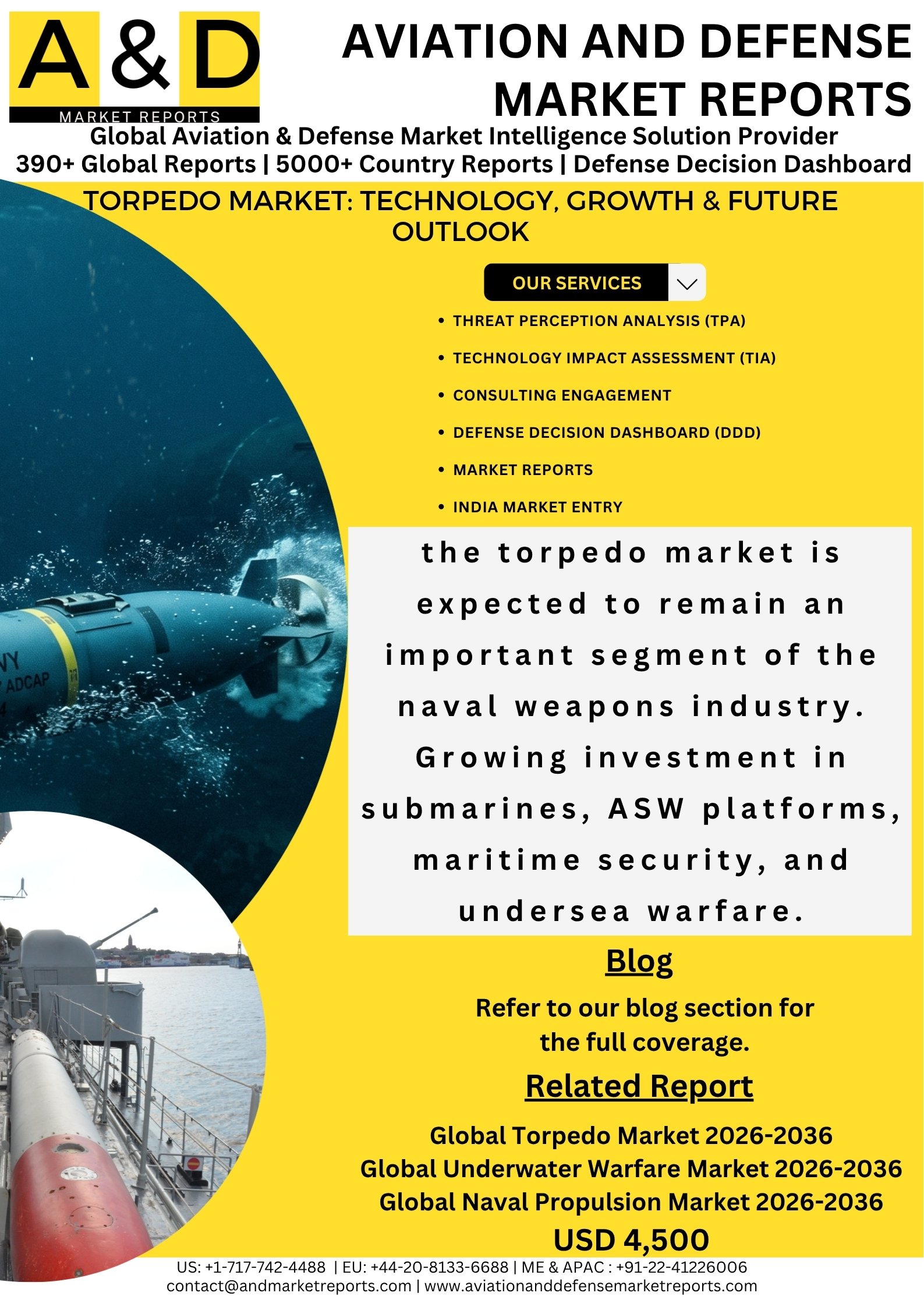
A torpedo is an underwater weapon designed to detect, track, and engage surface ships or submarines. Unlike naval guns and missiles, torpedoes operate beneath the water and use propulsion, guidance, and control systems to reach their targets. Modern torpedoes can be launched from submarines, surface ships, maritime patrol aircraft, and helicopters.
Torpedoes play an important role in naval warfare because they provide a stealthy method of attacking underwater and surface targets. Their ability to operate independently after launch has also made them an important component of anti-submarine warfare (ASW) and maritime strike missions.
Evolution of Torpedo
The development of torpedoes has progressed significantly since the first practical self-propelled designs emerged in the 19th century. Early torpedoes relied on relatively simple mechanical propulsion and basic depth-control mechanisms. Their effectiveness depended heavily on launch conditions and accurate targeting.
During the 20th century, advances in propulsion, sensors, electronics, and underwater acoustics transformed torpedo technology. World War II accelerated the development of acoustic guidance and improved propulsion systems. Later generations introduced wire guidance, digital control systems, advanced sonar, and programmable operating modes.
Modern heavyweight torpedoes are highly sophisticated weapons. They can incorporate active and passive sonar, digital signal processing, sophisticated guidance algorithms, and improved propulsion. Lightweight torpedoes have also become increasingly capable, particularly for helicopter and aircraft-based ASW missions.
Importance of Torpedo
Torpedoes remain important because underwater warfare presents unique operational challenges. Radar and conventional electro-optical systems have limited effectiveness underwater, making specialized acoustic sensors essential for detecting submarines.
For submarines, torpedoes provide a primary weapon for engaging hostile submarines and surface vessels while maintaining a degree of concealment. Surface combatants and maritime aircraft use lightweight torpedoes to counter submarine threats.
Torpedoes also support broader naval strategies. Modern fleets increasingly emphasize undersea deterrence, protection of sea lines of communication, and the ability to operate in contested maritime environments. These priorities are sustaining demand for advanced torpedo systems and upgrades.
Key Components of Modern Torpedo
A modern torpedo consists of several integrated subsystems. The guidance and homing system is one of the most important components. It typically uses sonar to detect and track a target. Active sonar transmits acoustic signals, while passive sonar listens for sounds generated by the target.
The propulsion system provides the energy required to travel underwater. Depending on the design, propulsion can use electric motors, batteries, thermal engines, or other advanced technologies. Improvements in energy density and propulsion efficiency can increase endurance and operational flexibility.
The warhead provides the destructive effect against the target. Modern warheads are designed to damage critical areas of ships or submarines, while advanced fuzing systems help determine the appropriate moment for detonation.
The guidance and control section uses onboard computers, inertial sensors, and control surfaces to maintain the desired course. Other components include batteries, navigation systems, communication interfaces, safety mechanisms, and the torpedo body.
Technological Advancements Driving Market Growth
Technology is one of the major factors influencing the torpedo market. Modern weapons increasingly use advanced sonar, digital signal processing, artificial intelligence-enabled algorithms, and improved navigation technologies.
Advanced sonar systems can improve target detection and discrimination in complex underwater environments. Digital processing allows torpedoes to analyze acoustic information more effectively and distinguish potential targets from background noise.
Artificial intelligence and machine-learning technologies are also attracting attention because they could support improved classification and decision-making. These technologies can potentially help torpedoes operate more effectively against quiet submarines and in acoustically challenging waters.
Propulsion improvements are another important area. Greater energy efficiency can extend range and endurance while reducing the physical size of power systems. Developments in batteries and alternative underwater propulsion technologies could further influence future torpedo designs.
Growing Torpedo Production Supporting Market Expansion
Increasing production of submarines, frigates, destroyers, maritime patrol aircraft, and anti-submarine helicopters is creating additional opportunities for torpedo manufacturers. New platforms frequently require compatible underwater weapons as part of their overall combat architecture.
Countries developing indigenous naval capabilities are also investing in domestic torpedo production. Local manufacturing can reduce dependence on foreign suppliers while strengthening national defense-industrial capabilities.
Production programs are increasingly accompanied by modernization initiatives. Instead of replacing complete inventories, navies may upgrade existing torpedoes with new electronics, batteries, sonar systems, software, and guidance technologies. This creates opportunities across both new-build and upgrade markets.
Increasing Demand for Torpedo and Upgrades
Demand for torpedoes is closely connected to the growing importance of undersea warfare. Many naval forces are expanding or modernizing submarine fleets, creating requirements for new heavyweight torpedoes.
At the same time, lightweight torpedoes remain important for anti-submarine warfare. Helicopters and maritime patrol aircraft can deploy these weapons rapidly over large areas, providing naval forces with additional submarine-hunting capabilities.
Upgrades are also becoming increasingly important. Aging torpedoes may still have useful mechanical structures, while their electronics and sensors become outdated. Manufacturers can extend service life by replacing obsolete components and introducing modern digital systems.
Regional Market Developments
North America remains an important torpedo market because of continued investment in submarine warfare, surface fleet modernization, and ASW capabilities. The United States maintains significant demand for heavyweight and lightweight torpedo systems.
Europe is also investing in advanced naval weapons as countries strengthen maritime security and submarine detection capabilities. Collaborative defense programs are supporting the development and modernization of underwater weapons.
Asia-Pacific represents a major growth region. Countries such as India, Japan, South Korea, and Australia are strengthening naval capabilities amid increasing focus on maritime security and undersea warfare. Fleet modernization and submarine procurement are creating additional demand for torpedoes.
The Middle East is another emerging market as regional naval forces expand their maritime surveillance and underwater warfare capabilities.
Competitive Landscape of the Market
The torpedo market includes major defense companies and specialized underwater-weapons manufacturers. Competition focuses on sonar performance, propulsion efficiency, reliability, integration, lifecycle support, and compatibility with naval platforms.
Leading manufacturers are investing in research and development to improve range, detection capabilities, navigation, energy systems, and digital electronics. Companies are also developing modular architectures that make future upgrades easier.
Partnerships between defense companies, naval forces, research organizations, and universities are becoming increasingly important. These collaborations can accelerate the development of new sensors, propulsion systems, software, and underwater technologies.
Challenges Affecting Market Growth
Despite positive growth opportunities, the torpedo industry faces several challenges. Developing advanced underwater weapons requires significant research and testing because the underwater environment is highly complex.
Acoustic conditions can vary significantly based on temperature, salinity, depth, seabed characteristics, and background noise. These factors can affect sonar performance and target detection.
High development and maintenance costs can also restrict procurement, particularly for countries with limited defense budgets. Export regulations and technology-transfer restrictions may further influence international sales.
Another challenge is the rapid development of counter-torpedo technologies. Navies are investing in acoustic decoys, hard-kill interceptors, improved sonar, and other defensive systems. Torpedo manufacturers must therefore continue improving weapon performance to address evolving countermeasures.
Future Outlook of Torpedo
The future of the torpedo market will be shaped by advances in underwater sensing, artificial intelligence, propulsion, energy storage, navigation, and networked warfare. Future torpedoes are expected to become more intelligent, reliable, energy-efficient, and adaptable.
Navies are likely to continue investing in both heavyweight and lightweight torpedoes as submarine fleets expand and anti-submarine warfare becomes more important. Modernization programs will remain another significant source of demand as existing inventories require new electronics, sensors, propulsion components, and software.
The integration of advanced digital technologies could enable future torpedoes to process more information and operate effectively in increasingly complex underwater environments. At the same time, improvements in manufacturing and modular design could reduce lifecycle costs and simplify maintenance.
Overall, the torpedo market is expected to remain an important segment of the naval weapons industry. Growing investment in submarines, ASW platforms, maritime security, and undersea warfare capabilities will continue to support demand for new torpedoes and advanced upgrade programs.