Introduction: When Milliseconds Mean Everything
In modern warfare, the margin between victory and defeat is measured not just in firepower or manpower — but in microseconds of computational decision-making. At the heart of every advanced combat aircraft, warship, armored vehicle, and autonomous drone lies a system few outside defense circles fully appreciate: the Defense Mission Computer.
Think of it as the battlefield brain. It synthesizes streams of real-time data from radars, sensors, weapons systems, and communications networks — then translates that chaos into coherent, actionable intelligence for the pilot, commander, or autonomous system in control. Without it, even the most sophisticated platform is little more than an expensive machine.
As modern warfare becomes increasingly data-driven, the Defense Mission Computer has evolved from a simple flight management tool into a complex, AI-enabled nerve center that determines the outcome of engagements before a single trigger is pulled.
What Is a Defense Mission Computers?
A Defense Mission Computer (DMC) is a ruggedized, high-performance embedded computing system integrated into military platforms to manage, process, and coordinate all mission-critical functions in real time.
Unlike commercial computers, a DMC must operate reliably under extreme conditions — high-G maneuvers, electromagnetic interference, temperature swings, and battlefield vibrations — without a single point of failure. It serves as the central processing hub connecting every subsystem aboard a platform, from fire control and navigation to communications and countermeasures.
In essence, a Defense Mission Computer doesn’t just support the mission — it defines what the mission can accomplish.
How Mission Computers Work: The Integration Layer
The true power of a Defense Mission Computer lies in its role as a universal integrator. On a modern fighter jet, the DMC simultaneously manages inputs from:
- Active Electronically Scanned Array (AESA) radars — tracking multiple targets in all-weather conditions
- Infrared Search and Track (IRST) systems — providing passive, low-observable target detection
- Electronic Warfare (EW) suites — detecting, jamming, and countering hostile radar emissions
- Inertial Navigation Systems (INS) and GPS — maintaining precise positional awareness
- Weapon Management Systems — managing arming, release, and guidance of missiles and bombs
- Data Links (e.g., Link 16, MADL) — enabling real-time communication with other platforms and command nodes
The DMC fuses all of this data through sophisticated algorithms, presenting the crew with a coherent, unified tactical picture rather than a confusing flood of raw sensor feeds. This process — called sensor fusion — is one of the most computationally demanding functions in modern defense systems.
Real-World Platforms Powered by Defense Mission Computers
The F-35 Lightning II: A Benchmark in Mission Computing
The Lockheed Martin F-35 is widely regarded as the gold standard in integrated mission computing. Its Integrated Core Processor (ICP) manages over 30 million lines of software code, fusing data from six external apertures and over 9,000 onboard sensors. The result is unmatched situational awareness — the pilot effectively “sees through” the aircraft in all directions via the Distributed Aperture System. The F-35’s Defense Mission Computer architecture set a new precedent for what fifth-generation warfare demands.
Dassault Rafale: Modular Intelligence
France’s Rafale fighter uses the SPECTRA electronic warfare system paired with its own mission computer architecture, allowing it to autonomously detect, identify, and counter threats while simultaneously conducting offensive operations. Its modular design allows rapid software updates — a key feature in a threat landscape that evolves constantly.
HAL Tejas Mk1A: India’s Indigenous Leap
India’s Tejas Mk1A light combat aircraft incorporates a domestically developed Mission Computer built around an open systems architecture. Developed through collaboration between the Defence Research and Development Organisation (DRDO), the Centre for Airborne Systems (CABS), and Bharat Electronics Limited (BEL), the Tejas mission computer integrates the aircraft’s AESA radar, Electronic Warfare Suite, and weapons management into a unified system. This milestone marks a strategic shift toward indigenous defense computing capability, reducing dependence on foreign technology for critical systems.
Boeing AH-64E Apache Guardian: Rotary-Wing Intelligence
The Apache helicopter’s mission computer orchestrates its Longbow millimeter-wave radar, Hellfire missile systems, and Target Acquisition and Designation Sight (TADS) — allowing crews to engage multiple armored targets simultaneously, even in degraded visual environments. The latest AH-64E variant includes enhanced networking capability, enabling the helicopter to control and task unmanned aerial vehicles directly from the cockpit.
Naval Combat Systems: From Frigates to Aircraft Carriers
Modern warships like the U.S. Navy’s Arleigh Burke-class destroyers depend on the AN/SPY-1 Aegis Combat System, whose central processing function is essentially a large-scale Defense Mission Computer network. It simultaneously tracks hundreds of threats across air, surface, and subsurface domains, cueing weapons responses in seconds. India’s Project 17A frigates incorporate locally developed combat management systems that perform similar integrated functions.
Unmanned Systems: Autonomy Through Computing
Drones like the MQ-9 Reaper and India’s DRDO Rustom-2 rely entirely on their mission computers for navigation, targeting, and threat response — without a human onboard. As the autonomy envelope expands, the Defense Mission Computer becomes not just a support system, but the sole decision-maker in contested environments.
Open Architecture and Modular Avionics: The New Paradigm
Legacy defense systems were built on proprietary, vendor-locked hardware. Upgrading them was expensive, slow, and often required replacing entire subsystems. The shift to Open Systems Architecture (OSA) has fundamentally changed this dynamic.
Standards such as the Future Airborne Capability Environment (FACE), SOSA (Sensor Open Systems Architecture), and VITA 65 OpenVPX allow mission computers to be upgraded incrementally — replacing software modules or hardware boards rather than entire systems. This philosophy, known as modular avionics, dramatically reduces lifecycle costs and allows militaries to incorporate new capabilities — including AI — without platform-level redesigns.
For emerging defense programs in countries like India, open architecture also enables greater indigenous content and reduces reliance on a single foreign supplier for critical mission-computing hardware.
AI-Enabled Mission Computing: The Next Frontier
Artificial Intelligence is rapidly reshaping what a Defense Mission Computer can do. Traditional rule-based systems responded to pre-programmed scenarios. AI-enabled mission computers learn, adapt, and even predict.
Current and near-future applications include:
Cognitive Electronic Warfare — AI algorithms that autonomously identify and adapt jamming strategies against previously unseen threat emitters, far faster than human operators.
Predictive Threat Assessment — Machine learning models that analyze radar tracks, emissions, and behavioral patterns to anticipate adversary actions before they occur.
Autonomous Target Recognition — Computer vision systems that identify and classify ground vehicles, naval vessels, and aircraft without crew input, reducing cognitive load in high-intensity engagements.
Human-Machine Teaming — AI copilot systems, like the DARPA Air Combat Evolution (ACE) program, where AI manages routine tactical decisions, freeing the human pilot to focus on higher-order mission objectives.
The integration of AI into the Defense Mission Computer is not a distant prospect — it is already entering operational testing in multiple advanced nations.
Cybersecurity and Electronic Warfare Resilience
The same digital sophistication that makes modern mission computers so capable also makes them targets. Adversaries increasingly seek to exploit vulnerabilities in software, supply chains, and communication links to degrade or deceive mission computing systems.
Robust Defense Mission Computer designs incorporate multiple layers of protection:
Cryptographic isolation — ensuring that sensitive data links cannot be intercepted or spoofed.
Anti-tamper hardware — physical and electronic measures that destroy sensitive data if tampering is detected.
Resilient redundancy — dual or triple-redundant processors ensure that a single hardware failure does not compromise the mission.
EMP and directed energy hardening — shielding against electromagnetic pulse weapons and high-powered microwave attacks, which are increasingly part of adversarial arsenals.
Software integrity monitoring — real-time checks that detect and isolate malicious code injected through supply chain compromises or over-the-air exploits.
In an era of multi-domain warfare, the cybersecurity of the Defense Mission Computer is as critical as the armor on a tank.
Challenges in Defense Mission Computers Development
Building a Mission Computer for defense applications is orders of magnitude more complex than commercial embedded computing. Key engineering challenges include:
Thermal Management — High-performance processors generate significant heat. In the confined, vibration-prone environment of a fighter aircraft or armored vehicle, advanced liquid cooling and conduction cooling techniques are required to maintain operational stability.
Real-Time Processing Demands — Modern sensor fusion requires deterministic, low-latency processing. Even microsecond delays in radar data processing can mean the difference between a successful intercept and a miss.
Software Integration Complexity — Integrating millions of lines of code from multiple vendors, across decades of legacy and new systems, while maintaining safety certifications, is an enormous engineering undertaking.
Size, Weight, and Power (SWaP) — Every gram and watt matters on a combat aircraft. Mission computer designers constantly balance computational power against strict SWaP constraints.
Certification and Qualification — Military-grade DO-178C software certification and MIL-STD-810 environmental testing requirements add years and significant cost to development timelines.
India’s Indigenous Mission Computer Ecosystem
India’s push toward Aatmanirbhar Bharat (self-reliant India) in defense has placed mission computer development at the forefront of its strategic technology agenda. DRDO’s Centre for Airborne Systems (CABS) has developed mission computers for the Tejas program, while BEL has built indigenous avionics suites integrating radar, EW, and navigation.
The Tejas Mk2 and the Advanced Medium Combat Aircraft (AMCA) program aim to take this further, developing next-generation mission computers with AI capabilities, higher processing throughput, and open architecture frameworks compatible with NATO-standard data links. These programs represent not just engineering achievements, but a statement of strategic independence.
Future Trends: Edge Computing, Autonomy, and Network-Centric Warfare
The evolution of the Defense Mission Computers over the next decade will be driven by three converging trends:
Edge Computing — Moving AI processing closer to the sensor, eliminating latency caused by transmitting raw data to distant servers. An edge-capable missile seeker or drone can make targeting decisions in flight, even when communications are jammed.
Autonomous Systems Integration — Mission computers will increasingly manage swarms of unmanned systems, coordinating dozens of drones to execute complex, multi-axis attacks or reconnaissance patterns under human supervision.
Network-Centric Warfare — The battlefield of the future is a network. Mission computers will serve as nodes in a vast, real-time combat cloud — sharing targeting data, threat assessments, and logistics updates across every platform simultaneously, enabling coordinated, distributed engagements at unprecedented scale.
Conclusion: The Invisible Combatant
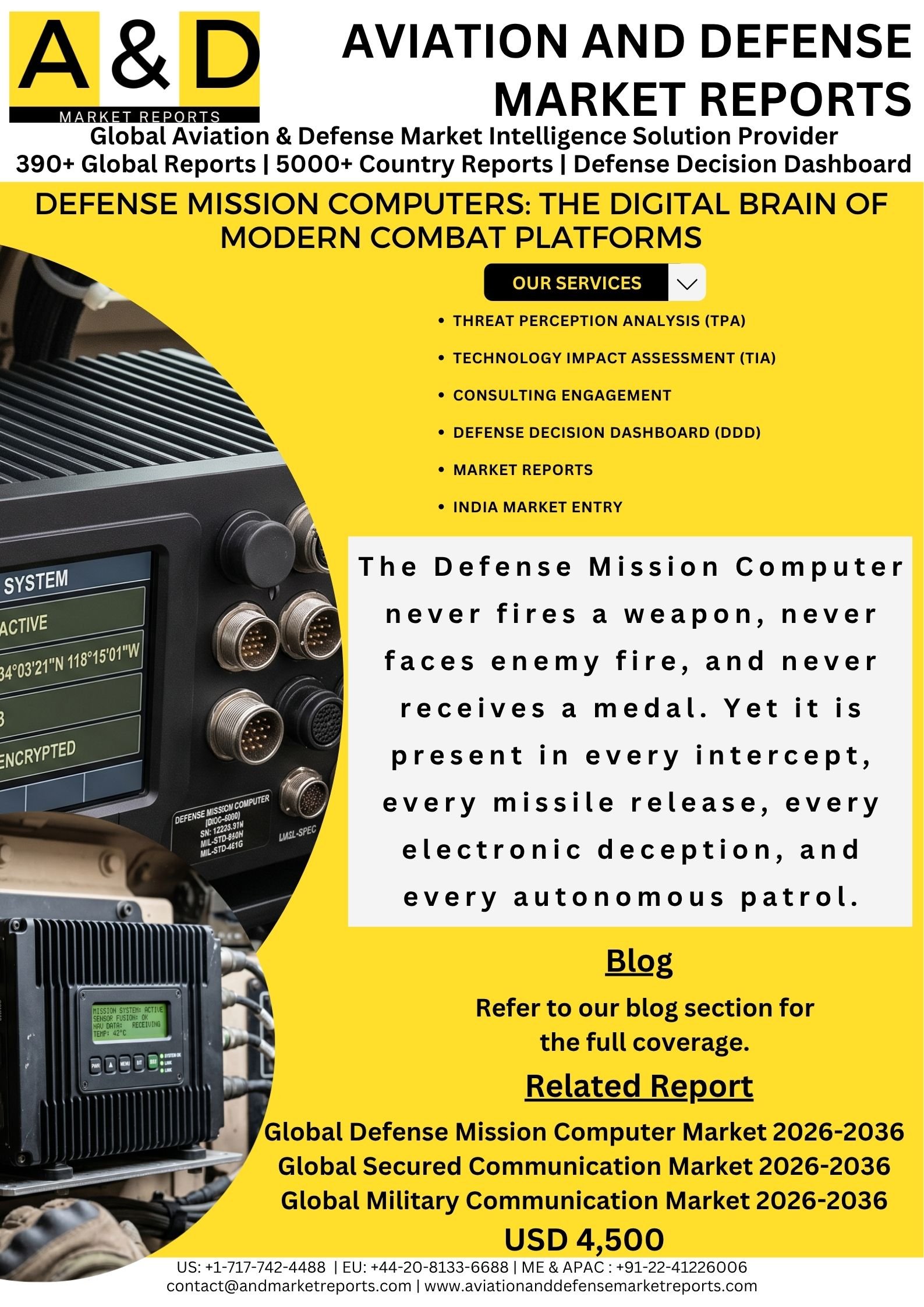
The Defense Mission Computers never fires a weapon, never faces enemy fire, and never receives a medal. Yet it is present in every intercept, every missile release, every electronic deception, and every autonomous patrol. It is the invisible combatant — the digital intelligence that gives modern combat platforms their decisive edge.
As warfare increasingly shifts to the electromagnetic spectrum, cyberspace, and the algorithmic domain, investment in mission computing capability is no longer optional — it is existential. Nations that master the art of the Defense Mission Computer will dominate the battlefields of tomorrow. Those that don’t will find that no amount of raw firepower can compensate for inferior intelligence.
The digital brain of modern warfare is already here. The question is who builds it best.