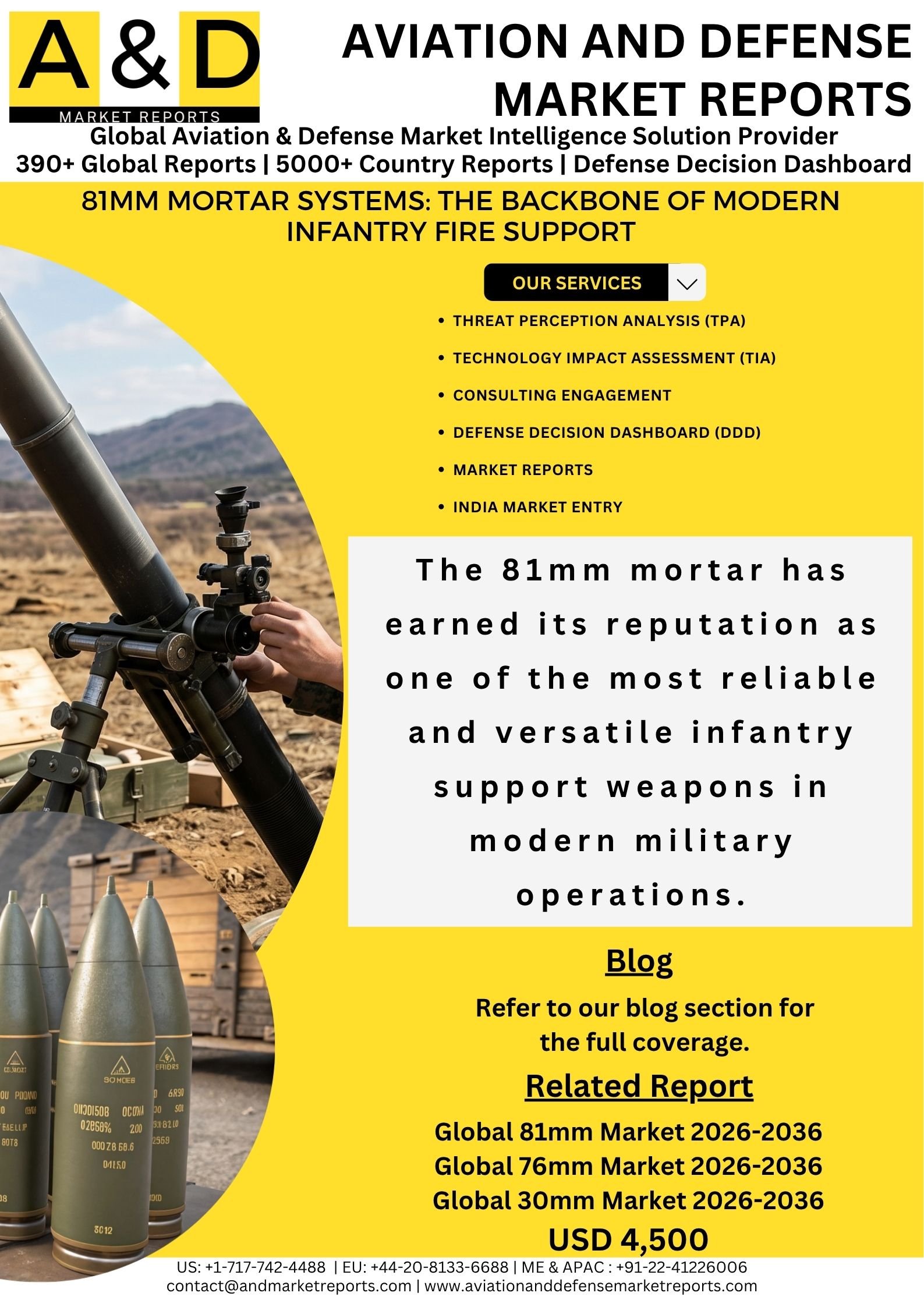
81mm mortar systems provide infantry forces with mobile, responsive, and effective indirect fire support through high-angle engagement capabilities, battlefield flexibility, precision targeting, and rapid deployment across diverse combat environments.
Introduction
In modern warfare, infantry units require immediate and reliable fire support to suppress enemy positions, disrupt hostile movements, and enhance battlefield effectiveness. While artillery systems deliver long-range firepower and air assets provide precision strikes, mortar systems remain one of the most versatile and responsive weapons available to ground forces. Among these, the 81mm mortar has established itself as a critical component of infantry fire support operations worldwide.
The 81mm mortar occupies a unique position between lightweight platoon-level mortars and heavier battalion-level systems. It offers a balance of mobility, range, lethality, and operational flexibility, making it suitable for a wide variety of combat missions. Whether deployed in conventional warfare, counterinsurgency operations, urban combat, or peacekeeping missions, the 81mm mortar continues to play a significant role in modern military doctrine.
Capable of delivering high-explosive, smoke, illumination, and specialized ammunition, 81mm mortars enable commanders to engage targets concealed behind terrain features, fortifications, and urban structures. As defense forces modernize their battlefield capabilities, the 81mm mortar remains a proven and highly effective indirect fire weapon system.
81mm Mortar Systems in the Past
The origins of modern mortar warfare can be traced to the early twentieth century when military forces sought portable artillery solutions capable of supporting infantry operations. During World War I, trench warfare created a requirement for weapons capable of engaging enemy positions protected by obstacles and defensive fortifications.
Mortars quickly emerged as effective solutions due to their high-angle firing capabilities. Early designs evolved into standardized infantry support weapons used extensively during World War II. By the mid-twentieth century, the 81mm mortar had become a common asset within infantry battalions across numerous armed forces.
Throughout major conflicts including the Korean War, Vietnam War, and various Cold War engagements, 81mm mortars demonstrated their value as responsive fire support systems. Their relatively lightweight construction allowed rapid deployment while providing sufficient firepower to suppress enemy positions and support advancing troops.
Traditional mortar operations relied heavily on manual calculations, visual observation, and map-based targeting methods. Despite these limitations, 81mm mortar crews consistently delivered effective indirect fire support across diverse operational environments.
As military technologies advanced, improvements in materials, ammunition, and fire-control procedures enhanced the effectiveness and reliability of mortar systems, laying the foundation for today’s modern 81mm platforms.
81mm Mortar Systems in the Present
Today, 81mm mortars remain among the most widely deployed indirect fire weapons within infantry formations worldwide. Modern systems combine proven mortar principles with advanced technologies designed to improve accuracy, survivability, and operational efficiency.
Contemporary 81mm mortars are constructed using lightweight alloys and advanced manufacturing techniques, reducing overall system weight while maintaining durability. This enables rapid transportation by infantry units, tactical vehicles, helicopters, and airborne forces.
Modern ammunition options have significantly expanded operational capabilities. In addition to traditional high-explosive rounds, forces now employ smoke ammunition for concealment, illumination rounds for nighttime operations, infrared illumination for specialized missions, and training munitions for operational readiness.
Digital fire-control systems are increasingly being integrated into mortar operations. GPS navigation, laser rangefinders, ballistic computers, and battlefield management systems allow crews to calculate firing solutions more rapidly and accurately than traditional methods.
Network-centric warfare environments further enhance mortar effectiveness. Forward observers, unmanned aerial vehicles (UAVs), surveillance systems, and command centers can provide real-time targeting information, enabling faster engagement of enemy positions.
Many armed forces are also exploring precision-guided mortar munitions capable of reducing ammunition expenditure while increasing target engagement accuracy. These developments are transforming the role of mortars from area-suppression weapons into precision battlefield assets.
81mm Mortar Systems – Future
The future of 81mm mortar systems is expected to be shaped by precision engagement capabilities, automation, digital connectivity, and enhanced battlefield integration. As military operations become increasingly data-driven, mortar systems will likely operate as integral components of networked combat ecosystems.
Precision-guided mortar ammunition is anticipated to become more widely adopted. These advanced rounds may incorporate GPS guidance, laser seekers, and other navigation technologies to engage targets with significantly greater accuracy compared to conventional ammunition.
Automation technologies are also expected to influence future mortar operations. Semi-automated and fully automated fire-control systems could reduce crew workloads, accelerate firing sequences, and improve responsiveness during combat operations.
Artificial intelligence may assist in target prioritization, ballistic calculations, and mission planning. AI-enabled systems could process battlefield information rapidly, helping commanders make faster and more informed decisions.
Future mortar platforms may also integrate directly with unmanned systems. Drones equipped with reconnaissance sensors could identify targets and transmit coordinates directly to mortar units, reducing engagement timelines and increasing battlefield effectiveness.
Advancements in materials science may lead to lighter and more durable mortar systems, enhancing mobility for expeditionary and special operations forces. Additionally, modular designs could improve logistical efficiency and simplify maintenance requirements.
As defense organizations continue to modernize their indirect fire capabilities, the 81mm mortar is expected to remain a critical element of infantry support operations.
Market Drivers for 81mm Mortar Systems
Several factors are driving demand for 81mm mortar systems globally. Increasing military modernization programs remain a primary growth driver as armed forces seek to improve battlefield effectiveness and fire support capabilities.
The growing emphasis on mobile warfare and rapid deployment operations is also contributing to demand. Compared with heavier artillery systems, 81mm mortars provide highly responsive fire support while maintaining operational mobility.
Rising geopolitical tensions and regional security challenges are encouraging governments to strengthen infantry combat capabilities. Mortars continue to offer cost-effective firepower solutions for both conventional and asymmetric warfare scenarios.
Technological advancements in ammunition, targeting systems, and battlefield communication networks are further supporting market expansion. Enhanced accuracy and integration capabilities are increasing the operational value of modern mortar systems.
Additionally, expanding investments in special operations forces, airborne units, and rapid reaction forces are creating sustained demand for lightweight indirect fire support platforms.
Restraints of the 81mm Mortar Systems Market
Despite strong demand, several restraints continue to affect market growth. Budget limitations within defense organizations may restrict procurement activities, particularly in developing nations facing competing military priorities.
The increasing availability of precision-guided artillery and missile systems may also reduce reliance on traditional mortar capabilities in certain operational scenarios.
Training requirements represent another challenge. Effective mortar operations require skilled personnel capable of conducting fire missions, target acquisition, and equipment maintenance.
Logistical considerations, including ammunition transportation and supply chain management, can also affect deployment flexibility during extended operations.
Furthermore, evolving battlefield threats such as counter-battery radar systems and precision strike weapons may increase operational risks for mortar units.
Challenges of the 81mm Mortar Systems Market
The market faces several operational and technological challenges. One major challenge involves balancing mobility, firepower, and survivability. Military forces require systems that can deliver effective fire support while minimizing exposure to enemy detection and engagement.
Counter-battery capabilities continue to evolve rapidly, forcing mortar units to adopt shoot-and-scoot tactics and enhanced concealment measures. Maintaining survivability in contested environments remains a critical concern.
Interoperability is another challenge, particularly among multinational coalition forces operating different mortar systems and communication networks.
The integration of advanced digital technologies can also increase acquisition costs and maintenance complexity. Ensuring reliable operation under harsh battlefield conditions remains essential.
Additionally, precision-guided mortar ammunition must achieve cost-effectiveness to justify widespread adoption across military inventories.
Conclusion
The 81mm mortar has earned its reputation as one of the most reliable and versatile infantry support weapons in modern military operations. Combining mobility, responsiveness, and effective firepower, it continues to provide commanders with critical indirect fire capabilities across a wide range of combat environments.
Advancements in digital fire control, precision-guided ammunition, battlefield networking, and automation are enhancing the effectiveness of modern mortar systems while expanding their operational roles. These innovations are enabling mortar units to respond more rapidly, engage targets more accurately, and integrate more effectively within modern combat formations.
Although challenges related to survivability, modernization costs, and evolving battlefield threats remain, the 81mm mortar is expected to retain its importance within military organizations worldwide. As armed forces continue to adapt to changing operational requirements, the 81mm mortar will remain a cornerstone of infantry fire support and battlefield effectiveness for decades to come.