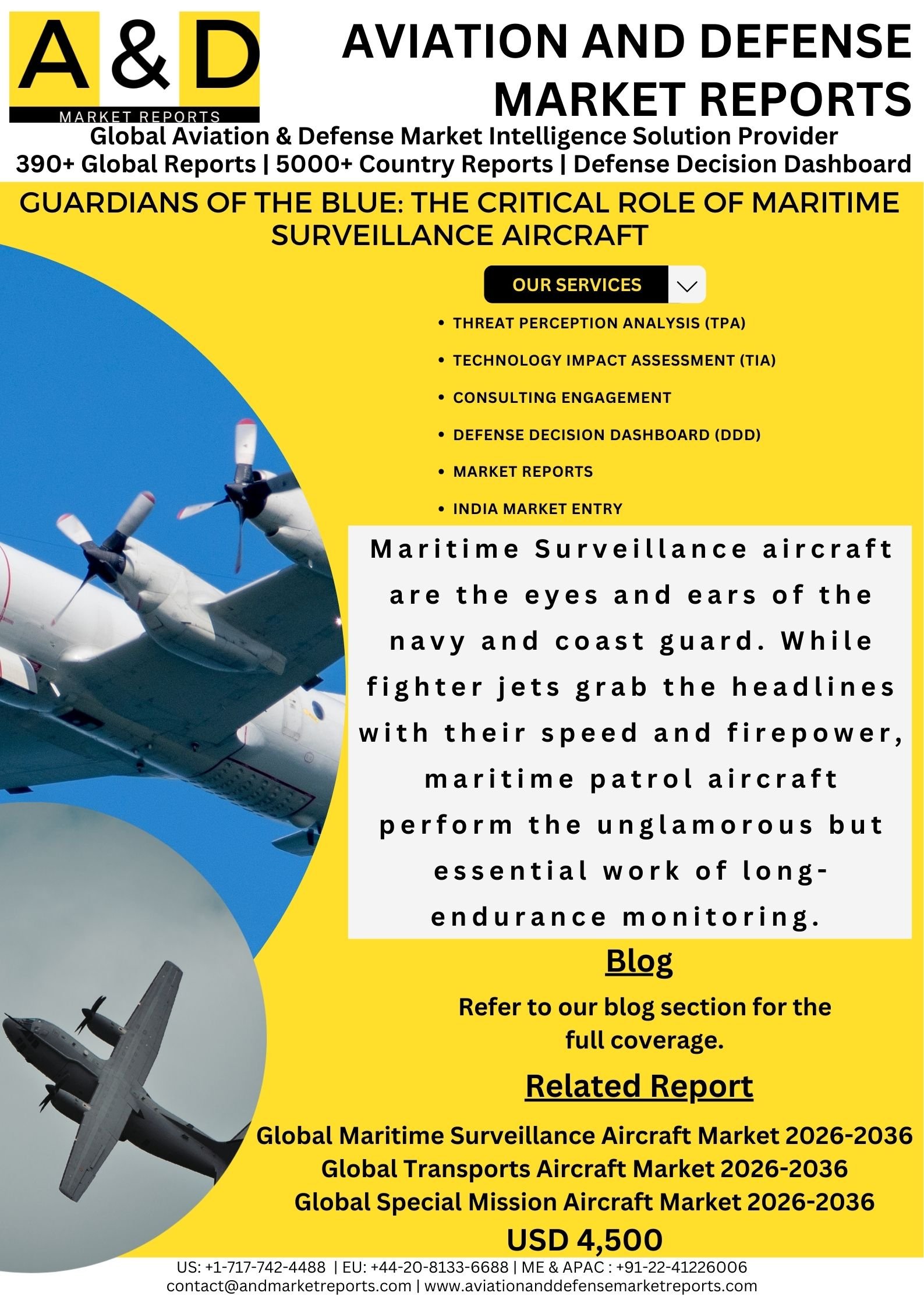
The ocean covers over 70% of our planet. It is the highway of global commerce, a source of vital resources, and a strategic domain for national security. Yet, unlike land or airspace, the maritime environment is notoriously difficult to monitor. A ship can disappear over the horizon, and a submarine can vanish beneath the waves. To maintain awareness over such a vast, fluid expanse, nations rely on a specialized breed of aviation: Maritime Surveillance Aircraft, often referred to as Maritime Patrol Aircraft (MPA).
These aircraft are the eyes and ears of the navy and coast guard. While fighter jets grab the headlines with their speed and firepower, maritime patrol aircraft perform the unglamorous but essential work of long-endurance monitoring. They are the guardians of the blue, ensuring security, safety, and sovereignty across the world’s oceans.
The Mission Profile: More Than Just War
Historically, the primary role of maritime surveillance aircraft was Anti-Submarine Warfare (ASW). During the Cold War, aircraft like the American P-3 Orion were designed to hunt Soviet nuclear submarines. While this remains a core capability, the mission profile has expanded significantly in the 21st century.
Today, these aircraft are multi-mission platforms. Their duties include:
- Exclusive Economic Zone (EEZ) Protection: Nations have rights to resources within 200 nautical miles of their coast. MPAs monitor these zones for illegal, unreported, and unregulated (IUU) fishing, which costs the global economy billions annually.
- Anti-Surface Warfare: Tracking hostile naval vessels or monitoring pirate activity in choke points like the Strait of Hormuz or the Gulf of Aden.
- Search and Rescue (SAR): When a distress signal is picked up from a sinking vessel or a downed pilot, MPAs are often the first on the scene. Their ability to loiter for hours allows them to coordinate rescue efforts and drop survival supplies.
- Environmental Monitoring: These aircraft detect oil spills, track hazardous waste dumping, and monitor marine wildlife migration.
In essence, the modern MPA is a tool of law enforcement and environmental protection just as much as it is a weapon of war.
The Technology: Seeing the Invisible
Operating over water presents unique challenges. There are no landmarks, weather conditions can be severe, and targets can be submerged. To overcome this, maritime surveillance aircraft are packed with sophisticated sensor suites.
Radar and EO/IR: The most visible feature of an MPA is often the large radar dome under the fuselage. This surface-search radar can detect periscopes or small boats dozens of miles away. Complementing this are Electro-Optical/Infrared (EO/IR) turrets, which allow crews to visually identify targets day or night.
Sonobuoys: To hunt submarines, the aircraft cannot rely on radar, as radio waves do not penetrate water well. Instead, they deploy sonobuoys—small, expendable sensors dropped into the ocean. These buoys float on the surface and lower hydrophones into the water to listen for engine noise or propeller cavitation. The data is transmitted back to the aircraft, where tactical coordinators build a picture of the underwater battlespace.
Electronic Support Measures (ESM): Modern ships and submarines emit electronic signals via their own radar and communication systems. ESM suites on MPAs act like passive listeners, detecting and triangulating these emissions without alerting the target that they are being watched.
Endurance: Perhaps the most critical “technology” is fuel efficiency. Missions can last 10 to 12 hours or more. Crews need rest facilities, galley kitchens, and mission systems that can operate continuously without fatigue.
Icons of the Industry
Several aircraft define the landscape of maritime surveillance today.
The P-3 Orion: For over 50 years, the Lockheed P-3 Orion has been the gold standard. A turboprop aircraft based on the Electra airliner, it is known for its ruggedness and incredible loiter time. Despite its age, many airframes remain in service globally because they are perfectly suited for low-and-slow patrol missions.
The P-8 Poseidon: As the P-3 reached the end of its service life, the Boeing P-8 Poseidon took the mantle. Based on the Boeing 737-800 airframe, the P-8 offers jet speed, allowing it to reach patrol areas faster. It features modern glass cockpits, advanced acoustic processing, and the ability to carry torpedoes and anti-ship missiles internally. It represents the shift toward high-speed, networked warfare.
The ATR 72 MPA: Not every nation needs a jet-powered giant. For smaller navies or coast guards, the ATR 72, a twin-turboprop regional airliner converted for maritime duty, offers a cost-effective solution. It provides excellent endurance and lower operating costs, making it ideal for EEZ monitoring and anti-smuggling operations in regional waters.
The MQ-4C Triton: The future is unmanned. The Northrop Grumman Triton is a high-altitude, long-endurance drone designed to complement manned aircraft. It can stay aloft for over 30 hours, providing a persistent “unblinking eye” over vast ocean areas, feeding data to ships and manned aircraft without risking a human crew.
The Future of Maritime Surveillance Aircraft Patrol
The domain of maritime surveillance is undergoing a radical transformation. The sheer volume of data collected by modern sensors is overwhelming for human analysts. Consequently, Artificial Intelligence (AI) and Machine Learning (ML) are being integrated into mission systems. AI can now automatically classify ships based on radar signatures or identify potential submarine contacts from acoustic data, allowing human crews to focus on decision-making rather than data sorting.
Furthermore, the concept of “Manned-Unmanned Teaming” (MUM-T) is becoming reality. A single P-8 Poseidon may soon control multiple Triton drones, extending its sensor range hundreds of miles further. This networked approach connects aircraft, satellites, surface ships, and underwater drones into a single grid of awareness.
There is also a growing emphasis on “open architecture” systems. In the past, upgrading an aircraft’s software was a years-long process. Future MPAs will allow for rapid software updates, much like a smartphone, ensuring they can adapt to new threats or sensors almost instantly.
Conclusion
The ocean remains the final frontier of global connectivity. As trade routes expand and geopolitical tensions rise in the Indo-Pacific and Arctic regions, the need for maritime domain awareness will only grow. Maritime Surveillance Aircraft are the linchpin of this awareness. They bridge the gap between satellite imagery, which is periodic, and surface ships, which are slow.
Whether hunting a stealthy submarine, rescuing survivors from a storm-tossed sea, or catching illegal fishing trawlers, these aircraft perform a vital service. They are a testament to the idea that security is not just about firepower, but about knowledge. In the vast, empty blue, knowledge is the most powerful weapon of all, and maritime surveillance aircraft are the keepers of that knowledge. As technology evolves, their role will shift, but their purpose will remain unchanged: to watch over the waves, ensuring the oceans remain safe, secure, and open for all.