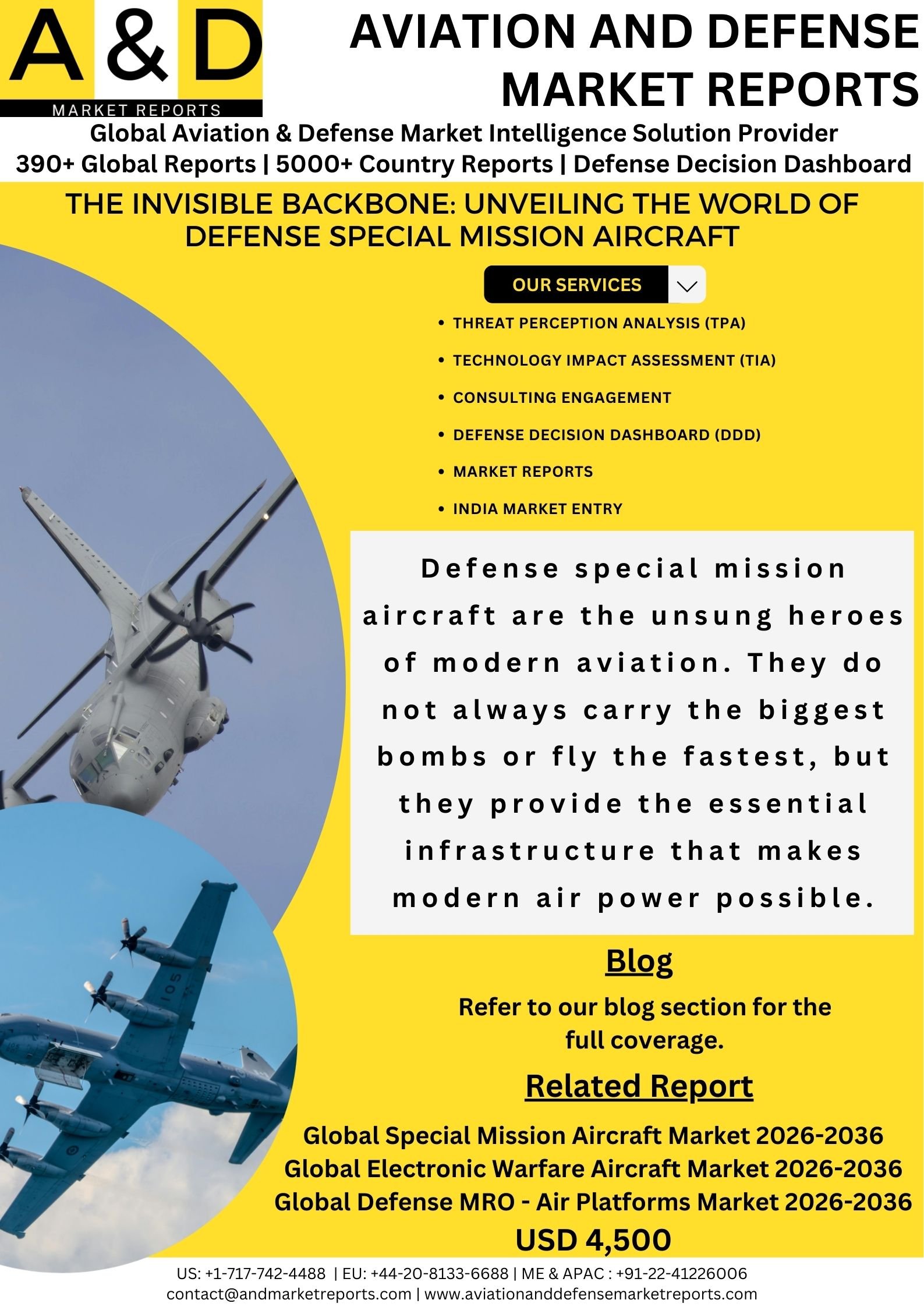
When most people think of military aviation, the image that comes to mind is usually a sleek fighter jet breaking the sound barrier or a heavy bomber delivering payloads. These kinetic platforms are the visible fist of air power. However, modern warfare is rarely won by firepower alone. It is won through information, endurance, and coordination. This is the domain of defense special mission aircraft.
Special mission aircraft are modified airframes designed to perform specific roles beyond standard combat or transport. They are the force multipliers of the sky, enabling combatants to operate more effectively, safely, and over greater distances. From airborne early warning to electronic attack, these aircraft form the invisible backbone of modern defense strategies. While they may lack the glamour of a dogfight, their strategic value is unparalleled, often determining the outcome of a conflict before the first shot is fired.
The High Ground: ISR and AWACS
In the complexity of modern battlefields, situational awareness is the most valuable currency. Intelligence, Surveillance, and Reconnaissance (ISR) aircraft, along with Airborne Warning and Control Systems (AWACS), provide commanders with a comprehensive view of the operational environment.
Imagine a chess game where one player can see the entire board while the other can only see their own pieces. AWACS aircraft fulfill this role in the sky. Equipped with massive rotating radar domes, these planes fly at high altitudes to detect incoming enemy aircraft, missiles, and ground movements from hundreds of miles away. They do not just detect threats; they manage the battle. An AWACS crew can vector friendly fighters toward targets, manage airspace deconfliction, and coordinate complex strike packages.
ISR platforms complement this by gathering detailed data. Using high-resolution cameras, signals intelligence suites, and synthetic aperture radar, these aircraft monitor enemy communications, track troop movements, and assess damage after strikes. This flow of information allows ground and air commanders to make informed decisions, reducing the fog of war and minimizing collateral damage. Without these eyes in the sky, even the most advanced fighter jets would be operating blindly.
Fighting in the Spectrum: Electronic Warfare
As militaries become more reliant on digital networks, radar, and communications, the electromagnetic spectrum has become a contested domain equal to land, sea, and air. Electronic Warfare (EW) special mission aircraft are designed to dominate this invisible battlefield.
These aircraft are equipped with sophisticated jamming pods and detection systems capable of disrupting enemy radar and communications. By emitting targeted noise or deceptive signals, EW aircraft can blind enemy air defense systems, allowing friendly strike packages to penetrate contested airspace safely. This is known as suppression of enemy air defenses (SEAD), a critical precursor to any major air campaign.
Beyond jamming, these platforms perform electronic attack and protection. They can intercept enemy communications to gather intelligence or protect friendly forces from incoming radar-guided missiles by confusing the weapon’s guidance system. In a conflict where connectivity is key, the ability to sever the enemy’s neural network while protecting one’s own is a decisive advantage. These aircraft ensure that friendly forces retain communication superiority while the enemy is left isolated and confused.
The Lifeline of Air Power: Aerial Refueling
Range and endurance are physical limitations that define air power. Without aerial refueling, most combat aircraft are limited to regional operations. Tanker aircraft remove this restriction, acting as flying gas stations that extend the reach of military aviation globally.
Air-to-air refueling allows fighters, bombers, and even other special mission aircraft to stay airborne for significantly longer periods. This capability is crucial for long-range strike missions, continuous combat air patrols, and rapid global deployment. A fighter jet that can be refueled mid-flight can take off from a home base, strike a target on the other side of a continent, and return without needing to land in a foreign country.
Furthermore, tankers provide strategic flexibility. In scenarios where forward operating bases are vulnerable or unavailable, tankers allow air forces to project power from secure locations far from the conflict zone. They are the logistical enablers that turn local air forces into global powers. The mere presence of a robust tanker fleet signals to adversaries that a nation has the ability to sustain prolonged operations anywhere on the globe.
Watching the Horizons: Maritime Patrol
The ocean covers the majority of the Earth’s surface, making it a challenging domain to monitor. Maritime Patrol Aircraft (MPA) are specialized special mission platforms designed to hunt submarines, monitor surface vessels, and conduct search and rescue operations over water.
Submarines represent a significant strategic threat, capable of launching attacks while remaining hidden. MPAs use magnetic anomaly detectors, sonobuoys, and advanced radar to locate these underwater vessels. Once detected, they can track the submarine or coordinate with surface ships and helicopters to neutralize the threat.
However, their role extends beyond anti-submarine warfare. In times of peace, MPAs monitor exclusive economic zones, deter smuggling, and assist in humanitarian missions. They provide a persistent presence over vast oceanic areas where surface ships would take days to traverse. By shrinking the vastness of the ocean, maritime patrol aircraft ensure that the seas remain secure for trade and navigation.
Future Horizons: Autonomy and Integration
The role of special mission aircraft is evolving rapidly. The future of this sector lies in the integration of unmanned systems and artificial intelligence. We are moving toward a model where manned special mission aircraft act as command nodes, controlling swarms of unmanned aerial vehicles (UAVs).
Imagine an AWACS aircraft directing a fleet of autonomous drones to investigate a radar contact while an electronic warfare drone jams the enemy’s response. This manned-unmanned teaming reduces risk to human crews and expands the sensor footprint exponentially. Artificial intelligence will also play a crucial role in processing the vast amounts of data collected by these aircraft, highlighting threats and suggesting courses of action to human operators in real-time.
Furthermore, modular mission systems are becoming more prevalent. Instead of dedicated airframes for specific roles, future aircraft may feature plug-and-play mission modules. A single airframe could be configured for ISR in the morning and electronic warfare in the afternoon, offering unprecedented flexibility to defense planners.
Conclusion
Defense special mission aircraft are the unsung heroes of modern aviation. They do not always carry the biggest bombs or fly the fastest, but they provide the essential infrastructure that makes modern air power possible. They provide the eyes to see the enemy, the shield to protect friendly forces, the fuel to reach the target, and the ears to listen to the ocean.
As geopolitical tensions shift and technology advances, the reliance on these platforms will only grow. They represent the shift from brute force to smart power, emphasizing information dominance and strategic reach. In the complex chessboard of global defense, special mission aircraft are the pieces that control the board, ensuring that when the time comes to act, the force is informed, supported, and ready. Their continued development remains a top priority for nations seeking to maintain sovereignty and stability in an increasingly contested world.