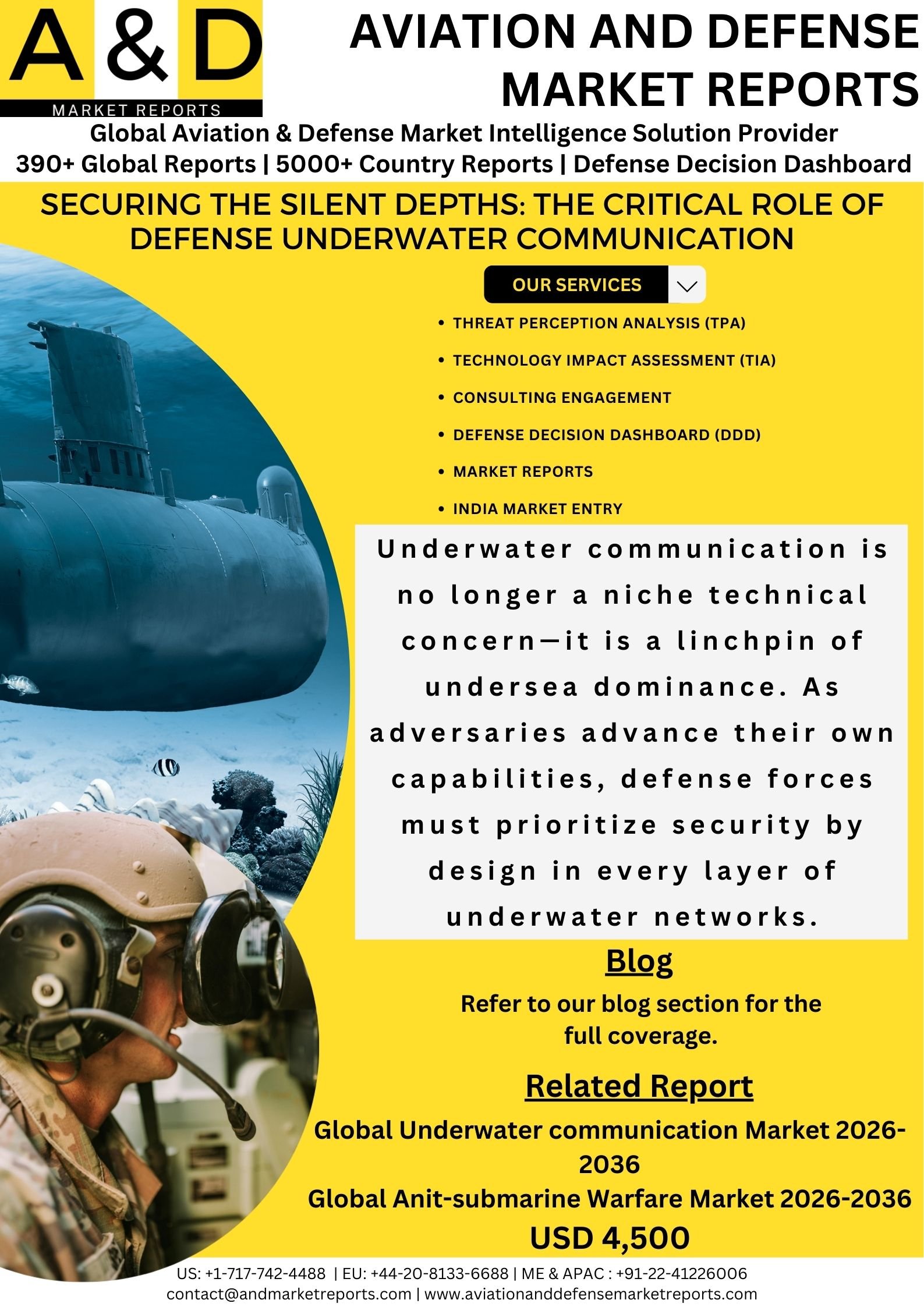
Beneath the ocean’s surface lies a vast, silent domain—one that remains among the most strategically vital and technologically challenging frontiers for modern defense operations. From submarine warfare and anti-submarine surveillance to mine countermeasures and special forces insertions, undersea operations rely heavily on robust, secure, and reliable communication systems. Yet, underwater communication presents unique obstacles: seawater severely attenuates electromagnetic waves (especially radio frequencies), ambient noise is pervasive, and the physical environment is dynamic and unpredictable. For defense forces worldwide, ensuring resilient and secure underwater communication is not just a technical challenge—it is a national security imperative.
The Physics of the Problem
Unlike terrestrial or airborne communication, where radio waves travel efficiently, seawater’s conductivity makes it hostile to most electromagnetic signals. High-frequency radio signals dissipate within centimeters; even extremely low frequency (ELF) signals—used historically by superpowers to reach submerged submarines—require massive land-based antenna arrays, transmit at painfully slow data rates (minutes per character), and offer only one-way broadcast capability.
This physical constraint has driven the defense sector to rely primarily on acoustic communication—using sound waves, which propagate much farther underwater (tens to hundreds of kilometers, depending on conditions). While effective, acoustic channels suffer from multipath propagation, Doppler shifts, time-varying noise (from ships, marine life, or weather), and limited bandwidth. These properties render conventional encryption and signal authentication techniques—designed for stable RF environments—less effective or infeasible.
Why Security Matters More Than Ever
In an era of rising great-power competition, undersea domains are contested spaces. Adversaries invest heavily in submarine fleets, unmanned underwater vehicles (UUVs), seabed warfare capabilities, and acoustic surveillance networks (e.g., SOSUS-style hydrophone arrays). In this context, insecure underwater communication creates multiple vulnerabilities:
- Interception: Acoustic signals can be passively eavesdropped by hydrophone-equipped platforms, revealing location, identity, mission intent, or fleet coordination.
- Spoofing/Jamming: An adversary may inject false commands into a network of UUVs or disrupt acoustic links during critical operations.
- Traffic Analysis: Even encrypted payloads can leak metadata—transmission timing, duration, directionality—enabling intelligence gathering.
- Cyber-Physical Attacks: Compromised undersea nodes (e.g., sensors or relay buoys) could serve as entry points to wider naval networks.
The 2022–2023 reports of underwater cable tampering and suspected seabed surveillance deployments near critical infrastructure underscore the urgency.
Current Defense Approaches & Innovations
To counter these threats, defense R&D agencies—DARPA (U.S.), DSTL (U.K.), ONR, and equivalents in China, Russia, and EU nations—are advancing multi-layered solutions:
1. Cryptographic Enhancements for Acoustic Channels
Traditional AES or RSA encryption is often too computationally heavy for low-power UUVs or real-time acoustic links. Lightweight cryptographic protocols—like SPECK or SIMON—are being adapted for embedded underwater systems. DARPA’s Secure Handhelds on Assured Resilient Tactical Edge Networks (SHIELD) program explores dynamic key exchange resilient to intermittent connectivity.
2. Low Probability of Intercept/Detection (LPI/LPD) Acoustics
LPI techniques include:
- Spread-spectrum modulation (e.g., FHSS, DSSS) to mask signals below ambient noise floor.
- Time-hopping and burst transmission, minimizing exposure windows.
- Directional acoustic beams using phased hydrophone arrays to reduce signal leakage.
The U.S. Navy’s Mobile Acoustic Communications and Ranging System (MACARS) integrates LPI with adaptive waveform selection based on real-time channel sensing.
3. Hybrid Communication Architectures
To bypass acoustic limitations, defense systems increasingly use hybrid approaches:
- Acoustic-to-RF Relays: Submarines or UUVs surface briefly to transmit via satellite (e.g., Iridium Certus), or deploy tethered or floating buoys with RF masts.
- Blue-Green Laser (Optical) Communication: In clear, shallow water, laser links offer high-bandwidth, low-intercept communication (e.g., China’s reported tests between submarines and aircraft). Challenges remain in turbid waters or during platform motion.
- Magnetic Induction (MI): For very short-range, high-security data transfer (e.g., diver-to-diver or diver-to-UUV), MI signals are localized and hard to detect beyond a few meters.
4. Autonomous & AI-Enabled Resilience
AI is enabling smarter, adaptive networks:
- Machine Learning for Channel Prediction: Neural networks model oceanographic conditions to optimize transmission timing, frequency, and power.
- Anomaly Detection: AI monitors acoustic traffic for spoofing/jamming signatures.
- Self-Healing Mesh Networks: Groups of UUVs form ad-hoc acoustic networks that reroute data if nodes fail or are compromised—critical for persistent seabed surveillance.
The NATO Centre for Maritime Research and Experimentation (CMRE) has demonstrated AI-coordinated UUV swarms communicating securely across contested acoustic channels in the Mediterranean.
5. Physical Layer Security
Beyond encryption, the physical layer itself can be a security asset:
- Covert Signaling via Ambient Noise: Embedding data in naturally occurring ocean sounds.
- Chaotic Waveforms: Using nonlinear dynamics to generate signals indistinguishable from noise without the correct synchronization key.
- Quantum Key Distribution (QKD) Prototypes: Early-stage efforts aim to use entangled photons in underwater optical channels for theoretically unhackable key exchange—though range and stability remain major hurdles.
Strategic & Operational Implications
The evolution of secure underwater communication is reshaping naval doctrine:
- Submarines gain safer, higher-bandwidth comms for real-time ISR (Intelligence, Surveillance, Reconnaissance) sharing—moving beyond “fire-and-forget” postures.
- Unmanned Systems can operate in coordinated, networked swarms across vast ocean areas, performing mine-hunting, ASW, or electronic warfare—provided their links are resilient.
- Seabed Warfare: Future conflicts may involve covert sensor emplacement or disruption of undersea infrastructure (cables, pipelines), demanding secure C2 for seabed drones and divers.
Moreover, interoperability among allied navies (e.g., Five Eyes, NATO) hinges on compatible, secure protocols—a logistical and cryptographic challenge requiring multinational standards.
Challenges Ahead
Despite advances, critical gaps persist:
- Depth-Versus-Bandwidth Tradeoff: Deeper operations mean higher pressure, lower temperatures, and greater acoustic attenuation—forcing harder tradeoffs between range, data rate, and power.
- Environmental Constraints: Arctic operations (under ice), littoral zones (high clutter), and biologically noisy regions (e.g., snapping shrimp habitats) each require tailored solutions.
- Scalability & Cost: Deploying thousands of secure, battery-efficient acoustic modems on UUVs remains expensive and logistically complex.
- Standardization: Proprietary military systems often lack cross-platform compatibility, hindering coalition operations.
Conclusion: Commanding the Blue Battlefield
Underwater communication is no longer a niche technical concern—it is a linchpin of undersea dominance. As adversaries advance their own capabilities, defense forces must prioritize security by design in every layer of underwater networks: physical transmission, protocol design, encryption, and operational procedure. Investment in quantum-resistant algorithms, AI-driven adaptive systems, and resilient hybrid architectures will define the next generation of naval superiority.
The ocean’s silence may be broken by sound—but in the defense context, ensuring that only the right ears hear, and only the right hands control, remains the ultimate mission. In the silent service, secure communication isn’t just about staying connected; it’s about staying hidden, staying trusted, and staying ahead.