
Description
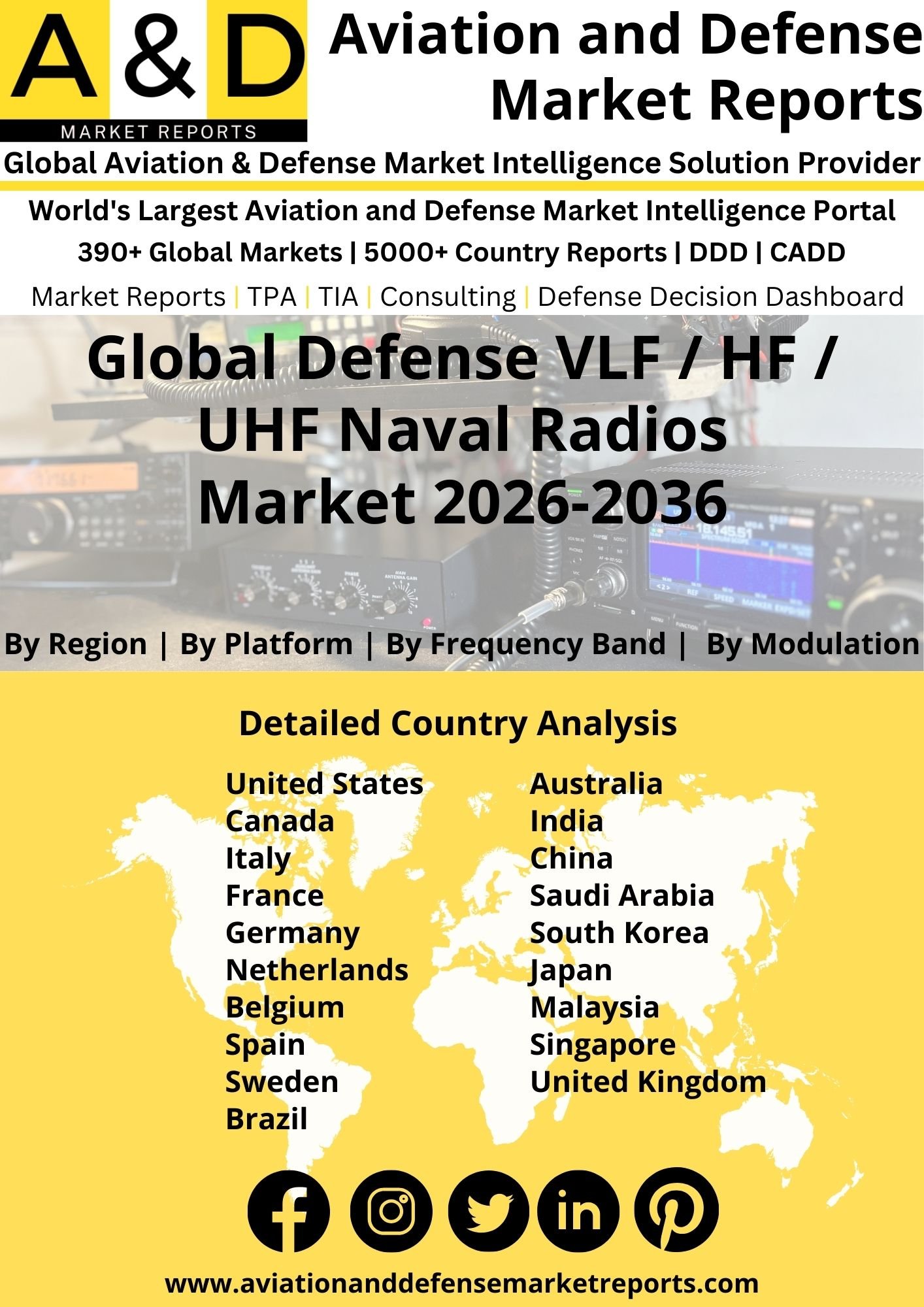
Global Defense VLF / HF / UHF Naval Radios Market Overview
Global Defense VLF / HF / UHF Naval Radios Market forms the backbone of maritime command and control. These radio systems support secure connectivity in contested and GPS-denied environments. When satellite links fail or degrade, naval radios ensure continuity of operations. Therefore, navies continue to invest in resilient radio infrastructure.
Very Low Frequency (VLF) radios penetrate seawater and support submarine communications. High Frequency (HF) systems enable beyond-line-of-sight connectivity through skywave propagation. Ultra High Frequency (UHF) radios deliver tactical line-of-sight voice and data links. Together, these bands provide layered maritime communications. As anti-access and electronic warfare threats increase, naval radios remain essential for sovereign operations.
Global Defense VLF / HF / UHF Naval Radios Market Technology Trends
Technology evolution shapes the Global Naval VLF, HF, and UHF Radio Communications Market. Modern systems rely on software-defined radio architectures. These designs allow operators to reconfigure waveforms, frequency bands, and encryption modes without hardware replacement. As a result, fleets gain flexibility and reduce lifecycle costs.
Advanced digital signal processing improves performance in harsh maritime conditions. Radios mitigate ionospheric disruption and atmospheric interference. In addition, adaptive equalization and frequency hopping reduce the impact of jamming. Cognitive radio functions now allow automatic spectrum sensing and real-time frequency selection. Consequently, vessels maintain connectivity during electronic attack.
Manufacturers also consolidate multi-band capability into compact units. Earlier systems required separate cabinets for each band. Now, integrated rack-mounted solutions reduce size, weight, and power consumption. This shift improves installation efficiency on space-constrained warships and submarines.
Global Defense VLF / HF / UHF Naval Radios Market Integration and Interoperability
Integration defines the current phase of the Global Naval VLF, HF, and UHF Radio Communications Market. Radios connect seamlessly with combat management systems, electronic warfare suites, and satellite terminals. For example, if an electronic warfare system detects jamming, the radio can switch automatically to a protected frequency. This coordination enhances survivability and mission continuity.
Submarines use VLF receivers linked to buoy or towed antennas to receive one-way secure broadcasts while remaining stealthy. Meanwhile, HF systems support long-range fleet broadcasts. UHF radios enable secure coordination with aircraft, UAVs, and amphibious forces. Therefore, integrated radio networks strengthen joint maritime operations.
Open standards further accelerate interoperability. Frameworks from organizations such as NATO promote compatibility across allied fleets. In parallel, modular hardware and containerized software enable rapid waveform updates and technology insertion.
Market Security and Supply Chain Dynamics
Security remains central to the Global Naval VLF, HF, and UHF Radio Communications Market. Modern systems integrate encrypted voice channels and hardware root-of-trust mechanisms. Secure boot processes prevent unauthorized firmware modification. Furthermore, anomaly detection tools guard against spoofing and covert interference.
Supply chain resilience also influences procurement decisions. Naval radios depend on high-power RF amplifiers, specialized antennas, and secure microelectronics. However, geopolitical volatility affects component availability. As a result, nations increasingly develop indigenous production capabilities and qualify alternate suppliers. Gallium Nitride-based amplifiers and domestic semiconductor sourcing improve both performance and sovereignty.
Market Future Outlook
The future of the Global Naval VLF, HF, and UHF Radio Communications Market centers on intelligent spectrum management. Artificial intelligence will enhance frequency agility and threat detection. Moreover, distributed radio networks using unmanned surface vessels may extend coverage in contested zones.
Research also explores quantum-resistant encryption and advanced modulation schemes. These technologies aim to deliver ultra-secure long-range communication. As naval forces expand operations in contested waters, resilient radio systems will remain indispensable. Rather than legacy tools, VLF, HF, and UHF radios now serve as adaptive and intelligent pillars of global maritime connectivity.