
Description
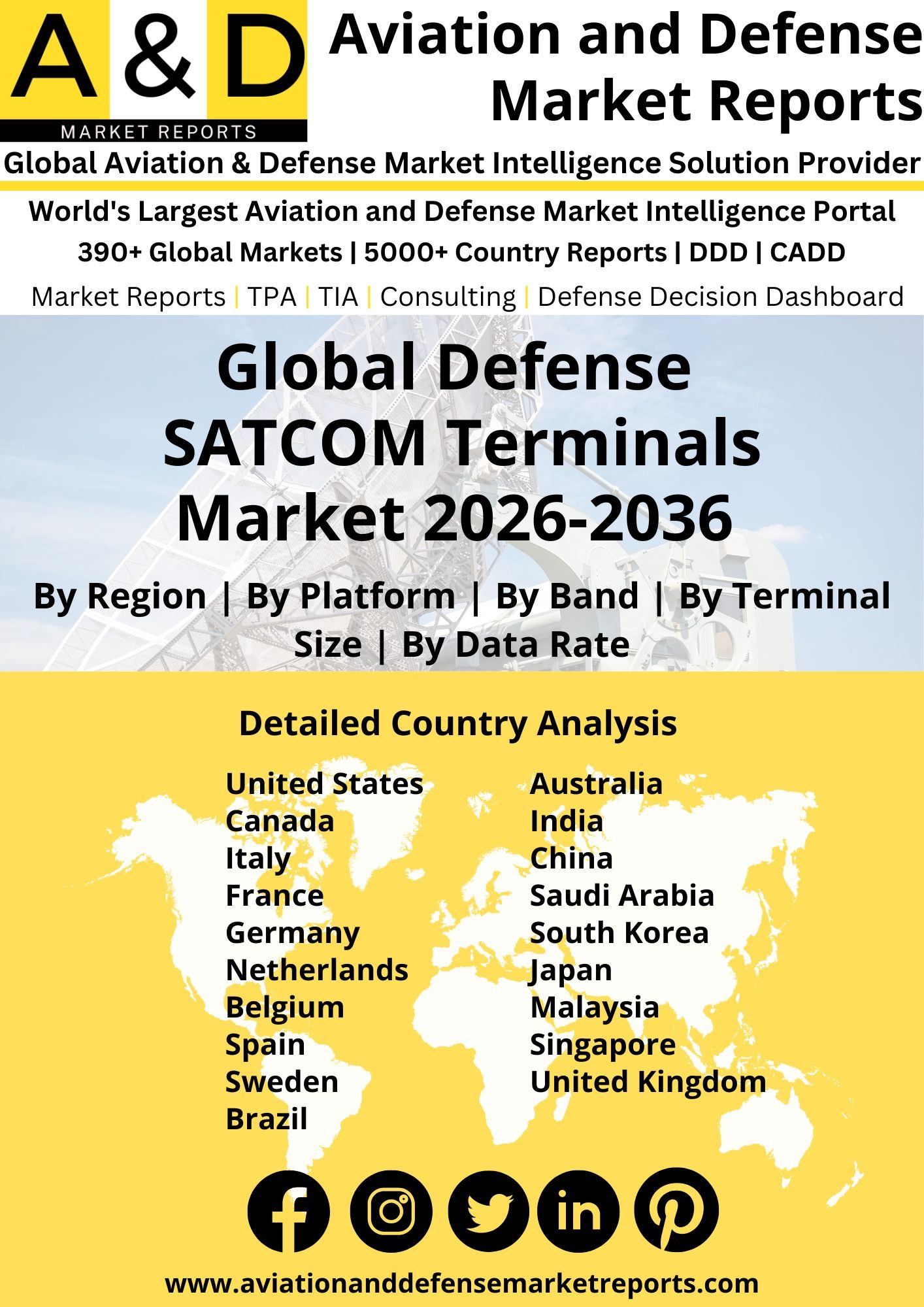
The global defense SATCOM terminals market encompasses ground, airborne, maritime, and man-portable systems that enable satellite-based communications for military forces. These terminals deliver beyond-line-of-sight connectivity, supporting secure voice, data, video, and command links in environments where terrestrial networks are unavailable or compromised. SATCOM terminals form a critical backbone for modern military communications across dispersed and remote theaters of operation.
Global Defense SATCOM Terminals Market: Operational Role and Strategic Connectivity
The operational significance of the global defense SATCOM terminals market lies in its ability to provide persistent global connectivity for deployed forces, command centers, and unmanned systems. SATCOM terminals enable real-time intelligence sharing, remote platform control, and synchronized operations across vast distances. High-bandwidth satellite links support mission-critical applications such as ISR data transmission, logistics coordination, and tactical communications, ensuring operational continuity in isolated or denied areas.
Global Defense SATCOM Terminals Market: Security, Resilience, and Electronic Warfare Protection
Security and resilience are central to the global defense SATCOM terminals market as systems are designed to operate in contested electromagnetic environments. Advanced encryption, anti-jamming, and low-probability-of-intercept technologies protect satellite links from disruption and interception. These capabilities ensure command and control reliability even under electronic warfare conditions, reinforcing operational security and mission assurance.
Global Defense SATCOM Terminals Market: Market Drivers and Modernization Programs
Growth in the global defense SATCOM terminals market is driven by increasing demand for resilient communications amid evolving threat landscapes. Militaries prioritize satellite-enabled connectivity to maintain operational flexibility when fixed infrastructure is degraded or unavailable. Ongoing modernization programs emphasize the integration of SATCOM into expeditionary forces and rapid deployment units, supporting sustained operations across geographically dispersed theaters.
Global Defense SATCOM Terminals Market: Technology Advancements and Terminal Design
Technological innovation shapes the global defense SATCOM terminals market through advancements in antenna and terminal architectures. Phased-array antennas, multi-orbit compatibility, and improved power efficiency enhance performance while reducing size, weight, and power constraints. These developments enable greater mobility and faster deployment across airborne, maritime, and ground platforms, expanding SATCOM accessibility across force structures.
Multi-Orbit, Software-Defined, and Platform Integration Trends
Key trends in the global defense SATCOM terminals market include the adoption of multi-orbit architectures that combine GEO, LEO, and MEO constellations to optimize latency, coverage, and resilience. Software-defined and modular terminal designs allow rapid reconfiguration and seamless integration with hybrid satellite-terrestrial networks. Miniaturization supports man-pack and vehicle-mounted systems, while growing integration with unmanned platforms expands applications in persistent surveillance and autonomous operations.
Strategic Outlook and Future Growth
The global defense SATCOM terminals market is positioned for sustained expansion as satellite constellations proliferate and demand for assured connectivity intensifies. Innovations in terminal security, efficiency, and adaptability will enable increasingly complex multi-domain operations. The shift toward hybrid commercial-military SATCOM models improves cost efficiency and scalability, while emphasis on survivable communications in high-threat environments reinforces the strategic importance of SATCOM terminals in modern defense postures.