
Description
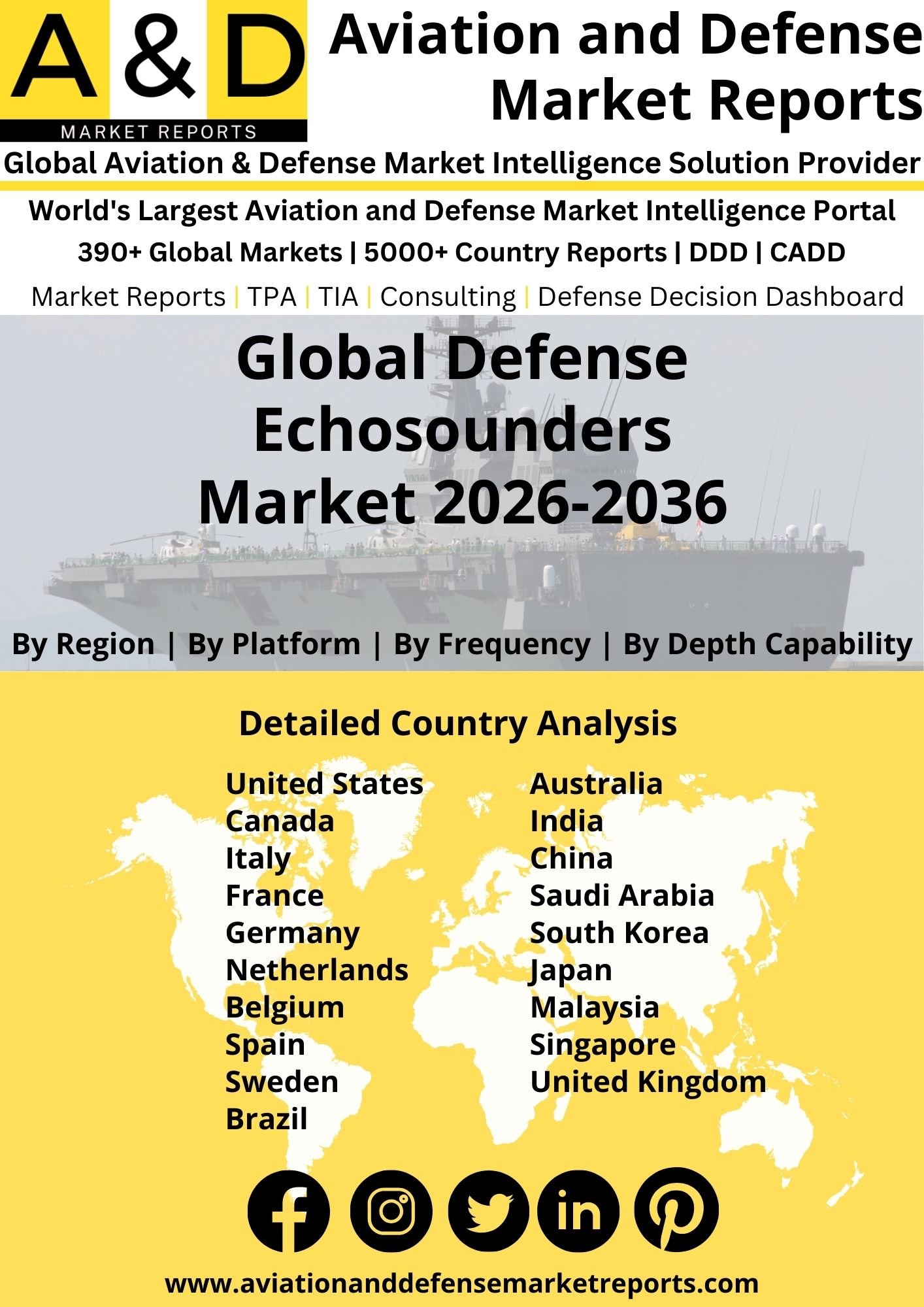
Global Defense Echosounders Market Overview
The Global Defense Echosounders Market plays a critical role in maritime navigation safety and underwater situational awareness. Echosounders measure water depth and seabed characteristics using acoustic echo-ranging principles. In defense applications, these systems do far more than provide under-keel clearance. Modern naval echosounders support bathymetric mapping, mine detection, bottom classification, submarine navigation, and amphibious mission planning. In congested littoral zones and strategic maritime choke points, reliable depth intelligence directly contributes to platform survivability and mission assurance.
Global Defense Echosounders Market Technology Trends
Technology advancement defines the trajectory of the Global Defense Echosounders Market. Contemporary systems operate across multiple frequency bands to balance depth penetration and imaging resolution. High-frequency transducers deliver detailed, shallow-water imaging for mine countermeasure and harbor navigation missions. Low-frequency systems provide deeper seabed penetration for blue-water bathymetric surveys and submarine operations.
Multi-beam and parametric echosounders represent the state of the art. These systems emit multiple acoustic beams simultaneously, generating wide swath coverage and enabling three-dimensional seabed mapping. Advanced digital signal processing enhances echo clarity and reduces noise interference. Modular processing units allow navies to configure systems for mission-specific requirements, whether for hydrographic survey or tactical mine detection.
Global Defense Echosounders Market Operational Applications
Operational versatility drives demand in the Global Defense Echosounders Market. Surface combatants rely on echosounders for safe navigation in unfamiliar or poorly charted waters. Mine countermeasure vessels deploy high-resolution variants to classify seabed objects and detect bottom or moored mines. Submarines use echosounders for covert seabed reconnaissance and hazard avoidance, particularly in shallow or constrained waters.
Hydrographic survey ships utilize advanced multi-beam systems to update nautical charts and support military engineering operations. Increasingly, acoustic depth data is fused with inputs from side-scan sonar and navigation sensors to generate a unified operational picture. This integration enhances decision-making and reduces navigational risk during high-tempo missions.
Market Integration and Interoperability
The Global Defense Echosounders Market increasingly emphasizes integration within broader ship systems. Modern echosounders connect directly to Integrated Navigation Systems and mine warfare suites using standardized digital interfaces. Operators can display depth data on multi-function consoles and overlay it on electronic chart systems for real-time visualization.
Mission adaptability is a key requirement. Platforms can install interchangeable transducer arrays depending on operational needs, enabling one vessel to conduct navigation support, survey tasks, and mine detection. Built-in health monitoring systems track transmitter performance and transducer condition, supporting predictive maintenance and improving lifecycle efficiency.
Market Security and Tactical Considerations
Because echosounders are active acoustic emitters, tactical emission management is essential. Naval commanders often control transmission timing and power levels to minimize acoustic detectability, particularly during submarine operations. Although cybersecurity risks are lower than in purely digital IT systems, the integrity of transmitted depth data remains critical. Data validation and network safeguards protect against spoofing or corruption that could lead to grounding or incorrect tactical assessments.
Supply chain resilience also shapes procurement strategies. Manufacturers carefully qualify suppliers of piezoelectric transducers and high-power acoustic transmitters to ensure reliability and operational consistency.
Global Defense Echosounders Market Future Outlook
The future of the Global Defense Echosounders Market centers on automation, artificial intelligence, and multi-functionality. AI-driven algorithms increasingly assist operators by automatically detecting and classifying seabed objects from acoustic returns. Real-time 3D seabed modeling and digital terrain mapping are gaining traction for both combat and survey applications.
Emerging ultra-wideband systems aim to combine high-resolution imaging with sub-bottom profiling in a single array. As unmanned surface vessels and autonomous underwater vehicles expand their roles in mine countermeasures and hydrographic surveys, demand will grow for compact, low-power, and high-performance echosounders. These advancements will ensure that echosounding technology remains a cornerstone of maritime safety, underwater intelligence, and naval mission effectiveness worldwide.