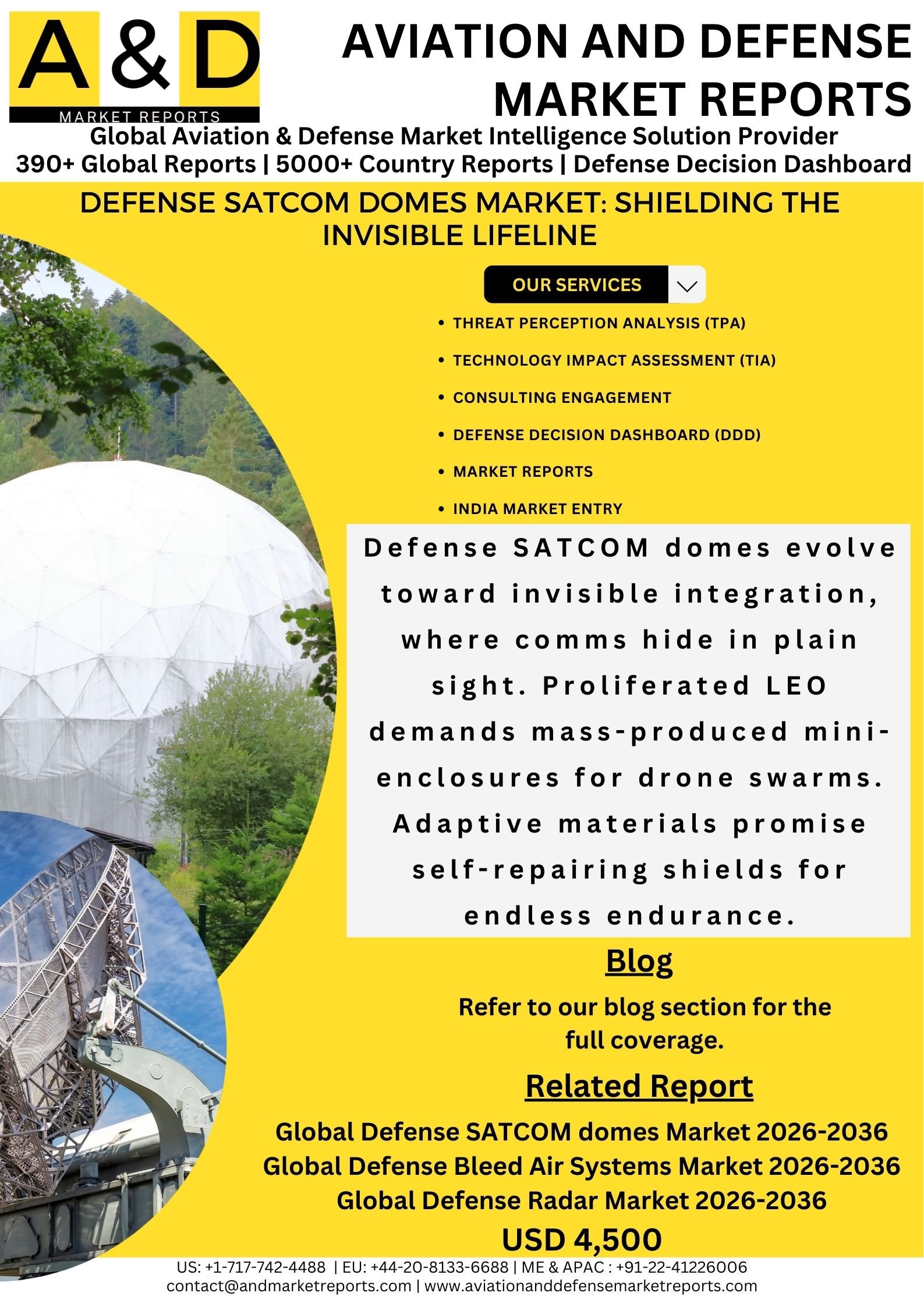
Defense SATCOM domes stand as critical sentinels in military communications, encasing satellite antennas in protective shells that ensure unbroken links across global battlefields. These geodesic structures, crafted from radar-transparent composites, shield sensitive terminals from weather extremes, shrapnel, and enemy fire while preserving signal integrity. In an era of contested orbits and jammed frequencies, this specialized market powers secure voice, video, and data flows for fighters, ships, and command posts.
Core Design and Material Science in Defense SATCOM Domes
SATCOM domes employ multi-layered sandwich panels of fiberglass, syntactic foams, and epoxies, engineered for RF transparency across X, Ku, and Ka bands. Hexagonal or triangular facets minimize distortion, with precise curvature matching antenna footprints. Inflatable variants deploy rapidly for expeditionary use, rigidizing via chemical cures.
Thermal barriers insulate against solar heating or arctic chills, while hydrophobic coatings repel rain and ice. Anti-radar-absorbent layers prevent detection, blending into hulls or masts. Vibration-damping cores absorb ship rolls or jet wakes, stabilizing gimbals inside.
Customization spans low-profile sails for stealth ships to massive geodesic spheres housing multi-beam arrays.
Evolution from Basic Covers
Early domes used simple canvas shrouds over Cold War dishes, evolving into rigid fiberglass for UHF links. Digital beamforming reduced sizes, enabling conformal sails flush with fuselages. Third-generation composites introduced self-healing resins, patching micro-cracks from sandblasting.
Hybrid designs now embed active elements—phased arrays within skins—eliminating domes entirely in some cases. Lessons from desert storms refined erosion resistance, pushing service lives into decades.
Strategic Roles in Operations
Naval destroyers mount flight-deck domes for drone control during swarm exercises, linking unmanned assets to command hubs. Ground vehicles hide low-observable SATCOM under armored geodesic shields, maintaining C2 amid urban chaos. Airlifters carry pop-up domes for forward operating bases, enabling instant theater networks.
Missile defense integrates domes with sensors, cueing interceptors via space relays. Special ops teams deploy man-portable inflatables, bouncing encrypted feeds from backpacks. Distributed apertures replace single domes, spreading risk across vehicle hulls for resilient comms.
These enclosures turn vulnerable antennas into survivable assets.
Defense SATCOM Domes: Market Drivers and Imperatives
Proliferating anti-satellite weapons demand jam-resistant, proliferated terminals under domes. High-altitude platforms like balloons need lightweight enclosures for stratospheric endurance. Budgets favor commercial radome tech hardened for mil-specs, slashing costs.
Coalition ops require interoperable bands, standardizing dome apertures globally. Export markets boom for mid-tier forces seeking affordable uplinks. Cyber threats spur embedded encryption, domes shielding physical layers.
Urban spectrum congestion pushes multi-band transparency.
Technical Innovations Enhancing Resilience
Aerogels slash weight while insulating RF paths. Shape-memory polymers adapt contours post-damage, restoring profiles. Graphene-infused skins conduct heat away, surviving laser dazzlers.
Active cooling channels bleed RF energy as waste heat. Metamaterial liners bend waves around obstacles, enabling hull-embedded arrays. 3D-printed facets enable rapid prototyping for custom fits.
AI-monitored integrity pings for cracks, cueing swaps preemptively.
Deployment Challenges Overcome
Sand abrasion erodes exteriors, countered by diamond-like carbon overcoats. Moisture ingress fogs internals, sealed by laser-welded seams. Weight penalties tax aircraft, alleviated by syntactic microspheres.
Ballistic impacts demand multi-hit tolerance, layered with Kevlar hybrids. Harsh chemicals from propellants corrode resins, repelled by fluoropolymers. Logistics favor modular skirts, swapping domes without full teardowns.
Testing in wind tunnels verifies RF patterns pre-fielding.
Leading Innovators and Supply Chain
General Dynamics pioneers naval flight-deck domes, integrating with Aegis baselines. CPI Design & Manufacturing crafts stabilized VSAT enclosures for helos. Saint-Gobain excels in composite sandwiches, supplying primes.
Startups like Kymeta disrupt with flat-panel electronica, dome-optional. Tiered chains link resin chemists to molders globally. Defense expos demo RF transparency live, sealing contracts.
Regional Deployments and Priorities
Indo-Pacific fleets prioritize masthead domes for carrier ops in contested seas. Europe fortifies ground vehicles with distributed arrays under low-observable skins. Mideast rigs oil platforms with dust-proof SATCOM bubbles.
Arctic bases use heated inflatables against ice buildup. Littoral navies adapt conformal sails for patrol craft.
Defense SATCOM Domes – Emerging Trends Reshaping Enclosures
Phased-array metamaterials phase out domes, antennas printing directly on skins. Inflatable hybrids rigidize in seconds via aerogel foams. Multi-orbit transparency spans LEO to GEO seamlessly.
Self-deploying drones carry mini-domes for pop-up relays. Bio-mimetic skins mimic camouflage, RF-transparent yet visually stealthy.
Quantum-secure liners preview post-quantum crypto.
Operational Impact and Force Multiplier
SATCOM domes grant persistent awareness, piping drone feeds to bunkers worldwide. Resilient enclosures sustain ops amid storms or strikes, minimizing blackouts. Low-drag designs boost aircraft endurance, extending legs.
They deter through denial, adversaries blind without links downed. Cost swaps fragile antennas for tough shells, scaling networks affordably.
Sustainability and Lifecycle Advances
Recyclable thermosets replace epoxies, easing disposal. Solar films power internal diagnostics. Modular panels enable field refurbishments, slashing logistics tails.
Carbon-neutral resins from bio-feedstocks align with green mandates.
Future Horizons in Shielded Skies
Defense SATCOM domes evolve toward invisible integration, where comms hide in plain sight. Proliferated LEO demands mass-produced mini-enclosures for drone swarms. Adaptive materials promise self-repairing shields for endless endurance.
This market fortifies the invisible spectrum, ensuring words outpace weapons. From destroyer decks to foxholes, domes preserve the digital battlespace, turning fragile signals into unbreakable lifelines.