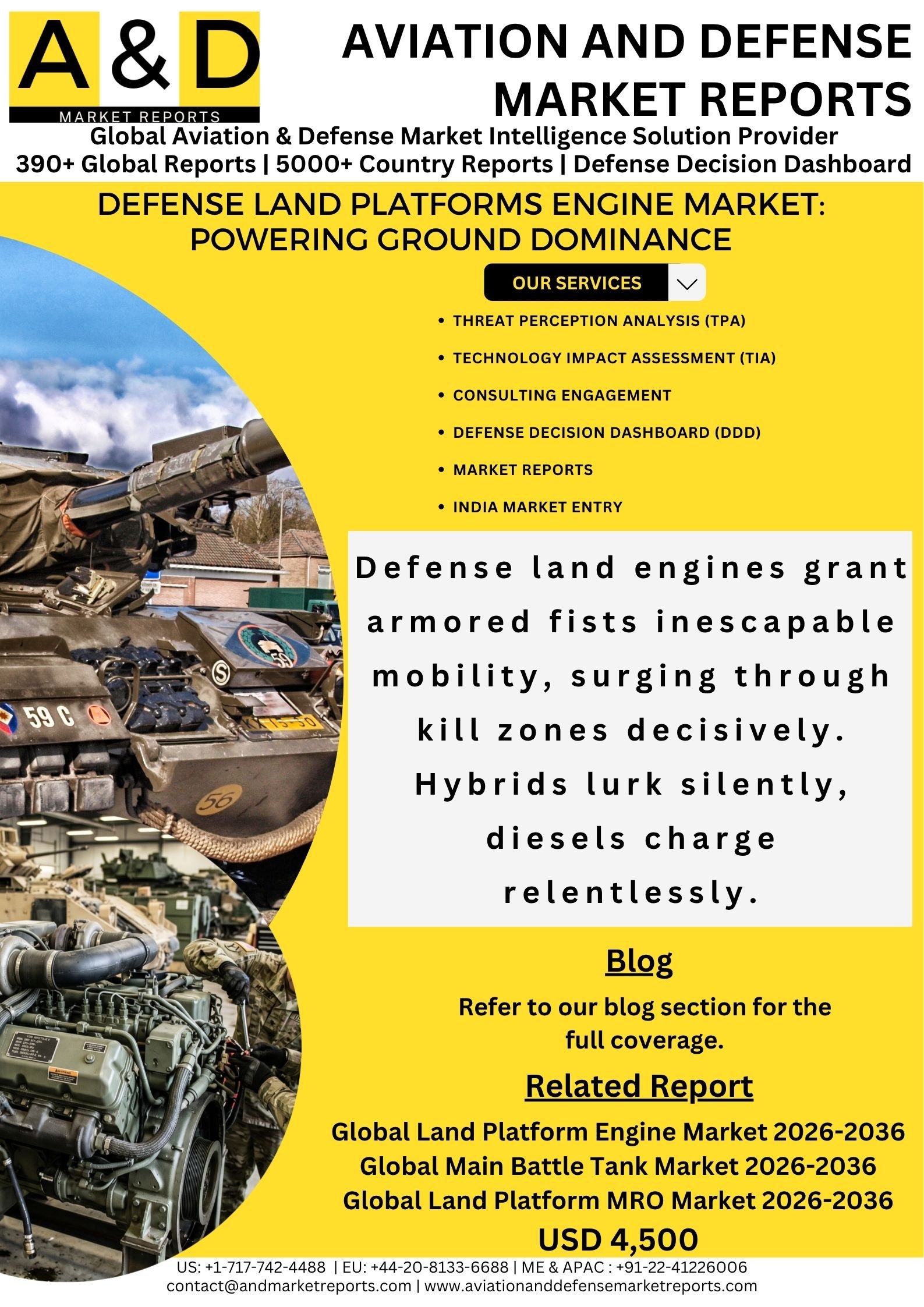
Defense land platforms engines drive the muscle behind tanks, armored carriers, infantry fighting vehicles, and tactical trucks, delivering torque, reliability, and efficiency across brutal terrains from deserts to arctic tundra. These powerplants—primarily high-output diesels, gas turbines, and emerging hybrids—must endure extreme heat, dust, and combat stress while enabling rapid maneuvers, heavy payloads, and extended missions without refueling. The market pulses with modernization demands as nations upgrade legacy fleets and deploy next-generation vehicles, prioritizing fuel-efficient, low-signature propulsion for multi-domain warfare.
Engine Types Fueling the Fight
Diesel engines dominate with turbocharged V-configurations providing high torque at low revs, ideal for tracked tanks crawling obstacles or wheeled carriers sprinting roads. Multi-fuel variants burn jet fuel in emergencies, enhancing logistics flexibility. Gas turbines spin up instantly for supersonic dashes in main battle tanks, though thirsty appetites demand hybrid assists.
Hybrid-electric systems pair diesels with electric motors for silent watch modes, slashing thermal signatures for ambushes. Fuel cells emerge for unmanned ground vehicles, emitting only water vapor stealthily. Modular designs swap powerpacks field-quickly, minimizing downtime.
Power density defines battlefield edge.
Design Imperatives for Harsh Duty
High-bypass cooling shrugs off sand ingestion, air filters self-cleaning continuously. Composite blocks shed weight without sacrificing durability. Electronic controls optimize fuel maps dynamically via sensors monitoring load and altitude.
NVH suppression quiets approaches undetected. Sealed fording kits submerge deeply, snorkels gulping air underwater. Ballistic tolerance encases vitals in armor, redundant systems surviving hits.
Fail-safes ensure limp-home mobility always.
Evolution from Raw Horsepower to Smart Propulsion
Cold War diesels prioritized brute force for massed armored thrusts. Gulf War lessons birthed efficient common-rail injectors and exhaust aftertreatment slashing emissions. Urban combat demands hybrids for electric stealth in alleys.
Digital twins simulate lifetimes pre-build. AI diagnostics predict failures from vibration signatures. Open architectures upgrade software mid-life economically.
Propulsion matures toward autonomy enablers.
Platform Applications Demanding Power
Main battle tanks haul massive guns over rough ground, engines powering active suspensions smoothing rides. Infantry carriers ferry squads rapidly, protecting against RPGs while mounting remote turrets. Self-propelled artillery dashes into firing positions, engines enabling shoot-and-scoot tactics.
Tactical trucks bridge gaps with rough-terrain mobility, cranes lifting supplies autonomously. Unmanned vehicles prowl borders silently, hybrids extending loiter indefinitely. Amphibious tractors ford beaches under fire, propellers folding for land mode.
Versatility spans blitzkrieg to patrols.
Market Forces Revving Growth
Geopolitical hotspots accelerate armored recapitalizations, nations bulking mechanized brigades affordably. Asymmetric wars highlight mobility over mass, light-yet-potent engines rising. Export deals bundle engines with local production offsets.
Sustainability edicts push hybrids cutting fuel logistics. Urbanization shrinks maneuver spaces, agile powertrains thrive. Budgets favor upgrade kits over new hulls.
Coalitions standardize mounts interoperably.
Technological Leaps Boosting Output
Variable geometry turbos spool precisely across rev ranges. Plasma ignition ignites lean mixtures cleanly. Regenerative braking recaptures energy in hybrids.
Graphene coatings slash friction losses. 48-volt architectures electrify accessories. Hypersonic fans cool turbine inlets actively.
Cognitive controls adapt to driver styles learnably.
Operational Challenges Conquered
Dust clogs filters rapidly, cyclonic pre-cleaners whirl it free. Overheating cripples in deserts, liquid immersion cools electronics. Logistics strain remote ops, biofuels extend range on local forage.
Vibration fatigues mounts, adaptive isolators counter. EMP pulses fry controls, hardened shielding protects.
Endurance tests validate brutally.
Prime Movers and Ecosystem
Cummins crafts rugged diesels for global fleets. MTU supplies high-mobility V-12s. Honeywell powers turbine beasts.
General Dynamics integrates Abrams upgrades. Oshkosh innovates heavy trucks. Strategies fuse mergers with R&D labs pioneering hybrids.
Supplier parks cluster near assembly lines.
Regional Terrain Tensions
North America pioneers hybrid Abrams evolutions. Europe refines Leopard powerpacks modularly. Asia-Pacific scales indigenous tanks amid border frays.
Middle East fortifies desert haulers against dunes. Russia patrols steppes with reliable V-92s. Africa pioneers light scouts ruggedly.
Global proving grounds sharpen edges.
Sustainability Geared Green
Biofuels blend seamlessly without mods. Hybrids sip diesel quietly. Recyclable composites lighten blocks.
Predictive maintenance drones slash overhauls. Solar trickle charges idling batteries.
Engines evolve eco-consciously.
Emerging Powertrains Unleashed
Solid-state batteries densify electric punch. Free-piston engines linearize power linearly. Laser ignition sparks precisely.
Swappable fuel cell cartridges refuel instantly. AI optimizes fleet fuel across theaters.
Unstoppable Ground Momentum
Defense land engines grant armored fists inescapable mobility, surging through kill zones decisively. Hybrids lurk silently, diesels charge relentlessly.
They conquer terrain tyrannically.
Markets throttle this power revolution forward, engines roaring into contested grounds. From foxholes to frontiers, propulsion prevails decisively. Rev the future—ground dominance drives.