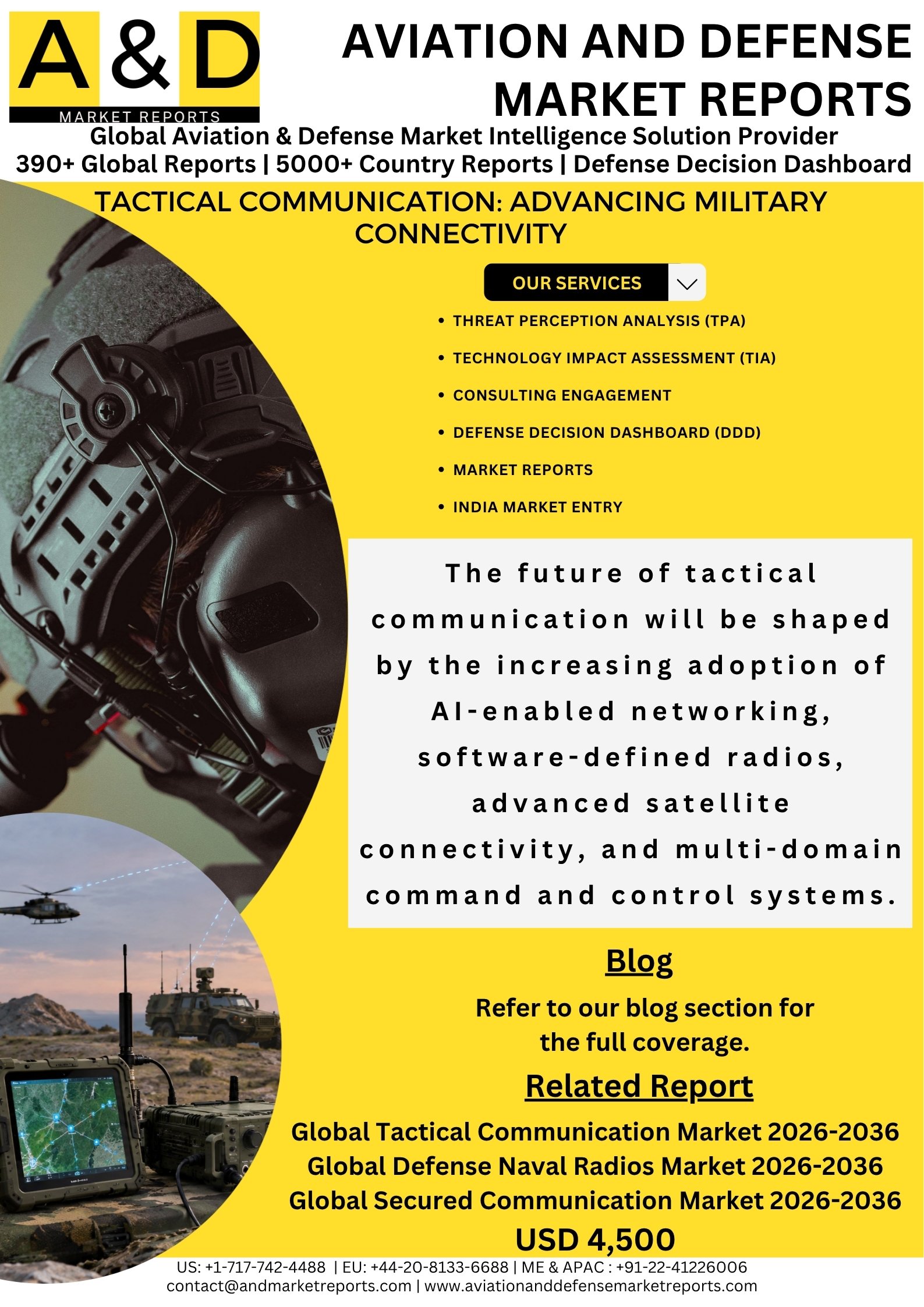
Tactical communication plays a critical role in modern military operations by enabling secure, reliable, and real-time information exchange between soldiers, commanders, vehicles, aircraft, naval platforms, and command centres. As defence forces increasingly operate across complex and interconnected battlefields, the ability to transmit operational information quickly and securely has become essential for mission success.
Modern tactical communication systems support voice, data, video, and situational awareness sharing across land, air, maritime, and space-based military environments. These systems allow military personnel to coordinate operations, share intelligence, monitor threats, and make informed decisions under challenging battlefield conditions.
The growing adoption of network-centric warfare, unmanned platforms, artificial intelligence (AI), and advanced electronic warfare technologies is increasing the importance of tactical communication. Consequently, defence organisations worldwide are investing in next-generation communication infrastructure to improve interoperability, operational flexibility, and battlefield connectivity.
Evolution of Tactical Communication
Military communication has evolved significantly from traditional battlefield signalling methods to sophisticated digital networks. Early military forces relied on visual signals, messengers, field telephones, and radio transmitters to exchange information. Although these technologies supported basic coordination, they offered limited range, mobility, and communication security.
The introduction of portable radio systems transformed battlefield communication by enabling forces to exchange information over greater distances. Later developments in satellite communication, digital encryption, frequency-hopping technology, and secure broadband networks improved communication reliability and resistance to interception.
Modern tactical communication has progressed towards software-defined radios (SDRs), mobile ad hoc networks (MANETs), satellite-based connectivity, and integrated battlefield management systems. These technologies allow military units to maintain communication even when conventional infrastructure is unavailable or damaged.
Importance of Tactical Communication in Modern Warfare
Tactical communication is essential for maintaining coordination, situational awareness, and operational effectiveness across military formations. Reliable communication allows commanders to distribute mission instructions, coordinate troop movements, and respond quickly to changing battlefield conditions.
One of its primary advantages is improved command and control (C2). Secure communication networks enable commanders to maintain contact with deployed units and coordinate operations across multiple military domains.
Tactical communication also supports intelligence, surveillance, and reconnaissance (ISR) activities by transmitting information collected through radar systems, unmanned aerial vehicles (UAVs), electro-optical sensors, and other surveillance platforms.
Additionally, these systems improve interoperability between different military services and allied forces. Standardised communication protocols and integrated networks allow participating units to exchange information during joint exercises, multinational missions, and complex combat operations.
Key Components of Modern Tactical Communication
Modern tactical communication infrastructure consists of several interconnected technologies designed to provide secure and continuous connectivity.
– Software-Defined Radios (SDRs): These systems support multiple communication frequencies, waveforms, and operating modes through programmable software, improving flexibility and interoperability.
– Satellite Communication (SATCOM): Satellite networks provide long-range connectivity for military forces operating in remote locations, maritime environments, and areas without terrestrial communication infrastructure.
– Tactical Data Links: Systems such as Link 16 enable military platforms to exchange tactical information, including aircraft positions, threat information, and operational updates.
– Mobile Ad Hoc Networks (MANETs): These decentralised networks allow military personnel and mobile platforms to communicate without depending on fixed communication infrastructure.
– Encryption and Cybersecurity Systems: Advanced encryption, authentication, and network protection technologies safeguard sensitive military information against interception and cyber threats.
– Command and Control Systems: Integrated communication platforms connect battlefield sensors, command centres, and deployed forces to support coordinated decision-making.
Technological Advancements Driving Market Growth
Rapid technological development is transforming the tactical communication industry. Software-defined networking, AI-enabled information processing, advanced encryption, and next-generation satellite systems are improving the performance of military communication networks.
The integration of AI and machine learning is helping defence organisations manage communication networks, identify potential disruptions, and improve information distribution. These capabilities are particularly important in environments where large volumes of battlefield data must be processed and shared rapidly.
The development of 5G-enabled military communication, low-Earth-orbit (LEO) satellite constellations, and advanced waveform technologies is also expanding connectivity options. Meanwhile, anti-jamming capabilities and electronic protection technologies are becoming increasingly important as adversaries develop sophisticated electronic warfare systems.
The integration of tactical communication with autonomous platforms, unmanned ground vehicles, UAVs, and naval systems is further supporting the transition towards connected multi-domain military operations.
Growing Tactical Communication Production Supporting Market Expansion
Increasing defence expenditure and military modernisation programmes are encouraging manufacturers to expand tactical communication production capabilities. Governments are prioritising domestic manufacturing of secure radios, satellite communication terminals, networking equipment, encryption technologies, and battlefield communication systems.
Defence contractors are investing in research and development, manufacturing infrastructure, and advanced testing facilities to meet the growing requirements of armed forces. Several countries are also strengthening indigenous defence production to reduce dependence on foreign communication technologies and improve supply-chain security.
The expansion of domestic manufacturing ecosystems is creating opportunities for semiconductor manufacturers, antenna developers, software companies, electronics suppliers, and specialised defence technology providers.
Increasing Demand for Tactical Communication and Upgrades
Demand for tactical communication systems is increasing as military forces replace ageing radio equipment and upgrade legacy communication infrastructure. Modern military operations require high-speed, secure, and interoperable networks capable of supporting voice, video, and data transmission simultaneously.
Rising geopolitical tensions, border security requirements, and the growing use of unmanned systems are further encouraging defence organisations to invest in advanced communication equipment.
Military modernisation programmes are also creating demand for lightweight, portable, and ruggedised communication devices suitable for dismounted soldiers, armoured vehicles, fighter aircraft, naval vessels, and special operations units.
Furthermore, the increasing adoption of network-centric warfare is driving investments in integrated communication architectures that connect sensors, weapons, command centres, and operational platforms.
Regional Market Developments
North America: The United States remains a major market for tactical communication technologies, supported by military modernisation programmes and investments in advanced battlefield networking. Programmes involving software-defined radios, satellite communications, and integrated tactical networks are supporting demand.
Europe: European countries are increasing defence expenditure and prioritising secure military communication systems amid changing regional security requirements. NATO interoperability initiatives are also encouraging investments in standardised communication equipment and encrypted networks.
Asia-Pacific: Countries such as India, China, Japan, South Korea, and Australia are strengthening military communication infrastructure as part of broader defence modernisation efforts. Indigenous production, border surveillance, and network-centric warfare capabilities are important regional priorities.
Middle East: Regional security challenges are encouraging investments in secure radios, tactical satellite communication, integrated command systems, and electronic warfare-resistant communication technologies.
Competitive Landscape of the Market
The tactical communication market includes established defence electronics manufacturers, specialised communication technology providers, and emerging defence technology companies. Competition is increasingly centred on secure networking, interoperability, software-defined architectures, advanced encryption, and multi-domain connectivity.
Major industry participants include L3Harris Technologies, RTX Corporation, Thales Group, BAE Systems, General Dynamics, Rohde & Schwarz, and Elbit Systems.
These companies are investing in next-generation radio systems, tactical networking solutions, satellite communication equipment, and integrated battlefield technologies. Strategic partnerships, defence contracts, technology collaborations, and indigenous manufacturing initiatives are shaping the competitive environment.
Challenges Affecting Market Growth
Despite increasing demand, the tactical communication industry faces several challenges. High development and procurement costs can restrict the adoption of advanced communication technologies, particularly among countries with limited defence budgets.
Cybersecurity threats, electronic warfare interference, signal jamming, and communication interception remain significant operational concerns. Military communication systems must maintain reliability even in highly contested electromagnetic environments.
Interoperability between legacy equipment and modern digital networks presents another challenge. Integrating systems from different manufacturers and military services requires standardised protocols, extensive testing, and continuous software upgrades.
Additionally, dependence on specialised semiconductor components, secure supply chains, and advanced manufacturing technologies can affect production timelines and equipment availability.
Future Outlook of Tactical Communication
The future of tactical communication will be shaped by the increasing adoption of AI-enabled networking, software-defined radios, advanced satellite connectivity, and multi-domain command and control systems. Defence forces are expected to prioritise communication architectures that provide secure, resilient, and uninterrupted connectivity across geographically dispersed operational environments.
The integration of autonomous platforms, electronic warfare systems, advanced sensors, and real-time intelligence networks will further increase demand for high-performance tactical communication solutions.
Emerging technologies such as 5G, LEO satellite networks, quantum-resistant encryption, and intelligent network management are expected to influence future system development. Meanwhile, governments will continue supporting indigenous manufacturing and technology partnerships to strengthen defence communication capabilities.
As military operations become increasingly data-driven and interconnected, tactical communication will remain a fundamental component of modern defence infrastructure. Continuous investment in secure connectivity, advanced networking, and resilient communication technologies is expected to create significant opportunities for manufacturers and technology providers across the global defence industry.