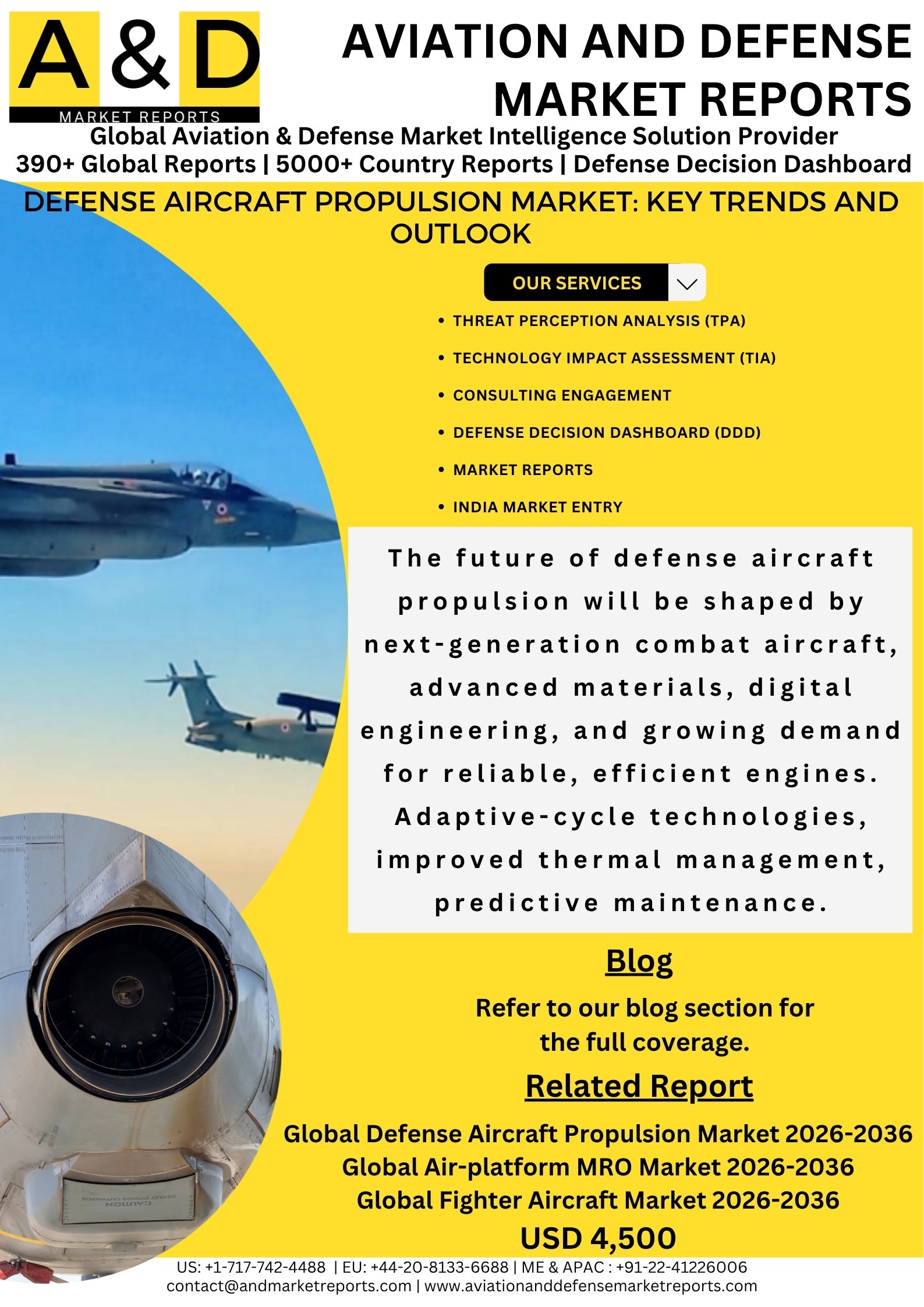
Defense aircraft propulsion is a critical component of military aviation, providing the thrust and power required for fighter jets, military transport aircraft, bombers, trainers, helicopters, and unmanned aerial vehicles (UAVs). These propulsion systems determine an aircraft’s speed, range, payload capacity, endurance, manoeuvrability, and operational effectiveness. As global military forces modernize their fleets, demand for advanced propulsion technologies is increasing, creating new opportunities across the defense aircraft propulsion market.
Modern military propulsion systems include turbofan, turbojet, turboprop, turboshaft, and emerging hybrid-electric configurations. Each technology serves specific mission requirements, ranging from high-speed combat operations to long-duration surveillance and tactical transportation. Increasing investments in indigenous engine development, fleet upgrades, and next-generation combat aircraft are expected to shape the market’s long-term development.
Evolution of Defense Aircraft Propulsion
Defense aircraft propulsion has evolved significantly since the early days of military aviation. Piston engines powered early military aircraft, providing the performance necessary for reconnaissance, air combat, and bombing missions. However, the demand for greater speed and operational altitude during the Second World War accelerated the development of jet propulsion.
Turbojet engines subsequently transformed military aviation by enabling aircraft to operate at higher speeds and altitudes. The introduction of turbofan engines improved fuel efficiency and thrust, making them suitable for modern fighter aircraft and strategic military platforms. Meanwhile, turboprop and turboshaft engines continued to support transport aircraft and helicopters.
Today, propulsion development focuses on increased thrust, thermal efficiency, reliability, and reduced maintenance requirements. Advanced materials, digital engine controls, and additive manufacturing are also influencing engine design. Future combat aircraft programmes are increasingly exploring adaptive-cycle engines and other technologies intended to balance fuel efficiency with high-performance operation.
Importance of Defense Aircraft Propulsion
Aircraft propulsion directly influences military readiness and mission success. High-performance engines allow fighter aircraft to accelerate rapidly, sustain demanding manoeuvres, and carry weapons and additional mission equipment. Reliable propulsion is equally important for transport aircraft, aerial refuelling platforms, and surveillance aircraft that must complete extended missions under challenging conditions.
Propulsion systems also affect operating costs, aircraft availability, and maintenance schedules. Engines with improved durability and fuel efficiency can reduce lifecycle expenses and increase fleet readiness. In addition, domestic engine development supports strategic autonomy by reducing dependence on foreign suppliers for critical technologies, spare parts, and maintenance services.
For countries seeking to strengthen their aerospace industries, propulsion technology represents an important area for defence manufacturing, research, exports, and industrial collaboration.
Key Components of Modern Defense Aircraft Propulsion
Modern propulsion systems combine several components that work together to generate thrust and maintain reliable operation.
- Compressor: Increases the pressure of incoming air before combustion, supporting efficient engine operation.
- Combustion chamber: Mixes compressed air with fuel and releases energy through controlled combustion.
- Turbine: Extracts energy from hot gases to drive the compressor and other engine systems.
- Exhaust nozzle: Directs high-energy gases to generate thrust, with variable-geometry designs used in certain high-performance engines.
- Fuel and control systems: Regulate fuel delivery and engine operation according to changing flight conditions.
- Afterburner: Provides additional thrust in selected military jet engines when required for demanding flight conditions.
- Digital engine controls: Monitor operating parameters, optimize performance, and support fault detection and maintenance planning.
Advanced cooling systems, high-temperature materials, sensors, and integrated health-monitoring technologies are becoming increasingly important in improving engine performance and service life.
Technological Advancements Driving Market Growth
Technological innovation is a major driver of the defense aircraft propulsion market. Manufacturers are developing engines that deliver greater thrust, improved fuel efficiency, enhanced reliability, and better performance across a wider range of operating conditions.
Adaptive-cycle propulsion is receiving attention for its potential to combine efficient cruising with high-thrust performance. These technologies could support future combat aircraft that require greater range, speed, and flexibility. However, their development involves substantial engineering challenges and high investment requirements.
Additive manufacturing enables the production of complex engine components while potentially reducing material waste and manufacturing time. Ceramic matrix composites and advanced superalloys are also being developed for components exposed to extreme temperatures. Furthermore, artificial intelligence-assisted maintenance analytics and digital twins can help identify emerging faults, improve maintenance planning, and reduce unplanned aircraft downtime.
Growing Defense Aircraft Propulsion Production Supporting Market Expansion
Increasing aircraft production and fleet modernization programmes are creating opportunities for propulsion manufacturers. Countries are procuring new fighter aircraft, military transport platforms, helicopters, and unmanned systems to address evolving security requirements.
New aircraft programmes generate demand for original equipment engines, while expanding installed fleets create long-term requirements for spare parts, repairs, overhaul services, and engine upgrades. Manufacturers are therefore investing in production capacity, testing facilities, supplier networks, and specialized manufacturing capabilities.
Indigenous engine programmes are also supporting industrial development in several countries. In India, efforts to strengthen domestic aerospace manufacturing and develop indigenous propulsion technologies are contributing to the broader objective of reducing import dependence. Collaboration among defence research organizations, public-sector enterprises, private manufacturers, and international technology partners remains important for advancing engine design and production capabilities.
Increasing Demand for Defense Aircraft Propulsion and Upgrades
Demand for defense aircraft propulsion is being supported by geopolitical tensions, increasing defence expenditure in several countries, and the replacement of ageing military fleets. Modernization programmes require engines that can meet demanding performance, reliability, and maintainability requirements.
Engine upgrades provide another growth opportunity. Existing aircraft may receive improvements to engine components, electronic controls, monitoring systems, and maintenance processes to extend operational service life. These upgrades can help air forces maintain fleet readiness while postponing the expense of replacing entire aircraft fleets.
The growth of unmanned combat aerial vehicles and long-endurance surveillance platforms is also diversifying propulsion requirements. Depending on mission profiles, these platforms may use compact turbofan engines, piston engines, turboprops, or other propulsion configurations.
Regional Market Developments
North America remains an important market due to its established aerospace industry, substantial defence research investment, and development of advanced combat aircraft and propulsion technologies. Engine manufacturers and defence contractors in the region support both new aircraft programmes and extensive maintenance networks.
Europe is investing in military aviation modernization, collaborative combat-aircraft programmes, and next-generation propulsion research. Cross-border industrial partnerships are important for distributing development costs and strengthening the regional aerospace supply chain.
Asia-Pacific is emerging as a significant growth region as countries modernize their air forces, expand domestic aerospace manufacturing, and invest in indigenous military aircraft. India, China, Japan, and South Korea are pursuing different combinations of domestic development, international collaboration, and imported engine technologies.
The Middle East is supporting demand through military aircraft procurement, fleet upgrades, and investments in maintenance and aerospace infrastructure. Other regions, including Latin America, are generating opportunities through selected fleet modernization programmes and sustainment requirements, although market growth varies by country and procurement budget.
Competitive Landscape of the Market
The defense aircraft propulsion market is characterized by high technological barriers, significant research and development expenditure, stringent certification requirements, and long programme lifecycles. Competition centres on thrust performance, reliability, fuel efficiency, maintainability, cost, and the ability to support engines throughout their operational lives.
Major industry participants include GE Aerospace, Pratt & Whitney, Rolls-Royce, Safran Aircraft Engines, Honeywell Aerospace, and other specialized propulsion manufacturers. Their activities span engine development, manufacturing, upgrades, maintenance, repair, and overhaul services.
Strategic partnerships between engine manufacturers, aircraft original equipment manufacturers, research institutions, and governments are important for developing next-generation propulsion systems. Companies are also strengthening supplier relationships and investing in advanced manufacturing to improve production efficiency and supply-chain resilience.
Challenges Affecting Market Growth
Despite promising opportunities, the market faces several challenges. Developing military aircraft engines requires substantial investment, extensive testing, and long development timelines. High operating temperatures, mechanical stresses, and demanding flight conditions make engine reliability and durability difficult to achieve.
Supply-chain constraints involving specialized alloys, advanced components, and precision manufacturing can delay production and increase costs. Export controls and restrictions on sensitive technologies may also limit international collaboration and access to critical engine systems.
Furthermore, integrating a new engine into an existing aircraft requires extensive testing and compatibility assessments. Maintenance costs, skilled workforce shortages, and the need for specialized testing infrastructure can create additional barriers, particularly for countries developing indigenous propulsion capabilities.
Future Outlook of Defense Aircraft Propulsion
The future of defense aircraft propulsion will be shaped by next-generation combat aircraft, advanced materials, digital engineering, and growing demand for reliable, efficient engines. Adaptive-cycle technologies, improved thermal management, predictive maintenance, and additive manufacturing are expected to remain important areas of development.
Long-term opportunities will extend beyond new engine production to include modernization, component replacement, repair, overhaul, and lifecycle support. The expanding use of unmanned aircraft will further diversify propulsion requirements across military aviation.
For India and other countries pursuing greater defence-industrial self-reliance, indigenous engine development and international technology partnerships will remain strategically significant. Although technical complexity, development costs, and supply-chain risks will continue to influence market expansion, sustained investment in research, manufacturing, and maintenance capabilities is likely to support the evolution of the global defense aircraft propulsion market.