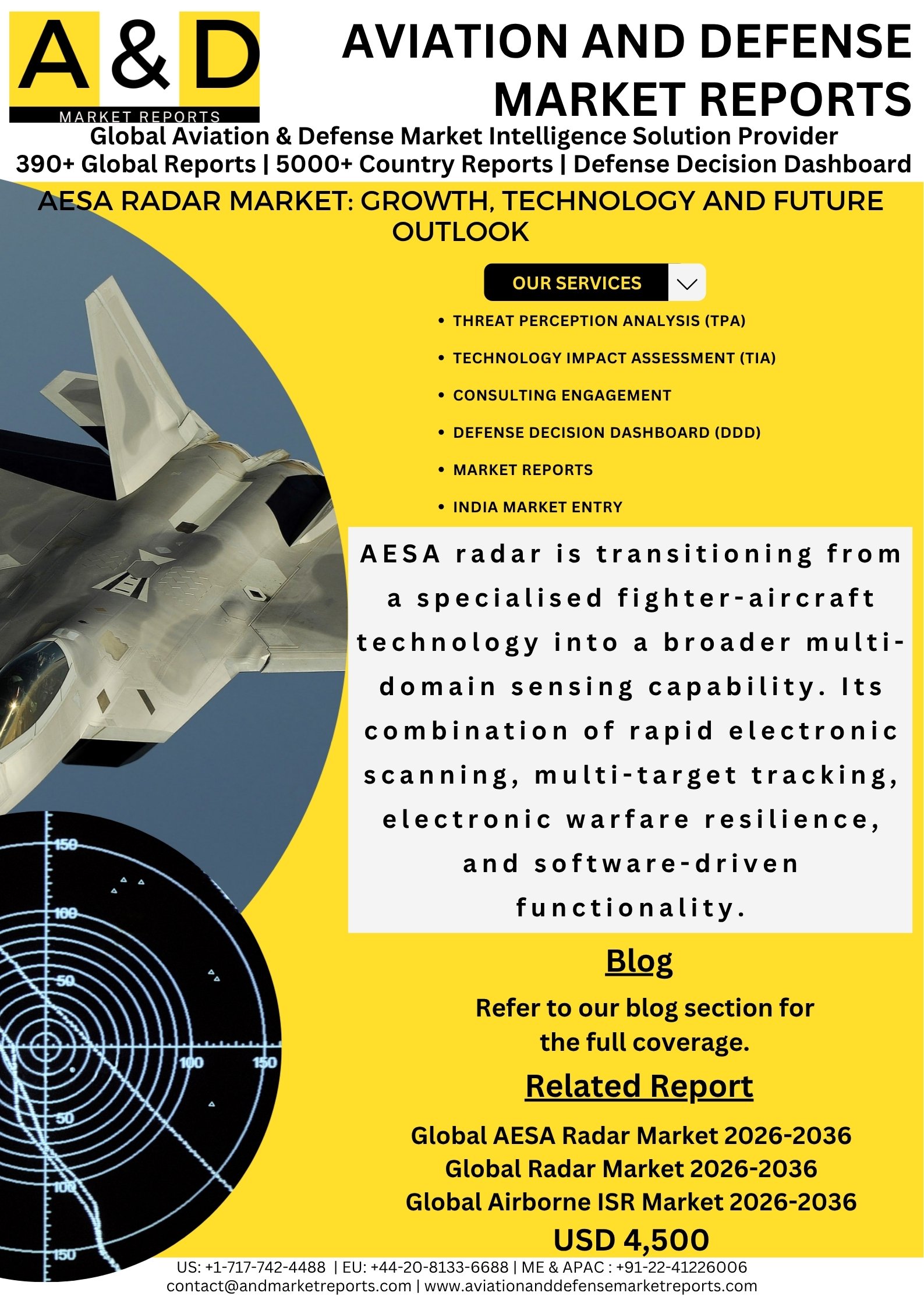
Active Electronically Scanned Array (AESA) radar is one of the most advanced radar technologies used in modern fighter aircraft, unmanned aerial vehicles (UAVs), naval platforms, air-defence systems, and other military applications. Unlike traditional mechanically scanned radar systems that rely on physically moving antennas, AESA radar uses numerous small transmit/receive (T/R) modules to electronically steer radar beams.
This architecture enables faster beam steering, improved detection, greater resistance to electronic interference, and the ability to track multiple targets simultaneously. As military forces increasingly adopt network-centric and multi-domain warfare capabilities, AESA radar has become an important technology for enhancing situational awareness and mission effectiveness.
Evolution of AESA Radar
Radar technology has evolved from mechanically scanned systems to passive electronically scanned arrays (PESA) and, eventually, AESA. Early radar systems depended heavily on mechanical antenna movement, limiting scanning speed and flexibility. PESA technology introduced electronic beam steering but generally relied on a central transmitter.
AESA technology represented a major shift by distributing transmit and receive functions across numerous independent modules. This improved reliability and enabled radar systems to perform multiple functions, including surveillance, tracking, target identification, electronic protection, and fire-control operations.
Modern AESA systems are becoming smaller, lighter, more powerful, and more digitally integrated. The adoption of gallium nitride (GaN) semiconductor technology is further improving power efficiency, thermal performance, bandwidth, and detection capabilities.
Importance of AESA Radar
AESA radar provides several advantages that are increasingly important in modern combat environments. Its electronic beam steering allows radar beams to be redirected within microseconds, enabling rapid scanning across large areas and quick transitions between search and tracking functions.
The distributed architecture also improves reliability. Since AESA radar contains many individual T/R modules, the failure of one or several modules does not necessarily result in complete system failure.
Another important advantage is electronic warfare resilience. AESA systems can rapidly change frequencies, waveforms, and beam characteristics, making them more difficult for adversaries to detect, jam, or deceive.
AESA radars can also support simultaneous functions such as air-to-air search, air-to-ground mapping, maritime surveillance, and target tracking. This multi-function capability is particularly valuable for modern platforms operating in complex electromagnetic environments.
Key Components of Modern AESA Radar
The T/R module is the fundamental component of an AESA radar. Each module can transmit and receive radar signals, allowing the system to electronically control the direction and characteristics of the radar beam.
Other major components include the antenna array, power amplifiers, digital receivers, signal processors, beamforming networks, cooling systems, power-management units, and radar control software.
Modern AESA radars increasingly use GaN-based semiconductor technology. Compared with older gallium arsenide (GaAs) technology, GaN can provide higher power density and improved efficiency, supporting greater performance within increasingly compact radar architectures.
Advanced digital signal processing and artificial intelligence-assisted algorithms are also becoming important. These technologies can help distinguish targets from clutter, improve tracking accuracy, and process large volumes of sensor data more rapidly.
Technological Advancements Driving Market Growth
Technological development is a major factor supporting the AESA radar market. GaN-based T/R modules, digital beamforming, advanced signal processing, and software-defined radar architectures are improving system performance.
GaN technology is particularly significant because it allows manufacturers to develop radar systems with higher output power while maintaining improved efficiency and thermal characteristics. This can contribute to longer detection ranges and enhanced performance against sophisticated targets.
Artificial intelligence and machine learning are also being explored for radar signal processing. AI-enabled systems can support automatic target classification, anomaly detection, clutter suppression, and improved situational awareness.
Integration with electronic warfare and other onboard sensors is another important development. Future radar systems are increasingly expected to operate as part of integrated sensor networks rather than as standalone systems.
Growing AESA Radar Production Supporting Market Expansion
Growing production of modern combat aircraft and upgrades to existing fleets are creating opportunities for AESA radar manufacturers. Several countries are developing indigenous fighter aircraft and radar technologies to reduce dependence on foreign suppliers and strengthen domestic defence-industrial capabilities.
Aircraft modernisation programmes are another important source of demand. Existing fighter fleets can receive AESA radar upgrades as part of broader avionics modernisation programmes, extending operational relevance without requiring complete replacement of the aircraft.
The production of AESA radar for naval combat systems, ground-based air defence, and surveillance platforms is also expanding the addressable market beyond fighter aircraft.
Increasing Demand for AESA Radar and Upgrades
Military forces are increasingly seeking improved detection, tracking, and electronic warfare capabilities as threats become more sophisticated. Stealth aircraft, cruise missiles, UAVs, hypersonic weapons, and electronic attack systems are encouraging defence organisations to invest in advanced sensor technologies.
AESA upgrades can provide fighter aircraft with improved target detection and tracking while supporting modern weapons and data-link systems. The technology is also increasingly relevant to multi-role aircraft that must perform air-to-air, air-to-ground, and maritime missions.
Beyond military aviation, AESA technology is being adopted in naval surveillance, missile defence, border monitoring, and other applications where rapid electronic scanning and multi-target tracking are required.
Regional Market Developments
North America remains an important centre for AESA radar development because of substantial defence investment, advanced aerospace industries, and large-scale aircraft modernisation programmes. The United States continues to integrate advanced radar technologies across fighter aircraft and other defence platforms.
Europe is also strengthening its radar capabilities through fighter modernisation programmes and collaborative aerospace initiatives. Indigenous radar development is becoming increasingly important as European countries seek greater technological and supply-chain autonomy.
Asia-Pacific is emerging as a significant growth region due to increasing defence spending, military modernisation, and the development of indigenous combat aircraft. Countries including India, Japan, South Korea, and China are investing heavily in advanced radar and electronic warfare technologies.
The Middle East is also generating demand through fighter aircraft acquisitions, air-defence programmes, and upgrades to existing military platforms.
Competitive Landscape of the Market
The AESA radar market includes major defence and aerospace companies involved in radar development, electronics, semiconductor technologies, and platform integration. Competition is focused on improving detection performance, reducing system size and weight, increasing reliability, and integrating advanced software capabilities.
Companies are also investing in GaN-based radar architectures, digital technologies, modular designs, and indigenous manufacturing capabilities. Strategic partnerships between radar manufacturers, aircraft producers, semiconductor companies, and defence organisations are becoming increasingly important.
The competitive environment is also influenced by long-term military procurement programmes, technology-transfer requirements, domestic-content policies, and the need for reliable supply chains.
Challenges Affecting Market Growth
Despite its advantages, AESA radar development involves significant technical and financial challenges. Advanced T/R modules, semiconductor components, signal processors, and thermal-management systems can increase development and production costs.
Thermal management remains particularly important because high-power radar operation generates considerable heat. Designers must balance performance, size, weight, power consumption, and cooling requirements.
Supply-chain constraints involving advanced semiconductor materials and specialised electronic components can also affect production. In addition, integrating AESA radar with legacy aircraft, weapons, electronic warfare systems, and mission computers can require extensive testing and software development.
Export restrictions and technology-transfer regulations may further influence international procurement and collaboration.
Future Outlook of AESA Radar
The future of AESA radar is closely connected to the development of network-centric and multi-domain military operations. Future systems are expected to become more digitally integrated, software-driven, multifunctional, and capable of sharing information across aircraft, ships, ground systems, satellites, and command networks.
GaN technology, artificial intelligence, digital beamforming, improved cooling solutions, and advanced signal processing are expected to support continued innovation. Radar systems may increasingly combine sensing, electronic warfare, communications, and data-processing functions within common architectures.
As countries modernise combat aircraft, air-defence networks, naval platforms, and surveillance systems, demand for AESA radar is expected to remain strong. Continued investment in indigenous radar development and next-generation sensor technologies will further support market expansion.
Overall, AESA radar is transitioning from a specialised fighter-aircraft technology into a broader multi-domain sensing capability. Its combination of rapid electronic scanning, multi-target tracking, electronic warfare resilience, and software-driven functionality positions AESA radar as a critical component of future defence and aerospace systems.