Defense air platform engines are among the most critical technologies supporting modern military aviation. They provide the propulsion required for fighter jets, transport aircraft, helicopters, unmanned aerial vehicles (UAVs), surveillance platforms, and other airborne defense systems. Engine performance directly influences an aircraft’s speed, range, payload capacity, maneuverability, endurance, and operational readiness.
Modern military aviation relies on several propulsion technologies, including turbojet, turbofan, turboshaft, turboprop, and piston engines for specialized applications. High-performance fighter aircraft primarily use advanced turbofan engines with afterburners, while military helicopters depend on turboshaft engines. Transport and maritime patrol aircraft often utilize turboprop or high-bypass turbofan engines.
As air forces increasingly prioritize long-range operations, stealth capabilities, fuel efficiency, and advanced mission systems, defense air platform engines are becoming more sophisticated and technologically advanced.
Evolution of Defense Air Platforms Engines
The evolution of military aircraft engines has closely followed developments in aerospace technology and changing operational requirements. Early military aircraft relied on piston engines, which provided limited power and operational altitude. The introduction of jet propulsion during the mid-20th century transformed military aviation by enabling significantly higher speeds and altitudes.
Turbojet engines became widely adopted during the early jet age, particularly for fighter aircraft. However, their high fuel consumption led to the development of turbofan engines, which offered improved efficiency and greater thrust. Low-bypass turbofan engines subsequently became the preferred propulsion solution for many combat aircraft.
Over time, military engine development focused on increasing thrust-to-weight ratios, improving reliability, reducing maintenance requirements, and enhancing fuel efficiency. Advanced materials, digital engine controls, and improved cooling technologies have enabled modern engines to operate at extremely high temperatures and pressures.
Today, the industry is moving toward adaptive-cycle engines, advanced variable-cycle propulsion systems, and digitally managed powerplants designed to support future-generation combat aircraft.
Importance of Defense Air Platforms Engines
The engine is often considered the heart of a military aircraft because propulsion performance determines many aspects of platform capability. A more powerful and efficient engine can increase combat radius, payload capacity, acceleration, and mission endurance.
For fighter aircraft, engine performance is essential for achieving supersonic speeds, rapid acceleration, and high maneuverability. Advanced engines also support supercruise capabilities, allowing aircraft to sustain supersonic flight without continuously using afterburners.
Military transport aircraft require highly reliable engines capable of carrying heavy payloads over long distances. Similarly, helicopter engines must provide consistent power across challenging operating environments, including high-altitude and high-temperature conditions.
Engine technology also has a direct impact on military readiness. Highly reliable engines reduce maintenance downtime and improve fleet availability. As a result, defense organizations increasingly invest in modernization programs, engine upgrades, and long-term maintenance, repair, and overhaul capabilities.
Key Components of Modern Defense Air Platforms Engines
Modern military engines consist of highly complex systems designed to operate under extreme mechanical and thermal conditions. Major components include fans, compressors, combustion chambers, turbines, exhaust systems, and digital control units.
The compressor system increases air pressure before it enters the combustion chamber. Advanced multi-stage compressors are designed to maximize airflow and improve overall engine efficiency.
The combustion chamber mixes compressed air with fuel to generate high-temperature gases. These gases expand through turbine sections, producing energy that drives the compressor and generates propulsion.
Turbine blades are among the most technologically demanding components. They operate under extremely high temperatures and require advanced materials such as nickel-based superalloys and single-crystal components.
Modern engines also incorporate Full Authority Digital Engine Control (FADEC) systems. These digital systems continuously monitor engine performance and optimize fuel flow, temperature, pressure, and thrust. FADEC technology improves operational efficiency, reliability, and pilot workload management.
Technological Advancements Driving Market Growth
Technological innovation is a major driver of the defense air platform engines market. Engine manufacturers are investing heavily in materials science, digital technologies, thermal management, and advanced manufacturing processes.
Additive manufacturing is increasingly being used to produce complex engine components with reduced weight and improved structural performance. Advanced manufacturing techniques can also reduce production timelines and material waste.
Ceramic matrix composites and advanced superalloys are enabling engines to operate at higher temperatures. Higher operating temperatures can improve thermodynamic efficiency and increase thrust output.
Adaptive-cycle engine technology represents another significant development. These engines are designed to modify airflow characteristics according to mission requirements, potentially providing a balance between high thrust and fuel efficiency.
Digital twins and predictive maintenance technologies are also becoming increasingly important. By continuously analyzing engine data, operators can identify potential maintenance issues before component failures occur.
Growing Defense Air Platforms Engines Production Supporting Market Expansion
Increasing military aircraft production is contributing significantly to demand for defense air platform engines. Fighter modernization programs, military transport aircraft procurement, helicopter acquisitions, and unmanned aircraft development are creating new production opportunities.
Many countries are also pursuing domestic aerospace manufacturing capabilities to reduce dependence on foreign suppliers. This trend is encouraging investments in indigenous engine development, component manufacturing, and maintenance infrastructure.
The expansion of fifth-generation and future sixth-generation fighter programs is expected to generate demand for advanced propulsion technologies. These aircraft require engines capable of supporting higher electrical power requirements, advanced sensors, electronic warfare systems, and directed-energy technologies.
Production growth is also supported by rising demand for military helicopters and UAVs. Turboshaft engines remain essential for rotary-wing aviation, while small turbine and hybrid propulsion systems are becoming increasingly relevant for advanced unmanned platforms.
Increasing Demand for Defense Air Platforms Engines and Upgrades
Military organizations often operate aircraft for several decades, creating a substantial market for engine maintenance and modernization. Upgrading an existing engine can improve fuel efficiency, reliability, thrust output, and operational life.
Maintenance, repair, and overhaul activities represent a significant part of the defense engine ecosystem. Engine manufacturers and defense organizations are investing in advanced MRO facilities to ensure long-term fleet availability.
Older aircraft fleets may also receive upgraded digital control systems, improved turbine components, and enhanced cooling technologies. These modernization initiatives can provide capability improvements without requiring the procurement of entirely new aircraft.
Additionally, geopolitical tensions and increasing defense budgets are encouraging countries to strengthen air force capabilities. This is contributing to procurement of new aircraft and the modernization of existing platforms, supporting sustained demand for propulsion systems.
Regional Market Developments
North America remains a major center for defense engine development due to significant military aviation programs and advanced aerospace industrial capabilities. The region continues to invest in next-generation fighter propulsion, strategic aircraft engines, and advanced rotorcraft systems.
Europe is also witnessing significant investment in military propulsion technologies. Collaborative programs involving multiple countries are supporting the development of engines for future combat aircraft and advanced aerospace platforms.
The Asia-Pacific region is expected to experience substantial growth due to increasing defense expenditure, expanding indigenous aircraft programs, and modernization of air forces. Countries including India, China, South Korea, and Japan are investing in domestic aerospace technologies and propulsion capabilities.
The Middle East is generating demand through military aircraft acquisitions and fleet modernization programs, while emerging defense industries in other regions are increasingly investing in maintenance and localized aerospace manufacturing.
Competitive Landscape of the Market
The defense air platform engines market is characterized by a relatively concentrated group of major aerospace and defense companies with significant technological expertise. Competition is primarily based on engine performance, reliability, lifecycle cost, technological innovation, and long-term support capabilities.
Major industry participants focus heavily on research and development because military engine technology involves long development cycles and substantial investment. Partnerships between governments, aircraft manufacturers, research institutions, and engine producers are common.
Companies are also expanding their aftermarket capabilities, including MRO services, digital engine monitoring, spare parts production, and lifecycle support. Long-term service agreements are becoming increasingly important as defense customers seek predictable maintenance costs and improved fleet availability.
Challenges Affecting Market Growth
Despite strong growth opportunities, the defense air platform engines industry faces several challenges. Developing advanced military engines requires significant financial investment, specialized infrastructure, and decades of technological expertise.
Supply chain constraints can also affect production schedules, particularly for high-performance materials and precision-engineered components. Dependence on specialized suppliers creates potential vulnerabilities.
Export restrictions and technology transfer limitations represent additional challenges. Advanced military engine technologies are often subject to strict government controls, making international collaboration difficult.
Furthermore, modern engine development programs face demanding technical requirements related to thermal efficiency, stealth integration, durability, and lifecycle costs. Achieving improvements across all these areas simultaneously remains a complex engineering challenge.
Future Outlook of Defense Air Platforms Engines
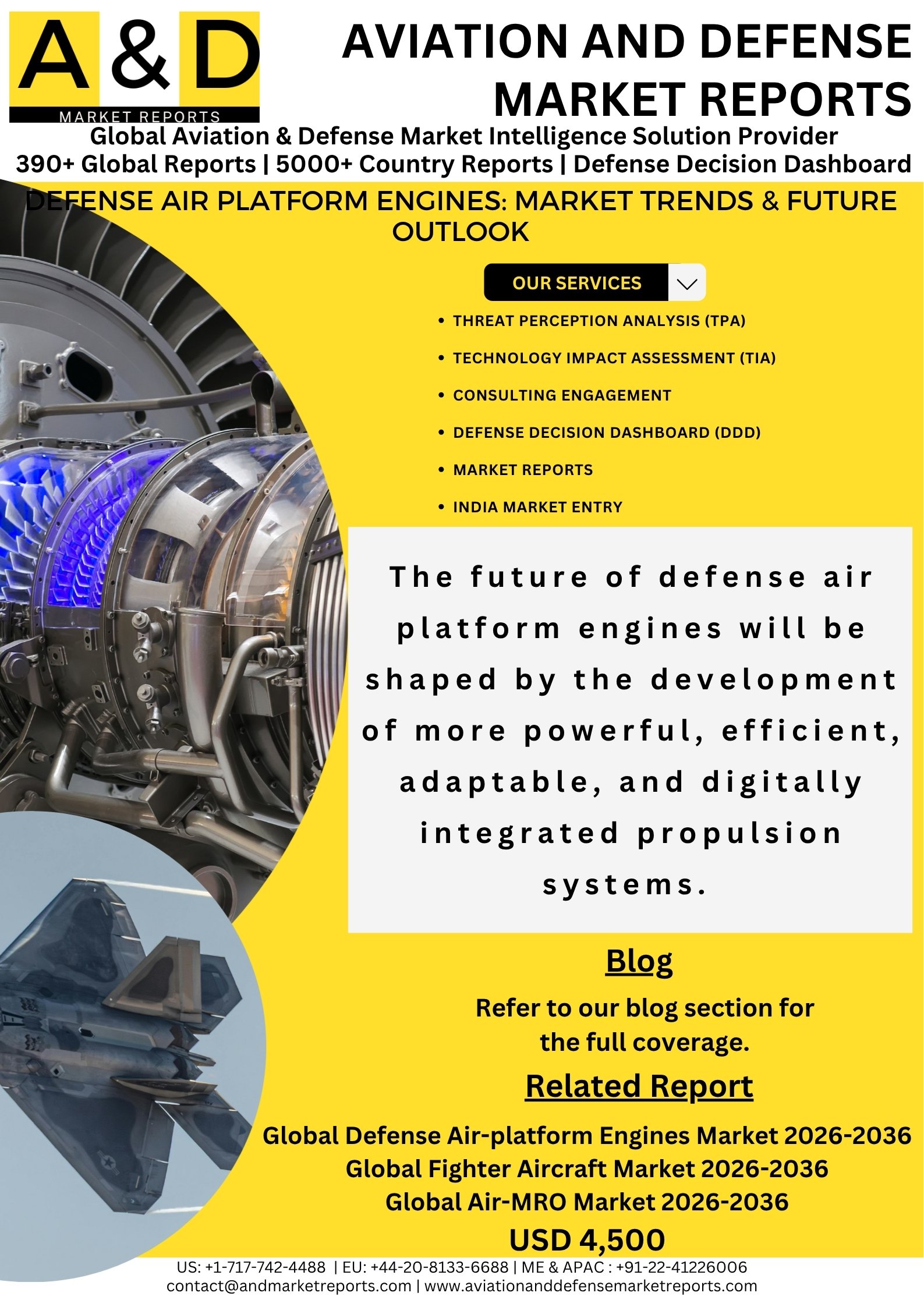
The future of defense air platform engines will be shaped by the development of more powerful, efficient, adaptable, and digitally integrated propulsion systems. Adaptive-cycle engines, advanced materials, additive manufacturing, and artificial intelligence-enabled maintenance are expected to play increasingly important roles.
Future combat aircraft will require engines capable of producing not only thrust but also significant electrical power for advanced sensors, electronic warfare systems, and other energy-intensive technologies.
Hybrid-electric propulsion may also find applications in smaller military platforms and unmanned systems. Meanwhile, sustainable aviation fuels could become increasingly relevant as defense organizations explore methods to improve energy security and reduce operational environmental impacts.
Overall, the defense air platform engines market is positioned for continued technological transformation. Rising defense modernization, increasing aircraft production, expanding MRO activities, and the emergence of next-generation combat platforms will continue to drive investment. As military aviation evolves, advanced propulsion systems will remain a fundamental enabler of air superiority, mobility, and future operational capability.