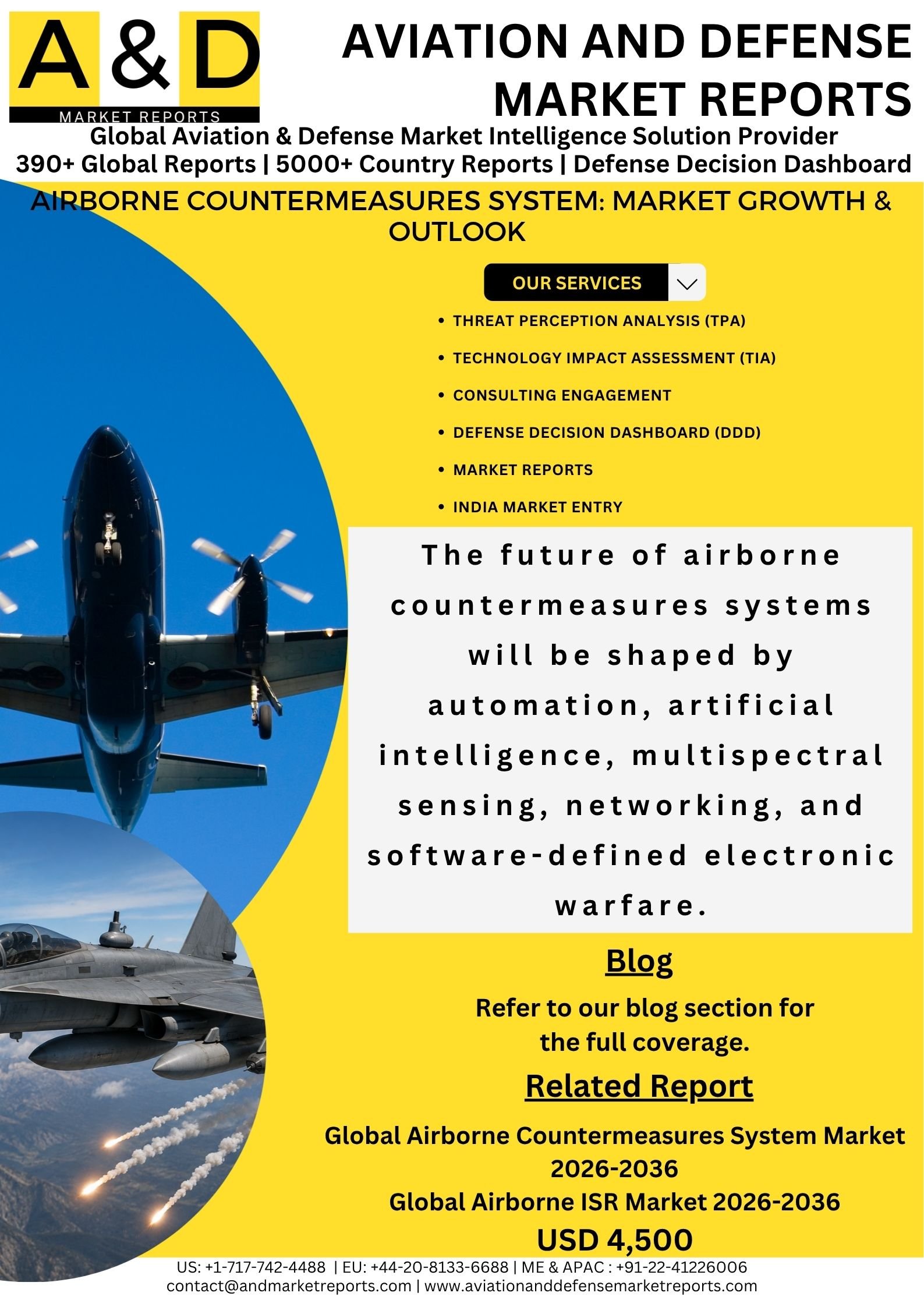
An airborne countermeasures system is a collection of defensive technologies installed on military aircraft to detect, identify, track, and counter threats such as radar-guided missiles, infrared-guided weapons, hostile radar systems, and other electronic threats. These systems are essential for improving the survivability of fighter aircraft, helicopters, transport aircraft, maritime patrol aircraft, and other airborne platforms operating in contested environments.
Modern airborne countermeasures increasingly combine electronic warfare, infrared protection, radar warning, expendable decoys, electronic jamming, and advanced threat-management capabilities. By integrating these functions into a coordinated defensive architecture, aircraft can detect threats earlier and employ appropriate countermeasures before an incoming weapon reaches the platform. The growing sophistication of air-defense systems is therefore creating sustained demand for advanced airborne countermeasures systems and upgrades.
Evolution of Airborne Countermeasures System
The evolution of airborne countermeasures has closely followed developments in air-defense technology. Early systems were relatively simple radar warning receivers and manually deployed chaff or flares. Their primary purpose was to alert aircrews to threats and provide basic protection against radar- and infrared-guided weapons.
As surface-to-air missiles and airborne radars became more capable, countermeasures evolved toward electronic jamming and automated threat detection. Digital signal processing enabled aircraft to identify increasingly complex radar emissions and respond more rapidly. Later generations introduced integrated electronic warfare suites capable of combining threat detection, identification, jamming, and deception.
Today, airborne countermeasures are increasingly software-defined and networked. Modern systems can integrate information from multiple sensors, use sophisticated databases to identify threats, and automatically recommend or initiate defensive responses. The emergence of low-observable aircraft, advanced missile seekers, multispectral sensors, and networked air-defense systems is driving another stage of evolution toward cognitive and multifunctional electronic warfare.
Importance of Airborne Countermeasures System
Airborne countermeasures systems play a critical role in aircraft survivability. Military aircraft increasingly operate within environments protected by sophisticated integrated air-defense systems, making early threat detection and rapid response essential.
A modern countermeasures system provides situational awareness by identifying radar emissions, missile launches, and other potential threats. It can also disrupt an adversary’s targeting process through electronic jamming or deception and reduce the probability of successful missile engagement through expendable or towed decoys.
For fighter aircraft, these capabilities support operations in heavily defended airspace. For helicopters and transport aircraft, countermeasures can provide protection against man-portable air-defense systems and other short-range threats. Consequently, airborne countermeasures are becoming an important component of survivability architectures across multiple military aircraft categories.
Key Components of Modern Airborne Countermeasures System
Modern airborne countermeasures systems typically combine several technologies into an integrated defensive suite. Radar warning receivers detect and classify electromagnetic emissions from hostile radar systems, providing early warning to the crew and mission systems.
Electronic support measures collect and analyze electromagnetic signals to improve threat identification and situational awareness. Electronic countermeasures, including electronic jammers, transmit carefully designed signals intended to interfere with hostile radar or missile seekers.
Infrared search and threat-detection technologies can identify heat-seeking missile launches, while infrared countermeasures provide protection against infrared-guided weapons. Chaff and flare dispensers remain important expendable countermeasures, while advanced aircraft may also employ towed radar decoys or other specialized deception technologies.
A central electronic warfare management system coordinates these components and helps determine the appropriate response. Increasingly, digital processors, mission computers, threat libraries, and data links are being integrated to create a more responsive and automated defensive architecture.
Technological Advancements Driving Market Growth
Technological innovation is one of the major factors supporting the airborne countermeasures system market. Artificial intelligence and machine learning are being introduced to improve threat recognition, signal classification, and decision-making. AI-enabled systems can process large volumes of electromagnetic data more rapidly and potentially identify unfamiliar or rapidly changing threats.
Digital radio-frequency memory and active electronically scanned technologies are also supporting more sophisticated electronic warfare capabilities. These technologies allow countermeasures systems to respond to complex radar signals with greater flexibility.
Another important trend is the development of multifunctional electronic warfare systems. Instead of operating as separate warning, jamming, and deception systems, modern architectures increasingly combine these functions through common hardware and software. Open architectures are also enabling faster upgrades and integration with new sensors, weapons, and mission systems.
Growing Airborne Countermeasures System Production Supporting Market Expansion
Increasing investment in military aviation is encouraging manufacturers to expand production of airborne countermeasures technologies. New fighter aircraft programs are incorporating electronic warfare and self-protection capabilities from the beginning of the design process, while existing fleets are being modernized with advanced defensive systems.
Production growth is also supported by the increasing use of helicopters, unmanned systems, transport aircraft, and maritime patrol platforms in contested environments. Manufacturers are developing scalable countermeasure solutions that can be integrated across different aircraft types, helping reduce development and integration costs.
The growing importance of domestic defense manufacturing is another factor influencing production. Countries are investing in indigenous electronic warfare and countermeasure technologies to reduce dependence on foreign suppliers and strengthen control over sensitive defense technologies.
Increasing Demand for Airborne Countermeasures System and Upgrades
Demand for airborne countermeasures is increasing as military forces face more advanced and diverse threats. Modern missile systems increasingly employ sophisticated seekers, electronic counter-countermeasures, multispectral guidance, and improved resistance to traditional jamming.
As a result, aircraft operators are not only purchasing new countermeasures systems but also upgrading existing equipment. Software updates, improved threat libraries, digital processors, new jammers, advanced missile-warning sensors, and enhanced infrared countermeasures can extend the operational relevance of older aircraft.
The growing use of unmanned aerial vehicles and loitering munitions is also changing the airborne threat environment. Although traditional countermeasures were largely designed around aircraft and missile threats, future systems will increasingly need to address diverse and networked threats across multiple frequency and spectral domains.
Regional Market Developments
North America remains a major market because of continued investment in advanced fighter aircraft, electronic warfare, missile warning, and aircraft survivability technologies. The United States is particularly focused on maintaining technological superiority against sophisticated peer-level air-defense systems.
Europe is also increasing investment in electronic warfare and airborne survivability. Modernization programs and multinational fighter initiatives are creating opportunities for advanced countermeasures suppliers.
The Asia-Pacific region is expected to experience strong demand as countries modernize fighter fleets, acquire advanced aircraft, and strengthen their capabilities against increasingly sophisticated air-defense threats. India, Japan, South Korea, and Australia are among the countries investing in advanced military aviation and associated electronic warfare capabilities.
The Middle East is another important market, supported by aircraft modernization programs and continued demand for technologies capable of protecting aircraft operating in complex regional security environments.
Competitive Landscape of the Market
The airborne countermeasures market is characterized by competition among major defense electronics and aerospace companies. Leading suppliers are focusing on electronic warfare suites, radar warning receivers, missile-warning systems, jammers, decoys, and integrated aircraft survivability solutions.
Companies are increasingly emphasizing modular architectures, software-defined capabilities, artificial intelligence, and rapid upgrade cycles. Partnerships between defense manufacturers, aircraft producers, government agencies, and specialized electronic warfare companies are also becoming increasingly important.
Competition is expected to shift from individual countermeasure components toward integrated survivability solutions capable of coordinating multiple sensors and effectors across an aircraft’s defensive architecture.
Challenges Affecting Market Growth
Despite strong growth opportunities, the market faces several challenges. Advanced countermeasures systems are expensive to develop, integrate, and maintain. Aircraft-specific integration can increase costs and extend development timelines.
Rapid changes in electronic warfare and missile technology also create a continuous requirement for upgrades. Countermeasure systems must remain effective against evolving seekers, radars, electronic counter-countermeasures, and increasingly autonomous threats.
Cybersecurity and software security represent additional concerns as modern systems become highly digital and networked. Protecting sensitive threat libraries, algorithms, communications, and mission data is essential.
Export restrictions and regulations governing sensitive defense technologies can also limit international market opportunities and complicate multinational procurement programs.
Future Outlook of Airborne Countermeasures System
The future of airborne countermeasures systems will be shaped by automation, artificial intelligence, multispectral sensing, networking, and software-defined electronic warfare. Future systems are expected to become more autonomous, enabling aircraft to identify and prioritize threats while reducing the workload placed on aircrews.
Cognitive electronic warfare is likely to become increasingly important, allowing systems to adapt their responses to unfamiliar or rapidly changing electromagnetic threats. Directed-energy technologies, advanced decoys, digital jamming, and integrated missile-warning systems are also expected to contribute to next-generation aircraft survivability.
Overall, the airborne countermeasures system market is positioned for continued expansion as military forces seek to protect increasingly valuable aircraft against sophisticated and rapidly evolving threats. The transition from standalone defensive equipment toward integrated, AI-enabled, multifunctional survivability architectures will remain a defining trend, creating opportunities for technology developers, aircraft manufacturers, and defense electronics suppliers worldwide.