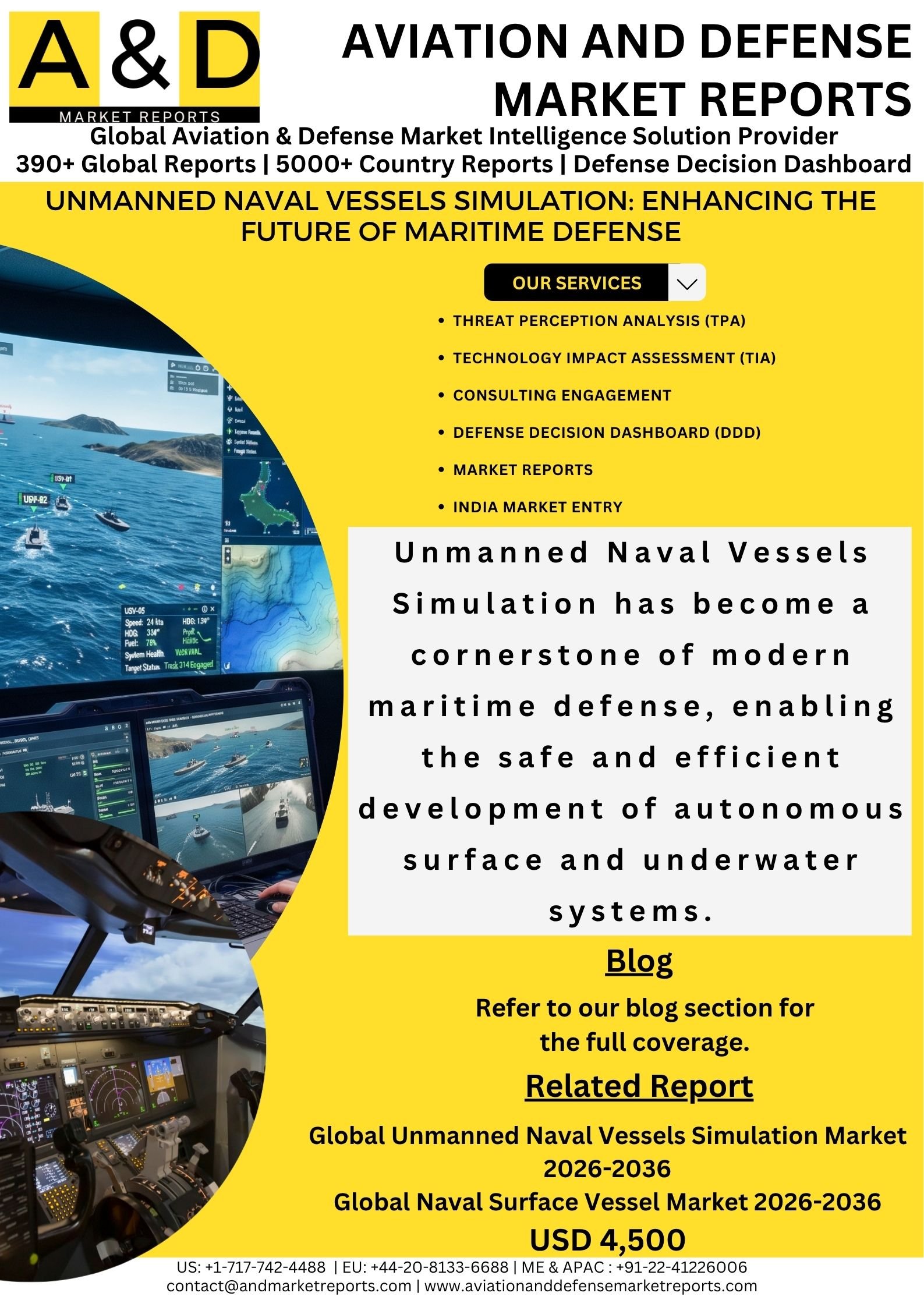
The maritime defense landscape is rapidly evolving as navies worldwide adopt autonomous and unmanned technologies to enhance operational effectiveness, reduce risks to personnel, and improve mission flexibility. Among these innovations, Unmanned Naval Vessels (UNVs)—including Unmanned Surface Vessels (USVs) and Unmanned Underwater Vehicles (UUVs)—have become indispensable for modern naval operations. These platforms are increasingly deployed for surveillance, mine countermeasures, anti-submarine warfare, intelligence gathering, logistics, and maritime security.
As these autonomous systems become more sophisticated, Unmanned Naval Vessels Simulation has emerged as a critical component of their development, testing, training, and operational planning. Simulation technologies allow engineers, operators, and military planners to evaluate vessel performance, validate autonomous behaviors, and prepare crews for complex missions without the cost and risks associated with real-world sea trials.
This article explores the significance, applications, technologies, benefits, challenges, and future trends of unmanned naval vessel simulation in modern maritime defense.
What Is Unmanned Naval Vessels Simulation?
Unmanned Naval Vessels Simulation refers to the use of advanced software, virtual environments, physics-based modeling, and digital technologies to recreate the behavior of autonomous maritime platforms under realistic operating conditions. These simulations replicate vessel dynamics, environmental conditions, sensor performance, communication systems, navigation algorithms, and mission scenarios.
Unlike traditional ship simulators that primarily focus on crew training, modern unmanned vessel simulators emphasize autonomous decision-making, multi-platform coordination, artificial intelligence validation, and mission optimization.
Simulation enables developers to assess system performance across thousands of operational scenarios before actual deployment, significantly reducing development costs and technical risks.
Types of Unmanned Naval Platforms
Simulation environments support a wide range of autonomous maritime systems, including:
Unmanned Surface Vessels (USVs)
USVs operate on the ocean surface and perform missions such as:
- Maritime surveillance
- Coastal patrol
- Harbor security
- Electronic warfare
- Intelligence, surveillance, and reconnaissance (ISR)
- Mine detection
- Logistics support
Simulation allows operators to evaluate navigation algorithms, collision avoidance systems, and autonomous mission execution in congested maritime environments.
Unmanned Underwater Vehicles (UUVs)
UUVs conduct underwater operations including:
- Mine countermeasures
- Seabed mapping
- Underwater surveillance
- Pipeline inspection
- Anti-submarine warfare
- Oceanographic research
Simulation is particularly valuable because underwater testing is expensive, technically challenging, and heavily influenced by environmental variables.
Why Simulation Matters
Developing autonomous naval systems requires extensive testing under countless operational conditions. Conducting all these tests at sea is both costly and time-consuming.
Simulation provides several important advantages:
- Safe testing of autonomous navigation
- Reduced development costs
- Faster software validation
- Risk-free mission rehearsal
- Early identification of design flaws
- Improved operator training
- Better system integration
Developers can recreate storms, heavy traffic, equipment failures, communication disruptions, and hostile engagements within virtual environments that would be difficult or dangerous to reproduce during live trials.
Key Components of Unmanned Naval Vessel Simulation
Physics-Based Vessel Modeling
Accurate simulation begins with realistic vessel dynamics.
Models replicate:
- Hull performance
- Hydrodynamic forces
- Wave interactions
- Wind effects
- Propulsion systems
- Rudder response
- Stability characteristics
These models help engineers predict vessel behavior under various sea conditions.
Environmental Simulation
Maritime environments are highly dynamic.
Simulation platforms reproduce:
- Ocean currents
- Tidal movements
- Wind conditions
- Wave heights
- Water temperature
- Underwater acoustic conditions
- Visibility
- Rain and fog
These variables significantly influence autonomous navigation and sensor performance.
Sensor Simulation
Modern unmanned vessels rely on numerous onboard sensors.
Simulation accurately models:
- Radar
- Sonar
- LiDAR
- Electro-optical cameras
- Infrared sensors
- GPS
- Inertial navigation systems
- Automatic Identification System (AIS)
Engineers evaluate sensor fusion algorithms under varying operational conditions.
Artificial Intelligence Simulation
AI serves as the decision-making engine for autonomous vessels.
Simulation enables developers to validate:
- Route planning
- Obstacle avoidance
- Threat recognition
- Autonomous docking
- Target tracking
- Mission prioritization
- Cooperative swarm behavior
Thousands of AI decisions can be evaluated without deploying actual vessels.
Applications in Maritime Defense
Operator Training
Simulation provides highly realistic training for naval personnel responsible for supervising autonomous missions.
Operators practice:
- Mission planning
- Fleet coordination
- Emergency response
- Communication management
- Autonomous system monitoring
Virtual training reduces costs while increasing readiness.
Mission Rehearsal
Before actual deployment, commanders can simulate entire missions.
Mission rehearsal includes:
- Coastal surveillance
- Mine hunting
- Convoy protection
- Harbor defense
- Intelligence collection
- Amphibious support
This improves operational planning and reduces uncertainty.
Software Testing
Every software update introduces potential risks.
Simulation allows engineers to verify:
- Navigation software
- Sensor integration
- Autonomy algorithms
- Communication protocols
- Cybersecurity features
Testing occurs before software reaches operational fleets.
Fleet Coordination
Future naval operations will involve large numbers of autonomous vessels working together.
Simulation evaluates:
- Swarm intelligence
- Distributed sensing
- Cooperative navigation
- Autonomous task allocation
- Multi-vessel communication
These capabilities are essential for next-generation maritime warfare.
Digital Twin Technology
One of the most significant advancements is the adoption of Digital Twins.
A digital twin is a virtual representation of a physical unmanned vessel that continuously updates using operational data.
Benefits include:
- Predictive maintenance
- Performance monitoring
- Fuel optimization
- Mission planning
- Component life prediction
- Operational analysis
Digital twins enable continuous improvement throughout a vessel’s operational lifecycle.
Artificial Intelligence and Machine Learning
AI has transformed unmanned vessel simulation.
Machine learning algorithms analyze massive datasets generated during simulation exercises.
Applications include:
- Autonomous navigation improvements
- Collision prediction
- Threat classification
- Route optimization
- Fault detection
- Mission success analysis
As AI models mature, autonomous vessels become increasingly capable of operating independently in complex maritime environments.
Cybersecurity Simulation
Autonomous naval platforms rely heavily on digital communications and networked systems, making cybersecurity a critical consideration.
Simulation environments help engineers evaluate:
- GPS spoofing attacks
- Communication jamming
- Malware scenarios
- Data interception
- Autonomous system resilience
- Network intrusion attempts
Testing cyber resilience in virtual environments strengthens the security of operational fleets before deployment.
Challenges in Unmanned Naval Vessel Simulation
Despite significant advances, simulation developers face several challenges.
Environmental Complexity
The maritime environment is highly unpredictable. Accurately modeling wave dynamics, underwater acoustics, weather changes, and vessel interactions requires substantial computational power and high-fidelity physics models.
Autonomous Decision Validation
AI systems must be tested across millions of scenarios to ensure safe and reliable behavior. Validating autonomous decision-making remains one of the most demanding aspects of simulation.
Sensor Accuracy
Creating realistic sensor models that account for environmental interference, noise, and equipment limitations is essential for reliable simulation outcomes.
Cybersecurity Threats
As unmanned platforms become increasingly connected, simulations must evolve to replicate sophisticated cyberattacks and electronic warfare scenarios.
Regulatory Compliance
The lack of globally standardized regulations for autonomous maritime systems presents challenges for developers seeking interoperability and certification across different naval forces.
Future Trends
Several technological advancements will shape the future of unmanned naval vessel simulation.
Artificial intelligence will enable more adaptive and intelligent autonomous behaviors, while cloud-based simulation environments will support collaborative development across geographically dispersed teams. Digital twins will become standard throughout vessel lifecycles, enabling real-time performance optimization and predictive maintenance.
Advances in high-performance computing will allow more realistic modeling of complex ocean environments, and immersive technologies such as virtual reality (VR) and augmented reality (AR) will enhance operator training and mission rehearsal. Swarm simulations involving dozens or even hundreds of autonomous vessels will become increasingly important as navies adopt distributed maritime operations.
Conclusion
Unmanned Naval Vessels Simulation has become a cornerstone of modern maritime defense, enabling the safe and efficient development of autonomous surface and underwater systems. By combining physics-based modeling, artificial intelligence, digital twins, cybersecurity testing, and realistic environmental simulation, these platforms allow engineers and naval operators to validate complex missions before real-world deployment.
As autonomous technologies continue to reshape naval operations, simulation will play an even greater role in reducing development costs, accelerating innovation, improving mission readiness, and enhancing fleet survivability. With growing investments in unmanned maritime systems worldwide, high-fidelity simulation will remain essential for ensuring that future naval vessels are capable of operating safely, intelligently, and effectively across increasingly complex maritime environments.