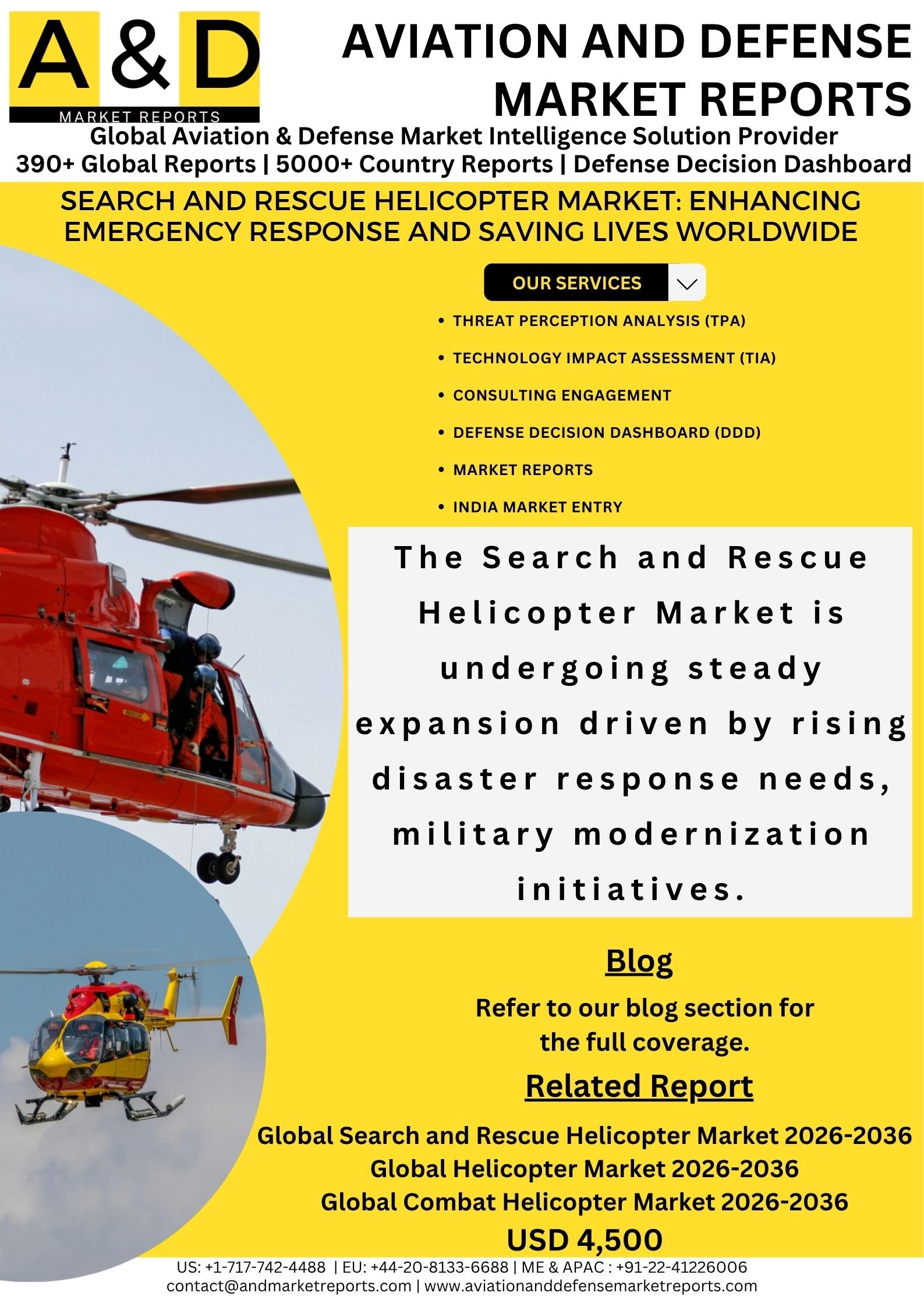
Search and rescue (SAR) helicopters play a vital role in emergency response operations across military, civilian, maritime, and disaster management sectors. These specialized aircraft are designed to locate, assist, and evacuate individuals in distress, often operating in extreme weather conditions, rugged terrains, and remote locations where conventional transportation methods are ineffective. As governments and emergency agencies continue to prioritize public safety and disaster preparedness, the global Search and Rescue Helicopter Market is witnessing significant growth.
Introduction
Search and rescue helicopters serve as critical assets during natural disasters, maritime emergencies, mountain rescue missions, medical evacuations, and military personnel recovery operations. Equipped with advanced navigation systems, thermal imaging cameras, rescue hoists, communication equipment, and medical support facilities, these helicopters significantly improve response times and increase survival rates during emergencies.
The growing frequency of natural disasters, increasing maritime activities, rising defense modernization initiatives, and expanding emergency medical services are driving investments in advanced SAR helicopter fleets worldwide. Manufacturers are also integrating cutting-edge technologies such as artificial intelligence, enhanced sensors, and digital mission management systems to improve operational effectiveness.
Key Search and Rescue Helicopter Market Drivers
Rising Natural Disasters and Climate-Related Emergencies
The increasing occurrence of hurricanes, floods, wildfires, earthquakes, and severe storms has highlighted the importance of rapid-response rescue capabilities. Governments and disaster management agencies are investing heavily in SAR helicopters to improve their ability to respond to emergencies and conduct evacuation operations.
Climate change has intensified the frequency and severity of extreme weather events, creating greater demand for aerial rescue platforms capable of operating in challenging environments. SAR helicopters provide a reliable means of reaching isolated communities and transporting victims to safety when ground infrastructure becomes inaccessible.
Growth in Maritime Search and Rescue Operations
Global maritime trade, offshore energy activities, fishing operations, and recreational boating continue to expand, increasing the need for effective maritime search and rescue capabilities. Coastal nations are modernizing their rescue fleets to improve coverage across vast ocean territories and exclusive economic zones.
Modern SAR helicopters equipped with long-range sensors, night-vision systems, and all-weather capabilities enable rescue teams to locate distressed vessels and survivors more efficiently. Maritime authorities increasingly rely on helicopters for rapid deployment of rescue personnel and emergency medical support.
Military Modernization Programs
Defense organizations worldwide are investing in advanced combat search and rescue (CSAR) helicopters to recover personnel from hostile environments. These specialized aircraft are equipped with defensive systems, secure communications, advanced navigation technologies, and enhanced survivability features.
Military SAR helicopters support a wide range of missions, including personnel recovery, humanitarian assistance, disaster relief, and special operations support. Growing geopolitical tensions and evolving battlefield requirements are encouraging armed forces to upgrade existing fleets and procure next-generation rescue helicopters.
Expanding Emergency Medical Services
Helicopter Emergency Medical Services (HEMS) have become increasingly important in healthcare systems worldwide. SAR helicopters often serve dual roles in rescue and medical evacuation missions, providing rapid transport for critically injured patients from accident sites, rural areas, and disaster zones.
The demand for faster medical response times, especially in remote and underserved regions, is driving investments in multi-role helicopters capable of supporting both rescue and emergency healthcare operations.
Technological Advancements Transforming the Search and Rescue Helicopter Market
Advanced Sensor Systems
Modern SAR helicopters utilize sophisticated sensor suites that include thermal imaging cameras, infrared sensors, radar systems, and electro-optical surveillance equipment. These technologies improve target detection capabilities during night operations, adverse weather conditions, and low-visibility environments.
Thermal imaging systems are particularly valuable for locating missing persons, shipwreck survivors, and disaster victims, significantly increasing mission success rates.
Artificial Intelligence and Mission Management
Artificial intelligence is becoming an important component of SAR operations. AI-powered systems can analyze sensor data, identify potential targets, optimize search patterns, and reduce operator workload.
Digital mission management platforms provide real-time situational awareness by integrating data from multiple sources, enabling rescue crews to make faster and more informed decisions during critical missions.
Enhanced Communication and Connectivity
Modern SAR helicopters feature advanced communication systems that support seamless coordination between rescue teams, emergency agencies, military units, and medical personnel. Satellite communication technologies enable reliable connectivity even in remote areas where conventional communication infrastructure is unavailable.
These capabilities improve mission efficiency and facilitate coordinated responses during large-scale emergencies.
Improved Aircraft Performance
Manufacturers are continuously enhancing helicopter performance through more powerful engines, increased fuel efficiency, advanced rotor technologies, and lightweight composite materials. These improvements extend operational range, increase payload capacity, and enhance reliability in demanding environments.
The ability to operate in high-altitude regions, offshore environments, and extreme weather conditions remains a key focus area for SAR helicopter development.
Regional Market Outlook
North America
North America represents one of the largest markets for search and rescue helicopters. The region benefits from substantial investments in emergency response infrastructure, military modernization programs, and coast guard operations. The United States continues to upgrade its rescue helicopter fleets to support homeland security, disaster response, and military personnel recovery missions.
Europe
European countries are actively investing in SAR capabilities to address maritime safety requirements, mountain rescue operations, and disaster response needs. Collaborative defense programs and growing emphasis on public safety are supporting market growth across the region.
Asia-Pacific
The Asia-Pacific region is expected to experience the fastest market growth during the forecast period. Rapid economic development, increasing defense expenditures, expanding coast guard operations, and rising vulnerability to natural disasters are driving demand for advanced SAR helicopters.
Countries such as India, Japan, Australia, South Korea, and China are enhancing their search and rescue infrastructure to improve emergency preparedness and disaster management capabilities.
Middle East and Africa
Growing investments in defense modernization, offshore energy operations, and emergency response systems are creating opportunities for SAR helicopter manufacturers in the Middle East and Africa. The need for rapid medical evacuation and border security support further contributes to market expansion.
Challenges Facing the Search and Rescue Helicopter Market
Despite strong growth prospects, the SAR helicopter market faces several challenges. High acquisition and maintenance costs can limit procurement, particularly for developing countries with constrained defense and public safety budgets.
Training requirements for pilots, rescue personnel, and maintenance crews also represent a significant operational expense. Additionally, regulatory compliance, certification processes, and evolving safety standards can extend development timelines and increase program costs.
Another challenge involves the integration of emerging technologies while maintaining operational reliability in harsh environments. Manufacturers must balance innovation with stringent safety and performance requirements.
Future Outlook of Search and Rescue Helicopter Market
The future of the Search and Rescue Helicopter Market appears highly promising as governments and emergency response organizations continue to prioritize life-saving capabilities. Advances in automation, artificial intelligence, sensor technologies, and connectivity are expected to enhance mission effectiveness and reduce response times.
The growing adoption of multi-role helicopters capable of performing search and rescue, medical evacuation, disaster relief, and security missions will further drive market demand. Additionally, the integration of unmanned aerial systems alongside manned helicopters may create new opportunities for coordinated rescue operations.
As natural disasters become more frequent and global safety requirements continue to evolve, search and rescue helicopters will remain indispensable tools for protecting lives and supporting humanitarian efforts worldwide.
Conclusion
The Search and Rescue Helicopter Market is undergoing steady expansion driven by rising disaster response needs, military modernization initiatives, maritime safety requirements, and advancements in emergency medical services. Technological innovations are transforming rescue operations by improving detection capabilities, situational awareness, and operational efficiency.
With increasing investments in public safety and emergency preparedness across both developed and emerging economies, SAR helicopters will continue to serve as critical assets in life-saving missions. The market’s long-term growth trajectory reflects the enduring importance of rapid aerial rescue capabilities in an increasingly complex and unpredictable global environment.