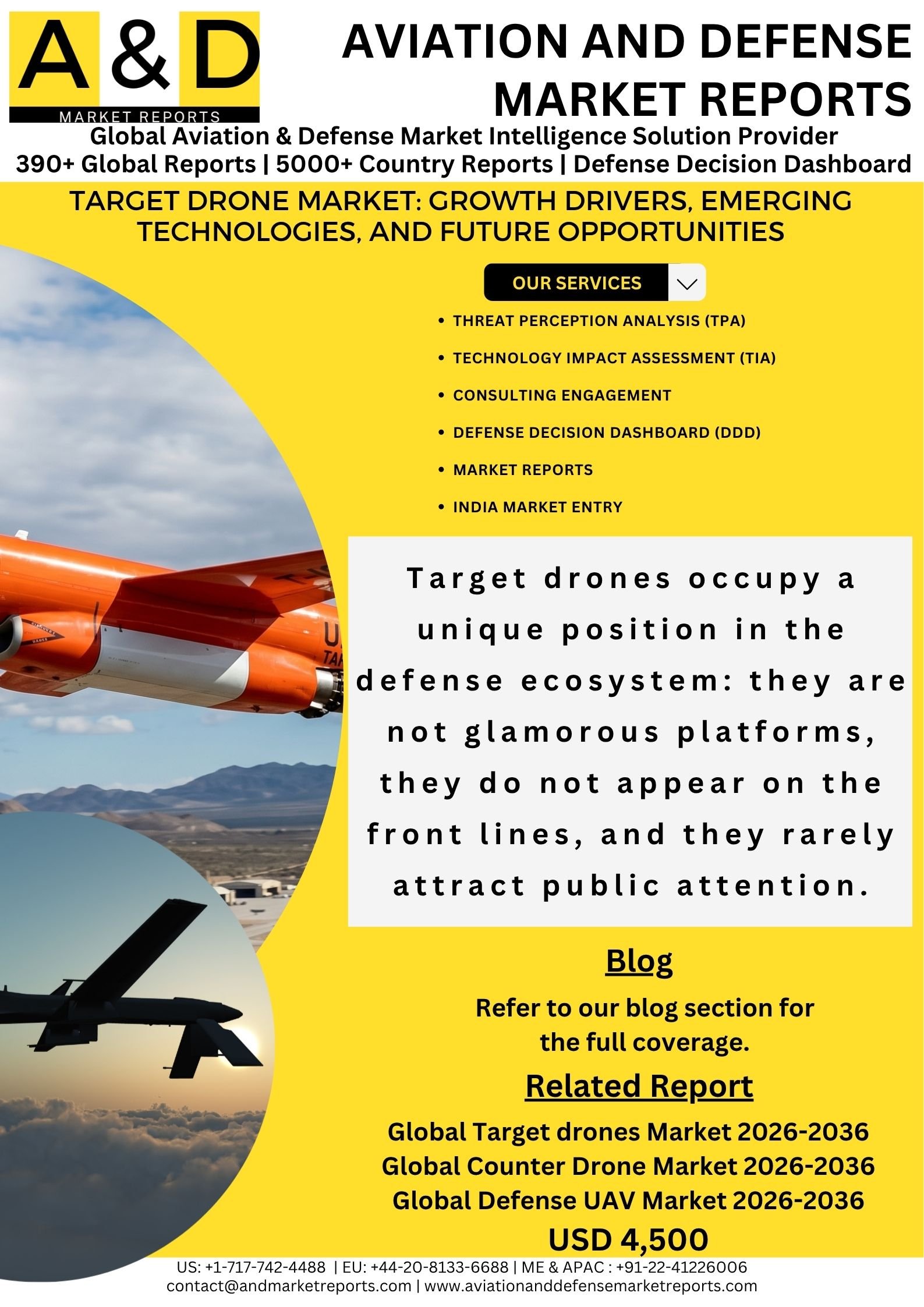
Before a missile system can be trusted to defend a carrier strike group, before an air defense battery is declared combat-ready, and before a fighter crew can claim proficiency against modern threats, something must fly into the danger zone on purpose. That something is a target drone — an expendable or reusable unmanned aerial vehicle engineered to replicate the signature, speed, and maneuverability of real-world threats so that weapon systems and their operators can be tested, evaluated, and trained against conditions as close to combat as peacetime allows. As military forces worldwide accelerate their modernization programs and the threat environment grows increasingly sophisticated, the Target Drone Market has emerged as one of the defense sector’s most strategically consequential and commercially dynamic segments.
Understanding Target Drones and Their Role in Defense Preparedness
Target drones — formally known as Aerial Target Systems — are purpose-built unmanned platforms designed to serve as surrogates for threat aircraft, missiles, and other airborne dangers. Unlike ISR or strike UAVs, their mission is not to gather intelligence or deliver ordnance; it is to be shot at, tracked, jammed, or evaded, providing a controlled, measurable, and repeatable training or test event.
The value of realistic aerial targets is difficult to overstate. Air defense systems represent some of the most expensive and complex investments a military can make. Deploying a Patriot battery, an F/A-18 Super Hornet, or a naval CIWS (Close-In Weapon System) against a live threat in peacetime is obviously impossible. Target drones fill that gap, enabling live-fire exercises, system validation, operator certification, and tactics development without geopolitical risk or civilian endangerment. They are, in every meaningful sense, the proving grounds of modern air power.
Key Market Drivers Accelerating Target Drone Demand
Rising Global Defense Budgets
Global defense expenditure has climbed to historic levels in the mid-2020s, with NATO members, Indo-Pacific allies, and Gulf states all channeling increased resources into air and missile defense modernization. A larger defense budget invariably means more procurement of weapon systems — and every new weapon system requires test and evaluation before operational acceptance. This creates a durable, procurement-linked demand signal for target drones that closely tracks broader defense spending trends.
Expanding Missile and Air Defense Test Programs
The proliferation of advanced surface-to-air missile (SAM) systems, hypersonic weapons, and directed energy technologies has driven a corresponding surge in test and evaluation activity. Nations developing fifth- and sixth-generation air defense capabilities — including the United States with LTAMDS, Israel with David’s Sling, and India with Akash-NG — require credible aerial targets that can accurately replicate the radar cross-sections, speeds, and flight profiles of the threats those systems are designed to defeat. Standard subsonic target drones are increasingly insufficient for this purpose, driving demand for supersonic and high-maneuverability variants.
The Imperative of Realistic Combat Training
Modern air combat is defined by compressed decision cycles, dense electronic environments, and threats that may arrive from multiple vectors simultaneously. Training against towed banners or simple drone targets does not prepare crews for this reality. Military training drones capable of executing realistic threat maneuvers, emitting representative radar and infrared signatures, and flying in coordinated groups provide a qualitatively superior training experience — and are increasingly considered essential rather than optional by air force and navy planners worldwide.
Expansion of Unmanned Systems Technologies
Advances in UAV propulsion, materials science, autonomous navigation, and miniaturized electronics have dramatically expanded what is technically achievable in a target drone. Capabilities that once required large, expensive, purpose-built platforms can now be packaged into far more affordable systems, broadening the customer base and enabling higher sortie rates. The same technology ecosystem driving the commercial drone revolution is accelerating capability development across the Defense UAV Market.
Major Technology Trends Reshaping the Target Drone Market
AI-Enabled Autonomous Target Drones
Artificial intelligence is transforming aerial target systems from pre-programmed flight-path followers into genuinely adaptive adversaries. AI-enabled target drones can execute evasive maneuvers in response to incoming intercepts, alter their electromagnetic signatures dynamically, and coordinate with other platforms to replicate multi-axis attacks — behaviors that reflect real-world threat doctrines rather than scripted test profiles. This authenticity significantly increases the value and fidelity of live-fire training events.
High-Speed and Supersonic Target Drones
The emergence of hypersonic threats and advanced cruise missiles has created urgent demand for target drones capable of replicating their performance envelopes. Supersonic aerial targets — such as the Kratos UTAP-22 and the QF-16 Full Scale Aerial Target — allow air defense systems and interceptor aircraft to train and test against the speed regimes that matter most in contemporary conflict. Development of Mach 2+ and eventually hypersonic target systems represents one of the market’s most technically challenging and commercially significant frontiers.
Swarm Drone Technologies
Perhaps no development is more disruptive to conventional air defense doctrine than the emergence of drone swarms — large numbers of coordinated, low-cost UAVs operating collectively to saturate defenses. Replicating this threat in a training environment requires target drone systems capable of coordinated autonomous flight at scale. Swarm target technologies are being developed by multiple defense contractors to give air defense crews and commanders realistic exposure to this increasingly prevalent operational challenge.
Reusable Target Drone Systems
The economics of target drone operations have historically favored expendable designs — drones built to be destroyed. But as the sophistication and cost of modern target drones increase, and as sortie rates climb with expanding training demands, the case for reusable platforms has grown considerably stronger. Systems designed to survive near-miss engagements through hardened airframes and recovery parachutes — and to be rapidly refurbished between missions — offer substantial lifecycle cost advantages over single-use equivalents.
Advanced Telemetry and Tracking Systems
The value of a target drone engagement is only as good as the data it generates. Advanced telemetry packages — incorporating GPS tracking, miss-distance indicators (MDIs), radar cross-section measurement systems, and real-time encrypted data links — enable precise evaluation of weapon system performance and operator proficiency. Integration of these data streams with range management and training analysis software is becoming a standard requirement in new target drone procurements.
Application Segments Driving Market Revenue
Military training represents the broadest and most consistent demand segment, encompassing fixed-wing and rotary-wing crew training, ground-based air defense operator certification, and joint force exercises. The requirement is global, recurring, and largely independent of any single procurement cycle.
Missile testing and evaluation commands some of the highest per-unit values in the market, given the technical sophistication required of targets used in developmental and operational testing of new interceptor systems. Each new missile program generates years of test activity with precise aerial target requirements.
Air defense exercises — including NATO integrated air defense drills, Indo-Pacific multilateral exercises, and bilateral training events — generate recurring demand for target drones capable of simulating a wide variety of threat types within carefully managed range environments.
Naval target operations present unique technical demands: target drones must be launched and recovered from ships or shore facilities, must operate in maritime electromagnetic environments, and must replicate the sea-skimming profiles of anti-ship missiles against which naval crews must train. This is a growing segment as navies worldwide modernize their close-in defense capabilities.
Electronic warfare training requires target drones capable of emitting or responding to radar and communications signals, enabling EW operators to practice jamming, spoofing, and signal intelligence collection against realistic airborne emitters.
Regional Market Analysis
North America
The United States remains the world’s dominant market for aerial target systems, anchored by the large-scale QF-16 and QF-4 full-scale target programs operated by the Air Force, extensive Navy test range requirements at Point Mugu and Eglin, and a robust industrial base led by Kratos Defense & Security Solutions, Boeing, and Northrop Grumman. US Army air and missile defense modernization — including integration of hypersonic interceptors — is expected to sustain high target drone demand through the 2030s.
Europe
European demand is growing significantly in the wake of NATO’s eastern flank rearmament, with Germany, Poland, Sweden, and the United Kingdom all investing in air defense upgrades requiring expanded test and training support. The UK’s Banshee target drone family, produced by Meggitt Defence Systems (now part of TransDigm), has long been a NATO mainstay. European defence cooperation frameworks are also enabling joint target drone programs that spread development costs across multiple user nations.
Asia-Pacific
Asia-Pacific is the fastest-growing regional market, driven by the intense pace of air and missile defense modernization in India, South Korea, Japan, and Australia. India’s development of the Lakshya target drone through HAL and its expanding Integrated Test Range on Wheeler Island reflect a deliberate strategy of indigenous capability development. Japan’s acceleration of counterstrike capabilities and Australia’s AUKUS commitments both carry significant test and evaluation implications for the target drone market.
Middle East
Gulf Cooperation Council states — particularly Saudi Arabia, the UAE, and Israel — represent a high-value regional segment, combining significant defense budgets with persistent operational threat environments that drive urgent emphasis on realistic training. Israel’s Rafael and Elbit Systems are active exporters of sophisticated target drone solutions with battle-proven operational pedigrees.
Key Industry Players
The target drone market is served by a range of specialized and large prime contractors. Kratos Defense & Security Solutions has established itself as the leading US pure-play provider with its BQM-167 Subscale Aerial Target and UTAP-22 Mako. Boeing operates the QF-16 program and maintains significant target systems integration capability. Northrop Grumman and Raytheon (RTX) supply target systems integrated with their broader air defense portfolios. Internationally, Airbus Defence and Space, Leonardo, Saab, and Elbit Systems are significant competitors. India’s Hindustan Aeronautics Limited (HAL) is advancing the Lakshya series as part of the country’s atmanirbhar (self-reliant) defense manufacturing push.
Challenges Facing the Target Drone Industry
Development costs for high-performance target drones — particularly supersonic and autonomous variants — are substantial, and the relatively small production volumes common in this market make unit economics challenging. Regulatory and range safety requirements add complexity to operations, particularly for supersonic flights and swarm exercises over test ranges with shared airspace. Operational complexity — coordinating target drone missions with live-fire assets, range safety officers, and tracking infrastructure — demands significant investment in ground support systems and trained personnel. Finally, the tension between making target drones realistic enough to provide meaningful training value and protecting sensitive threat-replication technologies from inadvertent disclosure or loss is a persistent challenge for procurement and program management teams.
Future Outlook: Opportunities Through 2035
The Target Drone Market is positioned for sustained growth through 2035, driven by the convergence of expanding air defense procurement, accelerating threat complexity, and the declining cost of capable UAV platforms. Market analysts broadly anticipate compound annual growth rates in the high single to low double digits across the forecast period, with the greatest dynamism in AI-enabled, supersonic, and swarm target categories.
The advent of directed energy weapons — high-energy lasers and high-power microwave systems — will create new target drone requirements tuned to evaluate these emerging interceptor technologies. Hypersonic target development, while technically formidable and expensive, will become a strategic priority as hypersonic offensive systems proliferate. And the integration of target drones into synthetic and live-virtual-constructive (LVC) training environments — where real aircraft and drones interact with simulated threat networks — will expand the contexts in which aerial targets deliver value.
Conclusion: A Market at the Intersection of Readiness and Innovation
Target drones occupy a unique position in the defense ecosystem: they are not glamorous platforms, they do not appear on the front lines, and they rarely attract public attention. Yet without them, the weapon systems and crews that defend national interests cannot be adequately tested, evaluated, or trained. As the threat environment grows more complex and military forces invest ever-larger sums in advanced air and missile defense capabilities, the Target Drone Market will continue to grow in strategic importance and commercial scale. For defense industry professionals, investors, and procurement planners, this is a market whose trajectory is as clear as it is consequential — upward, technology-driven, and essential to the readiness of every modern fighting force.