Introduction: When Silence Is Defeat
In naval warfare, the side that communicates faster and more securely often holds the decisive advantage. Long before missiles lock onto targets or torpedoes are launched, information flows between warships, submarines, aircraft, and command centres — shaping every tactical decision. A fleet that cannot coordinate is not a fleet; it is a collection of isolated platforms.
Defense naval radios are the invisible infrastructure of maritime power. From coordinating multi-carrier strike groups in the Pacific to relaying encrypted submarine orders beneath the Arctic, these systems form the nervous system of modern naval operations. Their reliability, security, and resilience can determine the outcome of engagements before a single shot is fired. In 2026, the arrival of advanced electronic warfare (EW) environments has made radio resiliency a critical element of multi-domain survivability.
What Are Defense Naval Radios?
Definition and Purpose
Defense naval radios are specialized military-grade communication systems designed to transmit and receive voice, data, and telemetry in maritime environments. Unlike civilian maritime radios governed purely by commercial standards, naval radios are engineered to operate under extreme conditions — electronic warfare jamming, physical shock, saltwater corrosion — while maintaining unbreakable secure links.
Types of Naval Communication Systems
Naval communication encompasses a layered ecosystem: ship-to-ship tactical radios for fleet coordination, shore-to-ship systems for command authority links, submarine very low frequency (VLF) and extremely low frequency (ELF) receivers for underwater communication, satellite communication terminals (SATCOM) for global reach, and aircraft datalinks for carrier air wing integration.
Military vs. Civilian Naval Radios
Civilian vessels use standard VHF marine band radios — open, unencrypted, and easily monitored. Military naval radios operate across a far broader spectrum with built-in frequency hopping, hardware encryption, anti-jam protocols, and survivability features that make interception or disruption exponentially harder. The performance gap is not incremental; it is categorical.
How Naval Radios Work
HF, VHF, and UHF Bands
High Frequency (HF, 3–30 MHz) enables long-range over-the-horizon communication by bouncing signals off the ionosphere — essential for fleet-wide coordination across ocean basins. VHF (30–300 MHz) provides reliable line-of-sight communication between ships and aircraft within a task group. UHF (300 MHz–3 GHz) supports high-capacity data links, satellite uplinks, and precision coordination with airborne assets. Modern ships carry all three, often managed through a single integrated communication suite.
Satellite Communication Integration
SATCOM has transformed naval operations by extending reliable communication to any ocean on Earth. Military satellites in geostationary and low-Earth orbit relay encrypted data at high bandwidth — enabling video feeds, mission data updates, and command authority links even in remote maritime theaters. Systems like the US Navy’s Extremely High Frequency (EHF) MILSTAR terminals and advanced commercial Low Earth Orbit (LEO) networks like Star shield offer jam-resistant global coverage that no adversary can easily interrupt.
Encryption and Anti-Jamming Technologies
Modern naval radios employ frequency hopping spread spectrum (FHSS) — changing frequencies thousands of times per second — making signal interception practically impossible. Direct sequence spread spectrum (DSSS) buries signals within noise floors, rendering them invisible to passive surveillance. Hardware-level encryption using NSA-approved Type 1 cryptographic modules ensures that even if a signal is captured, it reveals nothing without the correct keying material.
Key Features of Modern Defense Naval Radios
Network-Centric Warfare Capability
Contemporary naval radios are not standalone devices — they are nodes in a networked battle force. The transition to network-centric warfare (NCW) means every ship, aircraft, and submarine shares a common operational picture in near-real time. Tactical data links aggregate sensor data from across the fleet, enabling commanders to see the entire battlespace rather than just their immediate horizon.
Real-Time Situational Awareness
Integrated communication suites feed radar tracks, sonar contacts, and intelligence reports into a shared tactical picture. A destroyer’s fire control system can receive targeting data from a maritime patrol aircraft hundreds of miles away and prosecute a threat it has never itself detected — a capability made possible entirely by robust naval communications.
Interoperability with Allied Forces
Modern NATO and partner-nation exercises demand that warships from different nations communicate seamlessly. Systems are designed with standardized waveforms and encryption gateways so a US Navy destroyer can share tactical data with a Royal Navy frigate or an Australian submarine without communication latency that could cost lives.
AI-Assisted Signal Management and SDRs
Software-Defined Radios (SDRs) represent a paradigm shift: rather than dedicated hardware for each frequency band, a single programmable radio platform can be reconfigured via software to operate across multiple waveforms, encryption standards, and communication protocols. AI-assisted signal management algorithms now analyze the electromagnetic environment in real time, autonomously selecting optimal frequencies and power levels to minimize interception risk and maximize range.
Major Naval Radios Systems Worldwide
USA · NATO
Link 16 / JTIDS
The backbone of NATO tactical data exchange. Provides jam-resistant, encrypted voice and data between ships, aircraft, and ground forces at high update rates.
USA · Global
AN/USC-61 SDR Suite
The US Navy’s Digital Modular Radio (DMR) software-defined radio platform enables flexible waveform management across HF, VHF, UHF, and SATCOM bands from a single integrated system.
India
SITCOMS / BEL ICS
India’s Bharat Electronics Limited has developed integrated communication suites for INS warships, including HF/UHF radios with indigenous encryption — part of the Atmanirbhar Bharat defense initiative.
Russia
Akatsiya-M Suite
Russia’s shipboard integrated communication complex combining HF, VHF, and satellite links with hardened anti-jam features tailored for Arctic and contested-sea operations.
China
BeiDou-Integrated Comms
The PLAN integrates naval radios with BeiDou satellite navigation and communication, developing indigenous encrypted datalinks to reduce reliance on Western-controlled satellite infrastructure.
NATO
SATURN Waveform
Second-generation Anti-jam Tactical UHF Radio for NATO — a standardized waveform providing anti-jam voice and data across allied naval forces with significantly improved resistance to electronic warfare.
Challenges in (Naval Radios) Naval Communications
- Electronic Warfare Threats: Adversaries deploy sophisticated jamming systems capable of saturating frequency bands critical to fleet coordination. The South China Sea has already seen electronic warfare incidents that disrupted commercial and maritime navigation signals — a preview of contested-environment naval communications.
- Cybersecurity Risks: As naval radios become increasingly software-defined and network-connected, they become potential cyberattack vectors. A compromised software update or a spoofed signal could corrupt an entire fleet’s tactical picture without firing a shot.
- Underwater Communication Limits: Submarines remain the most challenging communication problem in naval warfare. Seawater attenuates most radio frequencies almost immediately. Only VLF signals at extremely low data rates can penetrate to operational depths — meaning submarines often surface or deploy buoys to receive high-bandwidth updates, creating tactical exposure. To mitigate this, navies are aggressively investing in blue-green laser communications for satellite-to-submarine data transmission.
- Multi-Domain Electromagnetic Congestion: In a major naval engagement, dozens of ships, hundreds of aircraft, and thousands of weapons systems simultaneously demand electromagnetic spectrum access. Managing this congestion without creating self-interference is an increasingly critical and unsolved operational challenge.
Future of Naval Radios Technology
⚛️
Quantum Communication
Quantum key distribution (QKD) promises theoretically unbreakable encrypted channels. Several navies are funding research into shipboard quantum communication terminals that would make signal interception not merely difficult but physically impossible under known physics.
🤖
AI-Driven Signal Management
Machine learning algorithms will autonomously manage electromagnetic spectrum allocation across entire task forces — predicting jamming attempts, rerouting communications in milliseconds, and optimizing bandwidth distribution without human intervention.
🚢
Autonomous Naval Platforms
Unmanned surface vessels (USVs) and autonomous underwater vehicles (AUVs) demand low-latency, resilient communication architectures. Future naval networks will manage human-machine teaming across manned and unmanned platforms simultaneously within a single tactical network.
🌐
Multi-Domain Battle Networks
The future battlefield integrates naval, air, space, cyber, and land domains into unified communication architectures. A warship will share a seamless tactical picture with satellites, cyber operations centers, and ground forces — collapsing the traditional boundaries between domains of warfare, aligning directly with frameworks like the US military’s Joint All-Domain Command and Control (JADC2).
The Radio That Wins the War
Naval warfare has always been decided at the intersection of firepower and information. In the age of network-centric operations, the communication system is no longer support infrastructure — it is the weapon system. A fleet that can see more, share faster, and communicate securely commands a decisive tactical advantage that no amount of additional hull tonnage can replicate.
As adversaries develop increasingly sophisticated electronic warfare and cyber capabilities, the premium on resilient, jam-proof, and cyber-hardened naval communication systems will only grow. Nations are responding: the United States is investing heavily in software-defined radio modernization and quantum-resistant encryption; India is accelerating indigenous naval communication development under its defense self-reliance programs; China is integrating BeiDou-based communication to reduce dependency on potentially hostile satellite infrastructure.
The race for naval supremacy in the twenty-first century will be won not only on the strength of missiles and hulls, but on the invisible electromagnetic battlefield — where the silent signals that carry orders, intelligence, and targeting data are as decisive as any weapon in any arsenal.
Conclusion
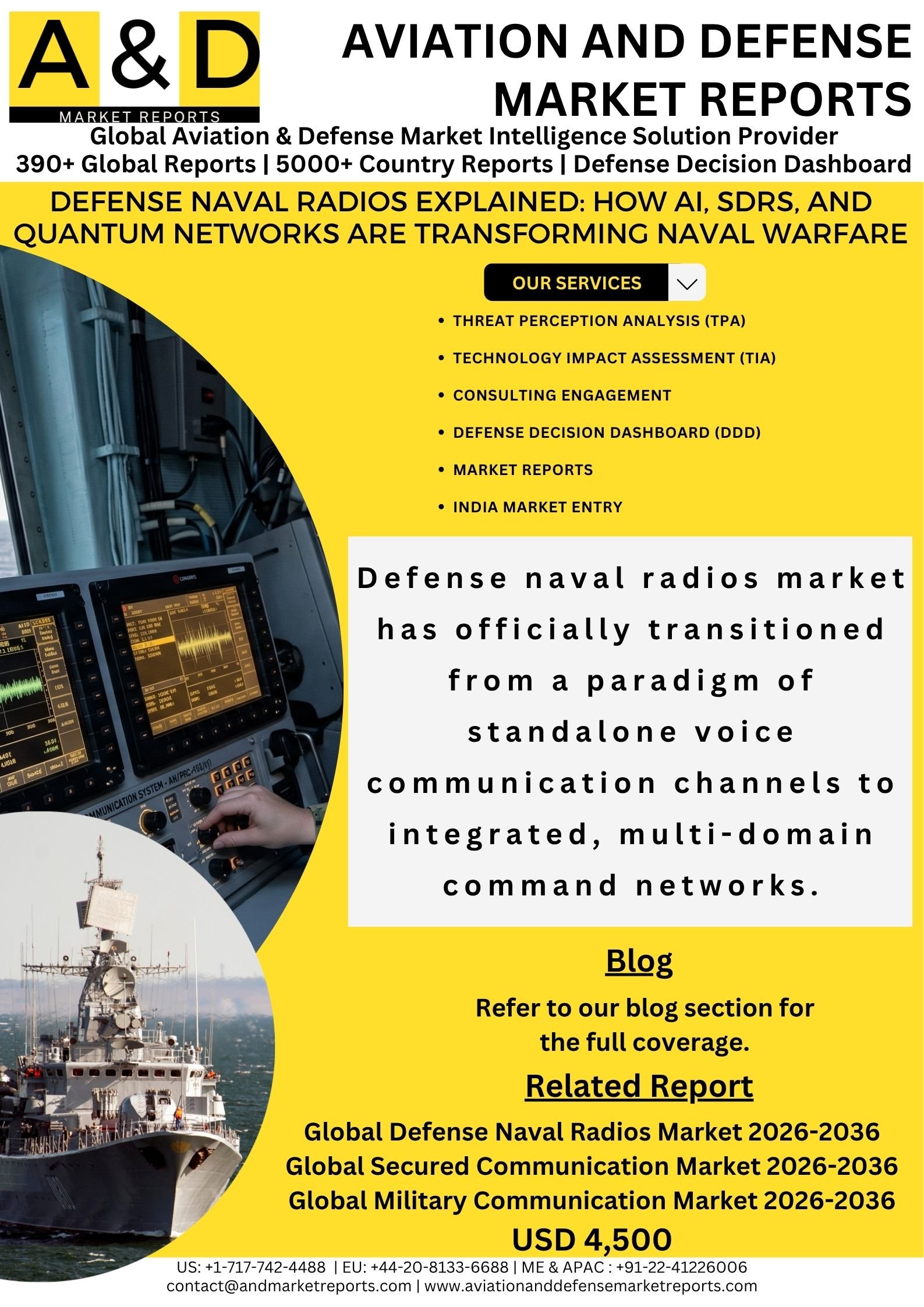
In conclusion, the 2026 defense naval radios market has officially transitioned from a paradigm of standalone voice communication channels to integrated, multi-domain command networks. Driven heavily by intense electromagnetic warfare lessons and satellite-denial threats in major maritime theaters, the baseline procurement standard has fundamentally shifted toward cognitive Software-Defined Radios (SDRs) and zero-trust tactical data links. The successful deployment of wide-bandwidth commercial LEO nodes alongside indigenous programs demonstrates that communication networks are now weapon systems in their own right. Moving forward, naval superiority will belong to fleets that can seamlessly integrate human-crewed assets with autonomous surface and underwater swarms, using self-healing waveforms that resist near-peer electronic spoofing and quantum decryption threats.