When a precision-guided munition locks onto a target through dense electronic jamming, or a tactical UAV holds formation in a GPS-denied urban canyon, the unsung hero is almost always a high-performance gyroscope. These devices—measuring angular velocity with extraordinary precision—form the indispensable core of inertial navigation systems (INS) that keep platforms oriented when satellite signals are spoofed or go completely dark.
For defense contractors, aerospace engineers, and procurement officers, understanding the defense gyroscope market isn’t optional. It’s strategic. The global defense supply chain depends on these components, and the technology is evolving faster than procurement cycles can track.
This analysis breaks down the core technologies, the forces driving demand, and the regional dynamics reshaping opportunities for suppliers—especially Tier 2/Tier 3 MSMEs positioned to capture emerging demand in a multipolar defense landscape.
Core Technologies: RLG, FOG, MEMS and HRG
Four gyroscope architectures dominate the defense sector. Each occupies a distinct niche defined by Size, Weight, Power, and Cost (SWaP-C) constraints versus required performance.
Ring Laser Gyros (RLG)
- The incumbent technology for strategic-grade applications
- Found in intercontinental ballistic missiles, nuclear submarines, and long-range aircraft
- Exceptional accuracy and stability over extended missions
- High cost and size limit deployment to premium platforms
Fiber Optic Gyros (FOG)
- Gaining ground in tactical and navigation-grade applications
- No moving parts, translating to superior reliability and lower maintenance
- Increasingly favored for shipboard navigation, precision-guided munitions, and FOG and MEMS technology hybrid systems
- Cost-performance balance makes FOG attractive for mid-tier platforms
Micro-Electro-Mechanical Systems (MEMS)
- The disruptor reshaping the market’s economics
- Dramatically smaller, lighter, and cheaper than legacy alternatives
- Performance historically limited to consumer and industrial applications—but tactical-grade MEMS are now viable
- Ideal for mass-produced systems: guided artillery shells, loitering munitions, and swarm-capable drones
Hemispherical Resonator Gyroscopes (HRG)
- HRGs (often called ‘wine-glass’ gyroscopes) are emerging as the ultimate ‘holy grail’ for space and strategic defense systems.
- Operating on the principle of solid-state resonance, HRGs offer near-infinite operational lifespans and complete immunity to radiation and shock.
- They are rapidly becoming the preferred choice for next-generation military satellites and hypersonic glide vehicles.
Key Market Drivers
1. The Tactical UAV and Autonomous Combat Vehicle Surge
The proliferation of tactical UAVs has transformed gyroscope demand from a niche procurement line into a volume market.
- Drone swarms require each unit to carry its own inertial measurement unit (IMU)
- Autonomous ground vehicles and unmanned surface vessels multiply installed base exponentially
- GPS denial is now a baseline assumption in contested environments, making onboard inertial navigation non-negotiable
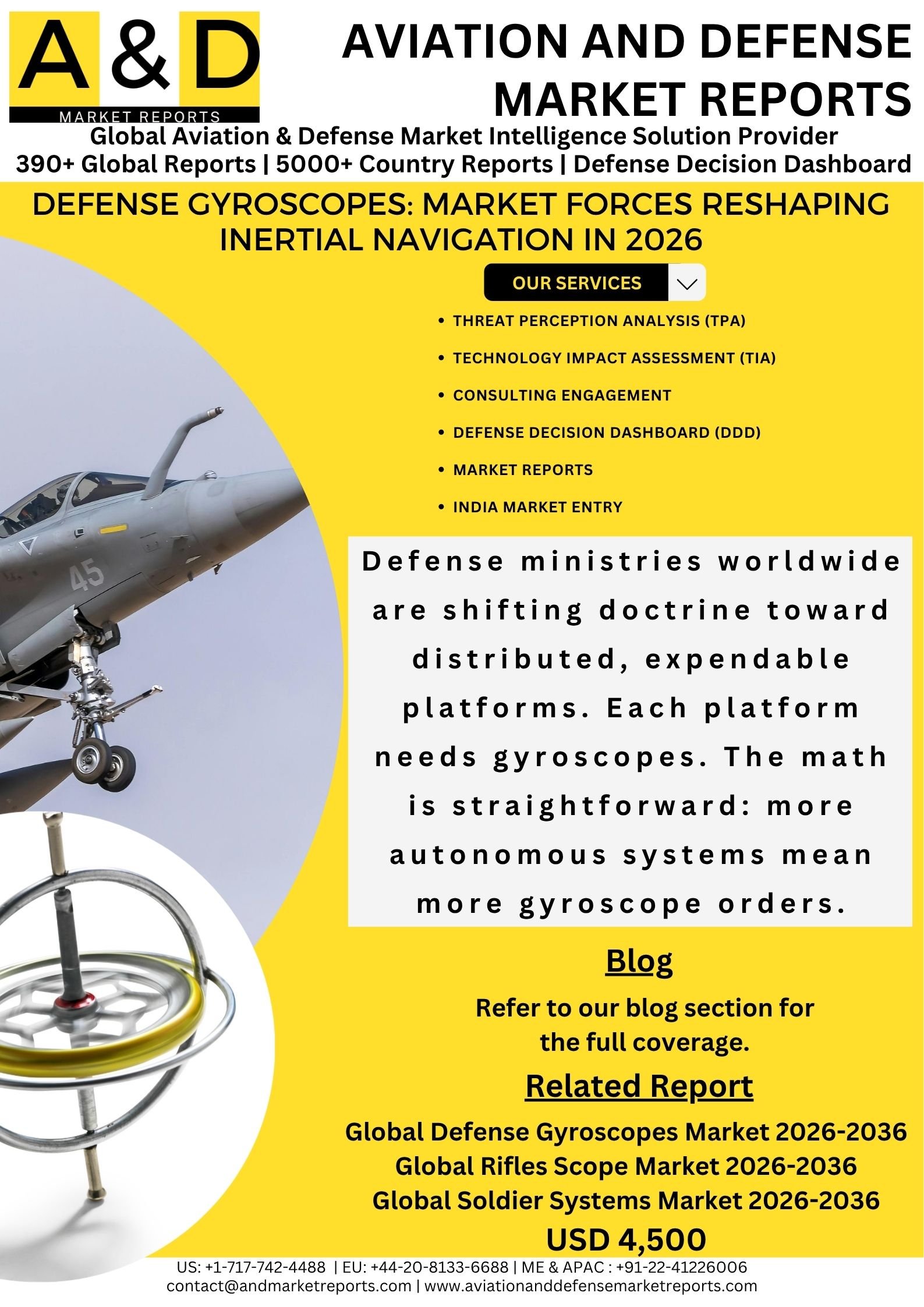
Defense ministries worldwide are shifting doctrine toward distributed, expendable platforms. Each platform needs gyroscopes. The math is straightforward: more autonomous systems mean more gyroscope orders.
2. Naval Modernization and Missile Defense Systems
Major navies are recapitalizing their fleets with advanced destroyers, frigates, and submarines. Every vessel requires multiple inertial navigation systems—for the ship itself, for embarked aircraft, and for missile payloads.
Simultaneously, missile defense architectures are expanding:
- Hypersonic glide vehicle interceptors demand extreme-precision guidance
- Theatre missile defense batteries require rapid slew and stabilization
- Shipboard close-in weapon systems rely on gyro-stabilized tracking
Naval and missile defense programs create long-tail procurement opportunities. These platforms remain in service for decades, generating sustained demand for replacement units, upgrades, and spares.
3. SWaP-C Optimization in Aerospace Manufacturing
Size, Weight, Power, and Cost (SWaP-C) optimization has become the central design philosophy in military hardware development.
- Every kilogram saved on a fighter jet extends range or payload capacity
- Every watt conserved on a satellite extends mission life
- Every dollar saved on guidance units enables larger production runs
This pressure directly benefits MEMS and advanced FOG suppliers. Legacy RLG systems—heavy, power-hungry, and expensive—face substitution pressure wherever performance requirements permit.
For aerospace manufacturing supply chains, the implication is clear: component miniaturization and cost reduction are now competitive imperatives, not incremental improvements.
Regional Dynamics and Emerging Markets
North American Dominance—For Now
The United States remains the world’s largest defense gyroscope market by a wide margin:
- Massive installed base across all service branches
- Continuous modernization programs (B-21, NGAD, Columbia-class submarines)
- Deep integration between prime contractors and specialized gyroscope suppliers
However, dominance doesn’t mean growth. The North American market is mature. The highest growth rates lie elsewhere.
Asia-Pacific: The Growth Engine
The Asia-Pacific region is emerging as the primary growth vector for defense gyroscopes:
- India is aggressively pursuing indigenization under “Make in India” defense initiatives, creating openings for domestic MSMEs and joint venture partners
- South Korea and Japan are expanding domestic defense industrial bases amid regional security concerns
- Australia’s AUKUS commitments are driving submarine and long-range strike investments
- Southeast Asian nations are modernizing air forces and coastal defense systems
For Tier 2 and Tier 3 suppliers, these markets offer a strategic advantage: less entrenched competition and government mandates favoring local content. MSMEs with technical capabilities in MEMS fabrication, FOG integration, or precision testing can establish footholds now that will compound over the next decade.
Indigenization as Market Access
Indigenization isn’t just policy rhetoric—it’s restructuring the defense supply chain.
- Technology transfer requirements are becoming standard in major contracts
- Offset obligations push primes to qualify local suppliers
- Domestic content thresholds create protected market segments
For defense MSMEs, this shift represents both opportunity and urgency. The window to establish local partnerships and manufacturing presence is open now. It won’t remain open indefinitely.
Market Trajectory and Strategic Implications
The global defense gyroscope market is entering a structural growth phase driven by three converging forces:
- Volume expansion from UAV and autonomous system proliferation
- Technology transition from RLG toward FOG and MEMS across application tiers
- Geographic diversification as Asia-Pacific and emerging markets scale indigenous defense production
For defense contractors, procurement officers, and aerospace manufacturing suppliers, the strategic imperative is straightforward: visibility into these shifts is a competitive advantage.
Understanding which programs are entering production, which technologies are displacing incumbents, and which regional markets are opening to new entrants separates proactive suppliers from reactive ones.
Navigate the Market with Precision Intelligence
The defense gyroscope market rewards suppliers who anticipate demand—not those who chase it.
Accurate, timely market intelligence is the difference between capturing emerging opportunities and watching competitors claim them first.
Explore our comprehensive Aerospace & Defense Market Reports ecosystem for deep-dive analytics on inertial navigation systems, defense supply chain dynamics, and regional procurement trends. Equip your business development and strategic planning teams with the data they need to act decisively.
In conclusion, the defense gyroscope market is fundamentally defined by the absolute operational necessity of GPS-denied navigation. As electronic warfare (EW) jamming becomes ubiquitous in modern conflicts, reliance on highly accurate, autonomous Inertial Navigation Systems (INS) is surging. The market is shifting decisively away from large, expensive Ring Laser Gyros (RLGs) toward Fiber Optic Gyros (FOGs) for medium-tier platforms, and rapidly advancing MEMS technology for the massive, high-volume tactical drone and loitering munitions sector. Furthermore, the emergence of Hemispherical Resonator Gyroscopes (HRGs) is solving the extreme survival requirements of the ongoing hypersonic weapons race. Moving forward, market dominance will belong to manufacturers who can master SWaP-C (Size, Weight, Power, and Cost) reductions while navigating the increasingly localized, ‘friend-shored’ defense supply chains of the Indo-Pacific and European theatres.