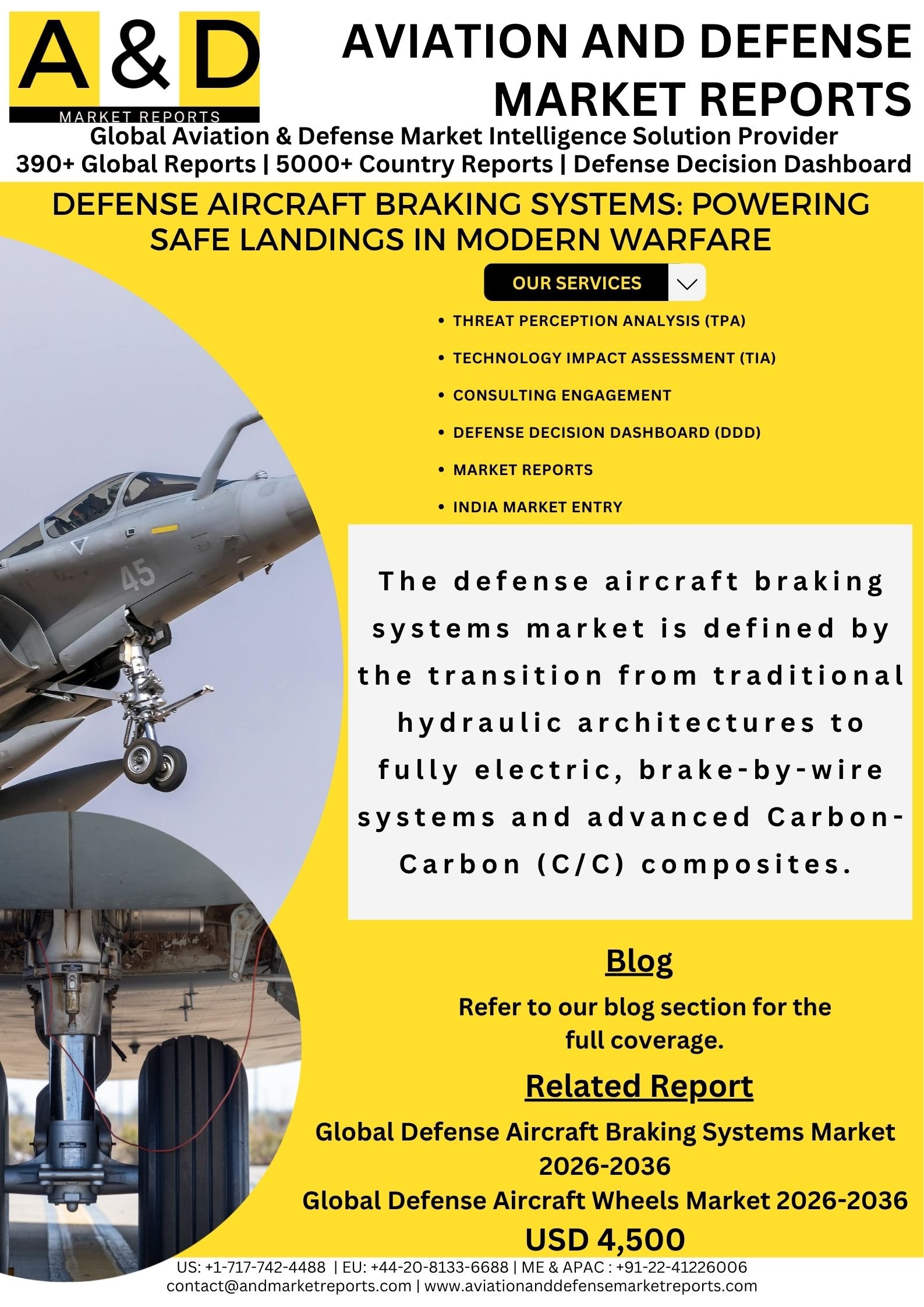
Defense aircraft braking systems market represents a critical segment within the broader aerospace and defense industry, focusing on technologies that ensure safe deceleration, landing control, and ground maneuverability of military aircraft. Braking systems in defense aviation are engineered to perform under extreme conditions, including high-speed landings, heavy payloads, and operations on varied terrains. These systems are integral to the operational safety and performance of fighter jets, transport aircraft, helicopters, and unmanned aerial vehicles used by armed forces worldwide.Defense forces worldwide depend on advanced braking technologies to ensure safe landings, rapid turnaround times, and operational effectiveness. As military aviation programs progress and fleets undergo modernization, the requirement for high-performance, reliable, and durable braking systems strengthens their position in global defense procurement strategies.
Rising Demand in the Defense Aircraft Braking Systems Market:
The defense aircraft braking systems market experiences strong expansion fueled by sustained military modernization programs and rising procurement of advanced fighter jets and transport aircraft. Nations invest in upgraded braking technology to enhance fleet performance and extend operational lifecycles of existing platforms. The aerospace and defense wheel and brake sector reaches. This upward trajectory stems from global defense budgets that prioritize lightweight high performance components for improved range and payload capacity. Manufacturers deliver solutions that meet stringent military specifications for reliability under combat conditions.
Operational Advantages and Battlefield Role:
Defense aircraft braking systems provide unmatched operational versatility by enabling safe landings on carrier decks, unprepared runways, and forward operating bases where conventional infrastructure remains limited. These components absorb tremendous kinetic energy during high-speed landings and support rapid deceleration in contested environments.
Their robust construction allows military aircraft to execute frequent sorties with minimal ground time, while specialized designs facilitate operations in diverse climates from arctic ice to desert sand. Braking systems equipped for high thermal capacity and damage resistance prove indispensable for troop transport, close air support, and surveillance missions, where aircraft must maintain operational readiness and responsiveness across dynamic battlefields with repeated landing cycles.
Technological Advancements in Aircraft Braking Systems:
Modern defense aircraft braking systems integrate cutting-edge materials such as carbon-carbon composites and ceramic matrix materials that reduce overall weight while increasing heat absorption capacity and wear resistance. Advanced manufacturing techniques, including precision machining and additive processes for component repairs, enhance durability and lower maintenance requirements.
Sensor-embedded designs now monitor real-time temperature, pressure, and wear rates, feeding data into aircraft health management systems for predictive maintenance. These innovations transform braking systems from passive mechanical components into intelligent systems that boost aircraft safety, extend operational intervals, and align with the demands of high-tempo military aviation operations requiring consistent performance under extreme conditions.
Global Demand and Drivers:
Rising global defense expenditures and comprehensive military modernization initiatives drive strong demand for advanced aircraft braking systems. Nations expand their fleets of next-generation fighters, strategic transports, and unmanned aerial vehicles, each requiring specialized braking systems optimized for performance and reliability under varying operational conditions.
The emphasis on expeditionary operations and rapid global response further accelerates procurement, as forces prioritize equipment that supports deployment from austere environments with limited infrastructure. Aftermarket requirements for fleet sustainment and overhaul programs also contribute significantly to market expansion, ensuring sustained growth through ongoing maintenance, component replacement, and upgrade cycles that keep existing fleets operationally ready.
Upgrade programs retrofit existing fleets with lighter carbon brakes and electric actuation to extend service life and improve performance. Rising geopolitical tensions accelerate procurement timelines and increase orders for complete braking assemblies. Aftermarket demand grows steadily as operators replace worn components to maintain airworthiness certifications. Suppliers develop modular designs that facilitate quick installation during depot level maintenance.
Competitive Landscape and Key Players:
The Global Defense Aircraft Braking Systems Market features established leaders alongside specialized suppliers that compete through continuous innovation and strategic alliances. Collins Aerospace, Safran dominate with comprehensive portfolios of braking systems and integrated landing gear solutions for fighters, transports, and naval aircraft.
Manufacturers differentiate their offerings through superior stopping performance, extended service life, precision engineering, and seamless compatibility with modern aircraft platforms. Research and development investments, combined with partnerships across defense agencies and participation in major exhibitions, secure market leadership positions and drive continuous product evolution.
Challenges and Constraints:
Budget limitations in certain defense sectors constrain large-scale procurement and upgrade programs for aircraft braking systems. Rising costs of advanced raw materials like carbon composites and complex manufacturing processes create pressure on supply chains and overall program economics. Export regulations and stringent certification requirements further influence global trade dynamics and limit rapid market access for new entrants seeking to establish positions. The demand for highly trained technicians to handle installation, inspection, and repair of sophisticated braking assemblies adds operational complexity for many military organizations maintaining diverse fleets. Despite these factors, the market maintains steady momentum through focused innovation and sustained investment in critical defense capabilities.
Integration with Modern Warfare:
Defense aircraft braking systems now integrate fully into network-centric warfare architectures through embedded sensors and data links that provide continuous status updates to command systems. This connectivity enables real-time health monitoring and coordinated maintenance planning across joint operations. Braking systems support seamless interoperability with unmanned systems and advanced surveillance platforms, allowing aircraft to operate effectively within integrated battle networks. Enhanced designs facilitate rapid reconfiguration for different mission profiles, ensuring that braking performance contributes directly to overall force effectiveness and tactical flexibility in multi-domain environments where rapid turnaround and operational readiness determine mission success.
Future of the Global Defense Aircraft Braking Systems Market
Ongoing advancements in materials science and digital integration position the Global Defense Aircraft Braking Systems Market for continued expansion. The introduction of smarter, lighter braking assemblies equipped with artificial intelligence-driven diagnostics will elevate reliability and reduce lifecycle costs.
As defense strategies prioritize speed, mobility, and resilience, the requirement for versatile braking systems that support next-generation aircraft platforms will intensify. Sustained investment in research and development, combined with global military modernization efforts, ensures that these components remain central to future aviation capabilities and operational success. The market stands ready for robust growth fueled by innovation, modernization initiatives, and unwavering demand for superior aerospace components.