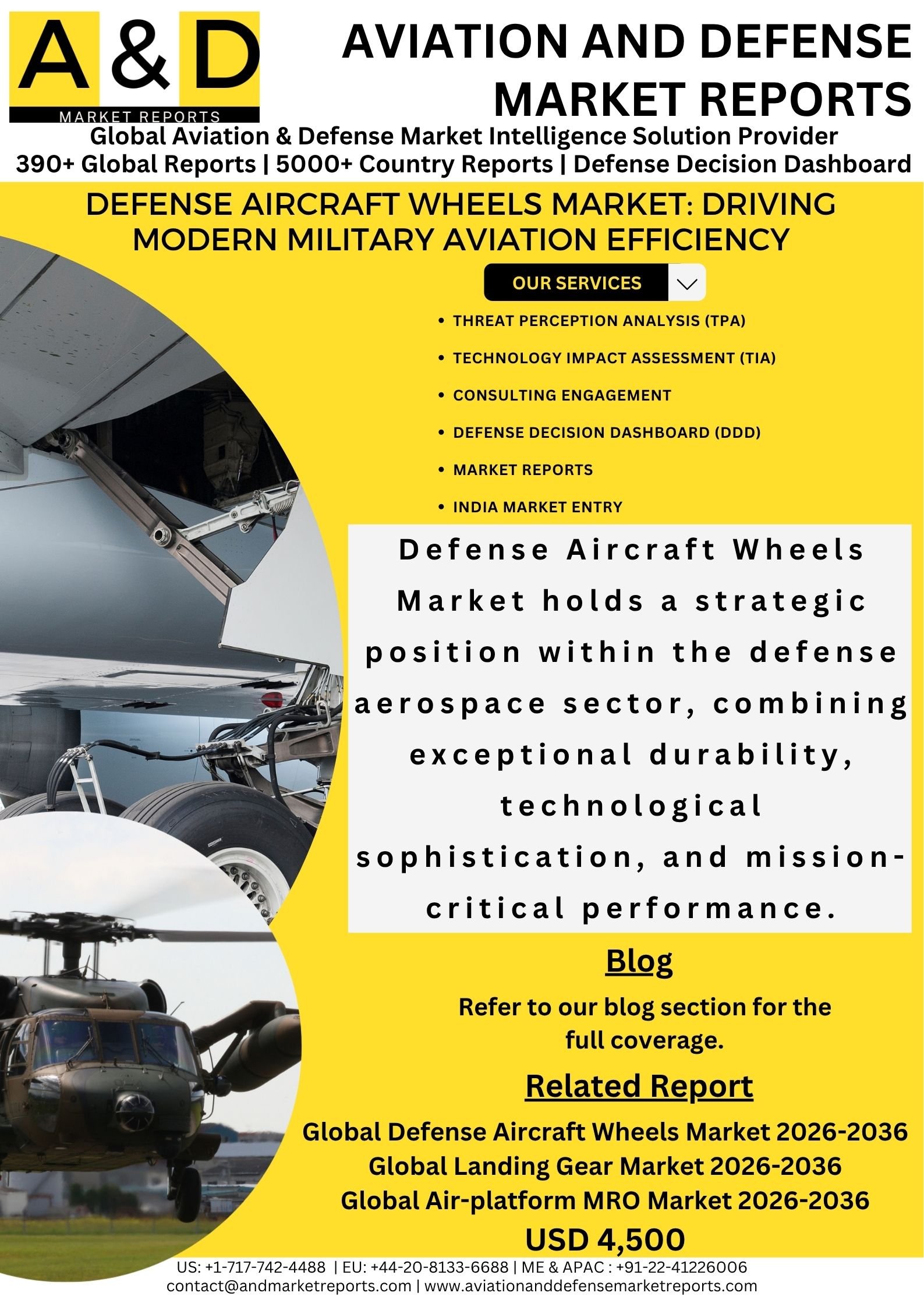
Global Defense Aircraft Wheels Market
The Global Defense Aircraft Wheels Market forms a vital component of military aviation infrastructure, delivering essential support for takeoff, landing, and ground operations across fighter jets, transport aircraft, reconnaissance platforms, and unmanned systems. These specialized wheels withstand extreme loads, high-impact forces, and harsh environmental conditions while maintaining reliability in combat zones and austere locations. Defense forces worldwide rely on advanced wheel systems to ensure mission readiness, rapid deployment, and operational superiority. As military aviation programs advance and fleets modernize, the demand for high-performance, lightweight, and durable wheels strengthens their role in global defense procurement.
Evolution of Defense Aircraft Wheels:
The development of defense aircraft wheels traces back to the early days of military aviation in the early 20th century, when basic skids and rudimentary pneumatic designs first appeared to support fragile airframes during landings. Initial systems used simple rubber tires on metal rims, but World War II demands for heavier bombers and fighters drove the creation of reinforced, multi-wheel configurations capable of handling increased weights and rough field operations. Subsequent decades introduced forged aluminum alloys and improved tread patterns for better stability and wear resistance. Contemporary designs incorporate precision-engineered rims, advanced composites, and integrated bearing systems that deliver superior strength-to-weight ratios and extended service life under extreme military conditions.
Operational Advantages and Battlefield Role:
Defense aircraft wheels provide unmatched operational versatility by enabling safe operations from carrier decks, unprepared runways, and forward operating bases where conventional infrastructure remains limited. These components absorb tremendous impact energies during high-speed landings and support rapid taxiing in contested environments. Their robust construction allows military aircraft to execute frequent sorties with minimal downtime, while specialized designs facilitate operations in diverse climates from arctic ice to desert sand. Wheels equipped for high flotation and damage resistance prove indispensable for troop transport, close air support, and surveillance missions, where aircraft must maintain mobility and responsiveness across dynamic battlefields.
Technological Advancements in Aircraft Wheels:
Modern defense aircraft wheels integrate cutting-edge materials such as carbon composites and high-strength aluminum alloys that reduce overall weight while increasing load-bearing capacity and fatigue resistance. Advanced manufacturing techniques, including additive processes for rim repairs and precision forging, enhance durability and lower maintenance requirements. Sensor-embedded designs now monitor real-time stress, temperature, and wear, feeding data into aircraft health management systems for predictive upkeep. These innovations transform wheels from passive structural elements into intelligent components that boost aircraft performance, extend operational intervals, and align with the demands of high-tempo military aviation.
Global Demand and Drivers:
Rising global defense expenditures and comprehensive military modernization initiatives drive strong demand for advanced aircraft wheels. Nations expand their fleets of next-generation fighters, strategic transports, and unmanned aerial vehicles, each requiring specialized wheel systems optimized for performance and reliability. The emphasis on expeditionary operations and rapid global response further accelerates procurement, as forces prioritize equipment that supports deployment from austere environments. Aftermarket requirements for fleet sustainment and overhaul programs also contribute significantly to market expansion, ensuring sustained growth through ongoing maintenance and upgrade cycles.
Regional Market Trends:
North America leads the Global Defense Aircraft Wheels Market through substantial United States defense investments and the presence of major original equipment manufacturers that supply advanced platforms to allied forces. Europe focuses on collaborative programs that integrate high-technology wheels into multinational aircraft fleets, emphasizing interoperability and performance upgrades. The Asia-Pacific region experiences accelerated expansion as countries including India and China bolster indigenous defense manufacturing and acquire modern military aircraft to address regional security priorities. The Middle East and other emerging markets pursue technology transfer agreements and local production capabilities to achieve greater self-reliance in wheel system supply chains.
Competitive Landscape and Key Players:
The Global Defense Aircraft Wheels Market features established leaders alongside specialized suppliers that compete through continuous innovation and strategic alliances. Collins Aerospace and Safran Landing Systems dominate with comprehensive portfolios of wheels and integrated landing gear solutions for fighters, transports, and naval aircraft. Héroux-Devtek, Honeywell, and Parker Hannifin deliver specialized components that emphasize lightweight construction and advanced durability. Manufacturers differentiate their offerings through superior portability, extended service life, precision engineering, and seamless compatibility with modern aircraft platforms. Research and development investments, combined with partnerships across defense agencies and participation in major exhibitions, secure market leadership and drive product evolution.
Challenges and Constraints:
Budget limitations in certain defense sectors constrain large-scale procurement and upgrade programs for aircraft wheels. Rising costs of advanced raw materials and complex manufacturing processes create pressure on supply chains and overall program economics. Export regulations and stringent certification requirements further influence global trade dynamics and limit rapid market access for new entrants. The demand for highly trained technicians to handle installation, inspection, and repair of sophisticated wheel assemblies adds operational complexity for many military organizations. Despite these factors, the market maintains steady momentum through focused innovation and sustained investment in critical defense capabilities.
Integration with Modern Warfare:
Defense aircraft wheels now integrate fully into network-centric warfare architectures through embedded sensors and data links that provide continuous status updates to command systems. This connectivity enables real-time health monitoring and coordinated maintenance planning across joint operations. Wheels support seamless interoperability with unmanned systems and advanced surveillance platforms, allowing aircraft to operate effectively within integrated battle networks. Enhanced designs facilitate rapid reconfiguration for different mission profiles, ensuring that wheel performance contributes directly to overall force effectiveness and tactical flexibility in multi-domain environments.
Future of the Global Defense Aircraft Wheels Market:
Ongoing advancements in materials science and digital integration position the Global Defense Aircraft Wheels Market for continued expansion. The introduction of smarter, lighter wheel assemblies equipped with artificial intelligence-driven diagnostics will elevate reliability and reduce lifecycle costs. As defense strategies prioritize speed, mobility, and resilience, the requirement for versatile wheel systems that support next-generation aircraft platforms will intensify. Sustained investment in research and development, combined with global military modernization efforts, ensures that these components remain central to future aviation capabilities and operational success.
Global Defense Aircraft Wheels Market holds a strategic position within the defense aerospace sector, combining exceptional durability, technological sophistication, and mission-critical performance. Its steady advancement mirrors the transformation of modern military aviation and the persistent requirement for dependable ground support systems. As armed forces worldwide pursue enhanced readiness and operational reach, defense aircraft wheels deliver the foundational reliability that enables effective air power projection and battlefield dominance. The market stands ready for robust growth fueled by innovation, modernization initiatives, and unwavering demand for superior aerospace components.