
Description
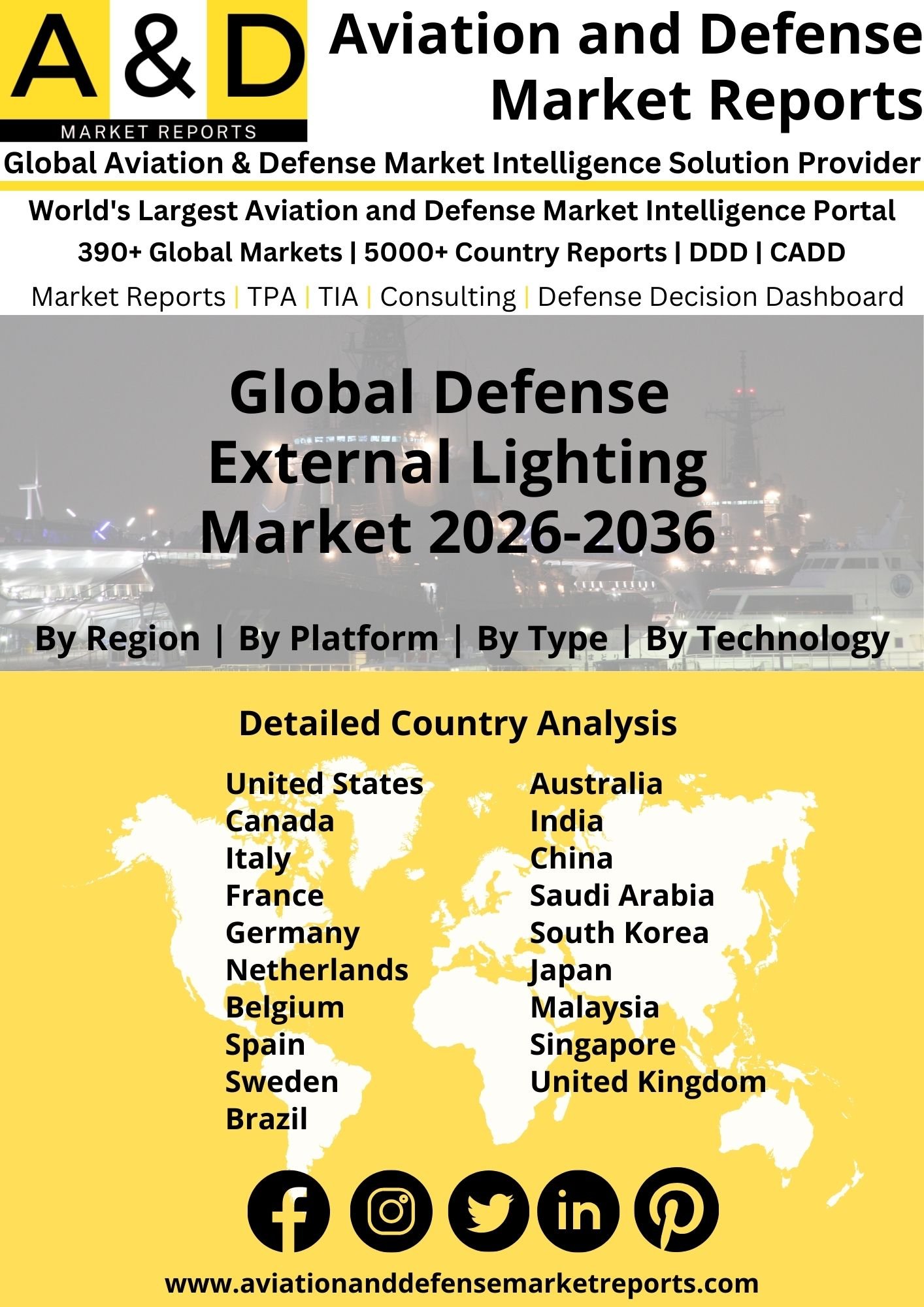
Global Defense External Lighting Systems Market Overview
The Global Defense External Lighting Systems Market supports safe, coordinated, and stealth-focused military operations across air, land, and sea platforms. These systems include navigation lights, formation lights, anti-collision beacons, and mission-specific illumination units. Although they appear simple, modern defense lighting systems are highly engineered electro-optical solutions. They must provide clear visibility to friendly forces while limiting detection by adversaries. Therefore, designers focus on spectral control, durability, and seamless integration with onboard avionics. As night operations and coalition missions expand, reliable and adaptable lighting becomes even more important.
Global Defense External Lighting Systems Market: Technology Advancements
Technology innovation strongly influences the Global Defense External Lighting Systems Market. Manufacturers now use high-brightness LEDs and, in some cases, laser-based light sources. These solid-state technologies offer long service life, strong shock resistance, and precise wavelength control. In addition, many systems support multiple modes, including visible light, near-infrared, and covert infrared. This flexibility enables compatibility with night-vision goggles and advanced optical sensors. Dynamic intensity control further improves performance. For example, lights can automatically adjust brightness based on ambient conditions or pilot commands. As a result, platforms reduce glare and limit unwanted visual signatures during sensitive mission phases.
Global Defense External Lighting Systems Market: Integration and Multi-Domain Expansion
Integration plays a central role in the Global Defense External Lighting Systems Market. Modern lighting units connect to digital data buses and flight management systems. This connection allows automatic mode switching during takeoff, landing, refueling, or combat ingress. Furthermore, some formation lights synchronize with data links to signal aircraft status through coded pulse patterns visible only to allied systems. Beyond aviation, demand is growing in ground and naval segments. Military vehicles require low-profile, blast-resistant lights for convoy safety. Similarly, naval vessels use compliant deck and mast lighting with additional infrared capability for covert fleet coordination.
Market: Future Outlook and Strategic Trends
Several trends shape the future of the Global Defense External Lighting Systems Market. Size, weight, power, and cost optimization drive modular and energy-efficient designs. Pulse-width modulation reduces power consumption, preserving electrical capacity for mission systems. At the same time, cybersecurity becomes critical as lighting systems adopt software control and network connectivity. Secure firmware and protected communication channels help prevent spoofing or remote interference. Looking ahead, external lights may serve dual purposes, such as optical communication nodes or proximity-sensing emitters. As military operations grow more complex and interconnected, external lighting will remain a vital yet discreet contributor to safety, coordination, and tactical advantage.