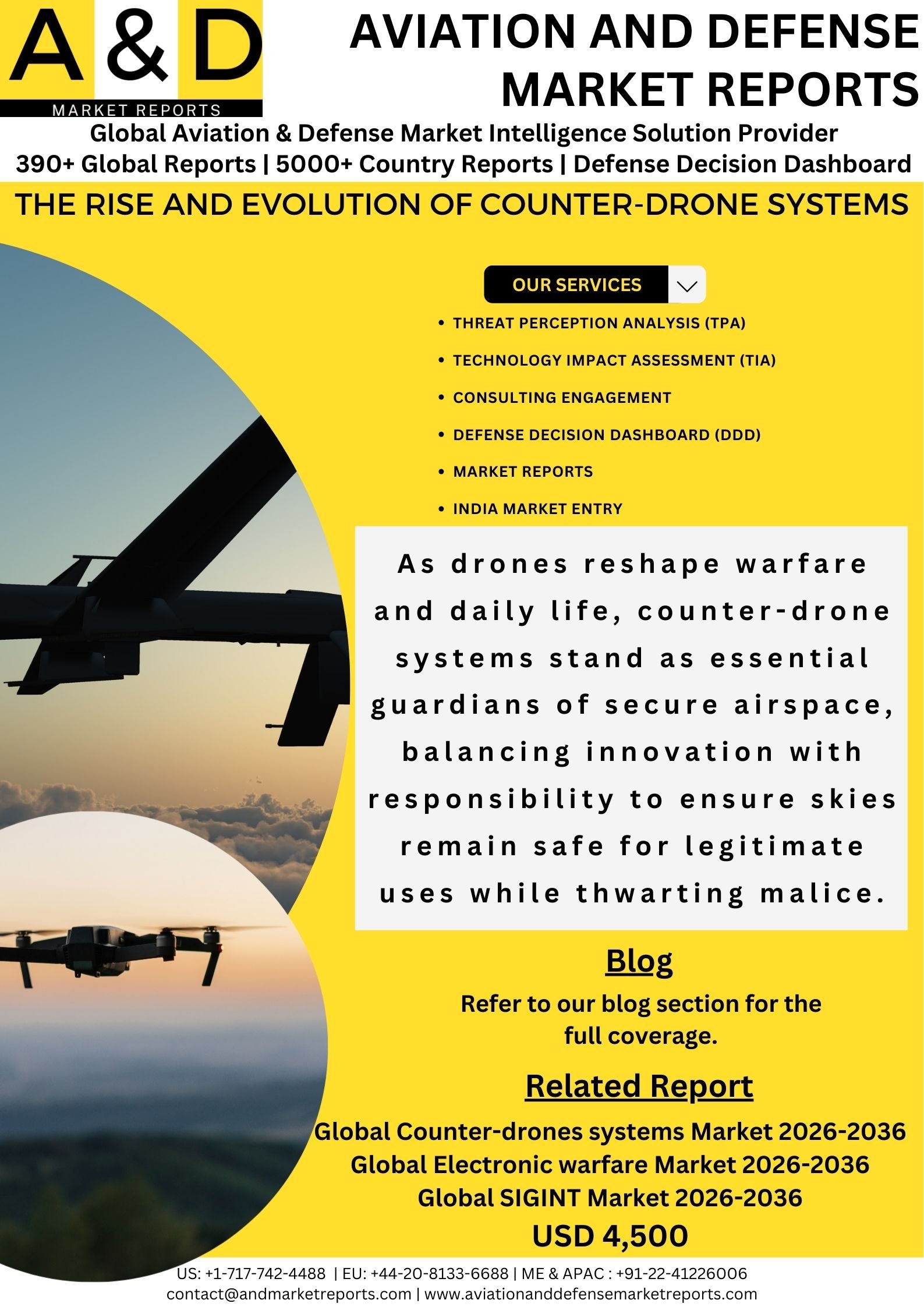
In an era where unmanned aerial vehicles, commonly known as Counter-Drone, have become ubiquitous, the need for effective countermeasures has never been more pressing. Drones offer remarkable benefits in fields ranging from agriculture and delivery services to surveillance and recreation, but their proliferation has also introduced significant risks. Unauthorized drones can infringe on privacy, disrupt critical infrastructure, smuggle contraband, or even carry explosive payloads in conflict zones. This dual-edged nature has spurred the rapid development of counter-drone systems, also referred to as counter-unmanned aerial systems (C-UAS). These technologies aim to detect, track, identify, and neutralize rogue drones while minimizing collateral damage and ensuring operational continuity.
The global anti-drone market reflects this urgency, valued at approximately $2.5 billion in 2024 and projected to exceed $10 billion by 2030, growing at a compound annual rate of over 27 percent in some estimates. Driving factors include escalating security concerns in military, homeland security, and commercial sectors, alongside advancements in drone capabilities that make traditional defenses obsolete. As drones grow smaller, faster, and more autonomous—some even incorporating AI for navigation in jammed environments—counter-drone solutions must evolve accordingly. By late 2025, the industry has seen a surge in layered, integrated systems that combine multiple technologies for comprehensive airspace protection.
At the heart of any effective C-UAS setup is detection. No neutralization can occur without first identifying a threat. Modern detection relies on a fusion of sensors to overcome the limitations of individual methods. Radar systems excel at long-range tracking and can distinguish drones from birds using micro-Doppler signatures that analyze rotor movements. Specialized 3D radars, for instance, detect nano-drones up to several kilometers away, even in cluttered environments.
Radio frequency (RF) sensors passively scan for communication signals between drones and operators, often locating the pilot as well. Optical and electro-optical/infrared (EO/IR) cameras provide visual confirmation, while acoustic sensors pick up distinctive propeller noises. Increasingly, artificial intelligence integrates these data streams, reducing false alarms and predicting drone trajectories in real time. Companies like DroneShield and Dedrone have pioneered AI-driven platforms that not only detect but also classify drones by model, assessing potential payload and threat level.
Once detected, mitigation follows. Non-kinetic methods dominate civilian and many military applications due to their lower risk of debris or interference. Jamming disrupts control links or GPS signals, forcing drones to hover, return home, or land safely. Handheld jammer guns, resembling rifles, offer portable defense for VIP protection or events.
More advanced cyber takeover systems, like those from D-Fend Solutions, hijack the drone’s protocol without broad-spectrum jamming, guiding it to a safe landing zone. This approach preserves evidence and avoids disrupting friendly communications.
Kinetic options provide hard kills for high-threat scenarios. Nets launched from ground or drone platforms entangle rotors, while interceptor drones ram targets mid-air. Missiles and directed energy weapons, such as high-power lasers or microwaves, offer precision destruction at low cost per shot—some lasers engage for mere dollars.
In 2025, innovations focus on affordability and scalability, with efforts to make missiles viable against swarms by slashing production costs.
Layered defenses represent the gold standard, combining detection with multiple effectors under unified command-and-control software. Systems like Lockheed Martin’s modular platforms or DroneShield’s AI-fused solutions allow seamless integration, adapting to solo intruders or massed attacks.
Leading firms include RTX, Rafael Advanced Defense Systems, Israel Aerospace Industries, Leonardo, Thales, and specialists like Fortem Technologies and DroneShield. Recent developments highlight portability—lightweight systems for expeditionary forces—and resilience against emerging threats like fiber-optic or autonomous drones resistant to traditional jamming.
Challenges persist. Legal frameworks lag technology, restricting active mitigation in civilian spaces to authorized entities. Ethical concerns arise with kinetic methods in populated areas, and autonomous drones demand AI countermeasures that avoid over-reliance on vulnerable signals. Swarm attacks overwhelm single effectors, necessitating high-volume, low-cost responses like directed energy.
Looking ahead, 2025 trends point to greater AI integration for predictive defense, quantum-enhanced sensing, and hybrid systems blending kinetic and non-kinetic tools. As drones reshape warfare and daily life, counter-drone systems stand as essential guardians of secure airspace, balancing innovation with responsibility to ensure skies remain safe for legitimate uses while thwarting malice.