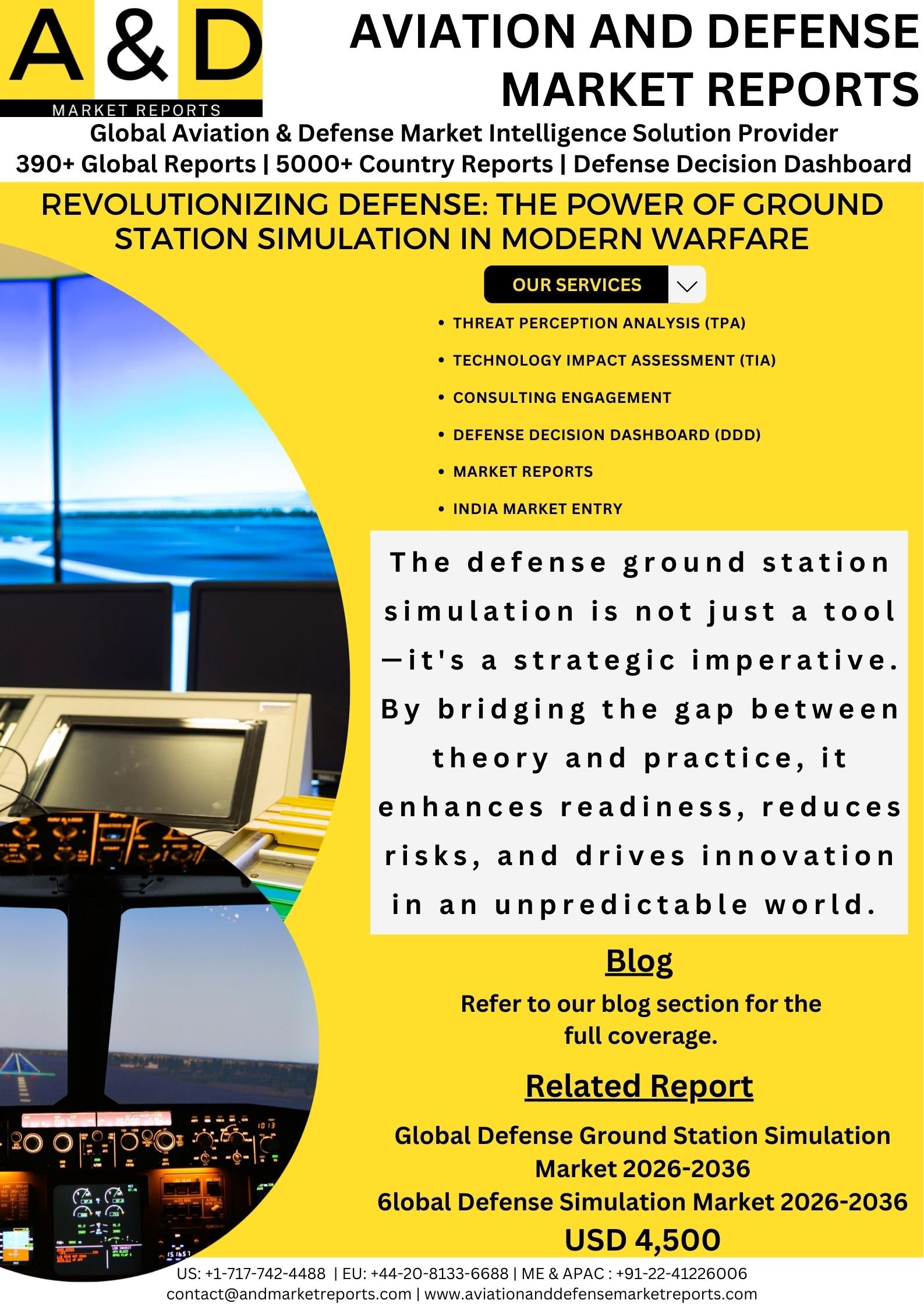
In the high-stakes world of defense and aerospace, ground stations serve as the nerve centers for satellite communications, missile tracking, radar operations, and command-and-control systems. These facilities are critical for maintaining situational awareness, coordinating military assets, and ensuring national security. However, building, testing, and operating physical ground stations can be prohibitively expensive, time-consuming, and risky—especially when dealing with live scenarios involving hostile environments or classified technologies. This is where simulation steps in, offering a virtual sandbox to replicate, analyze, and optimize these complex systems without the real-world hazards.
Defense ground station simulation involves creating digital models that mimic the behavior of antennas, signal processors, telemetry receivers, and environmental factors like atmospheric interference or electronic warfare. By leveraging advanced software tools, defense organizations can train operators, test new designs, and simulate threats in a controlled setting. As global tensions rise and space becomes a contested domain, the role of these simulations has never been more vital. In this blog, we’ll explore the fundamentals, applications, benefits, challenges, and future trends of defense ground station simulation, drawing on insights from industry leaders and recent advancements.
Understanding Defense Ground Stations and Their Simulation
At its core, a defense ground station is a ground-based facility equipped with antennas, transceivers, and computing infrastructure to communicate with satellites, unmanned aerial vehicles (UAVs), or ballistic missiles. These stations handle tasks such as telemetry (remote data collection), tracking, and command uplinks. For instance, in missile defense, ground stations process radar data to detect and intercept incoming threats in real-time.
Simulation recreates these operations virtually. Tools like MATLAB and Simulink from MathWorks allow engineers to build satellite scenario models, including orbital dynamics and signal propagation. Similarly, companies like Nullspace provide specialized software for designing radar antennas and communication arrays, even generating synthetic data for AI/ML training in signal processing. This virtual approach enables “what-if” analyses—such as how a station would perform under jamming attacks or in adverse weather—without deploying expensive hardware.
One key type of simulation is hardware-in-the-loop (HIL), where real components like antennas are integrated with virtual models to test interfaces. Another is full software simulation, ideal for early design phases. For example, Keysight’s solutions focus on RF system modeling and phased-array antenna simulation, accelerating space and satellite workflows. These tools ensure that ground stations can handle the increasing complexity of multi-domain operations, where space, air, and ground assets must synchronize seamlessly.
Applications in Defense Operations
The applications of ground station simulation are vast and transformative. In training, simulators like Bohemia Interactive’s Advanced Air Defense Simulator prepare operators for systems such as the RBS-70 ground-based missile defense. Located at facilities like Australia’s Woodside Barracks, these setups allow soldiers to practice intercepting aerial threats in immersive virtual environments, reducing the need for live-fire exercises that could cost millions and pose safety risks.
In system design and testing, simulations are indispensable. Curtiss-Wright’s ground station hardware and software optimize data acquisition for flight tests, ensuring that telemetry from aircraft or missiles is accurately captured and analyzed. Parraid’s telemetry ground stations support military operations by simulating real-time data from missile tests, helping refine guidance systems before actual launches.
Moreover, in mission planning, simulations model entire networks. Lockheed Martin’s ground software manages satellite constellations, including orbit determination and autonomous operations. NASA’s insights on ground data systems highlight how direct-to-Earth (DTE) communications can achieve higher data rates, and simulations help optimize these for small satellites in defense applications. For instance, simulating geostationary relays versus low-Earth orbit setups allows planners to predict bandwidth bottlenecks in wartime scenarios.
Electronic warfare (EW) simulation is another critical area. Ground stations must counter jamming or spoofing, and tools from Kratos enable software-defined ground systems that can be virtually tested against adversarial tactics. This is particularly relevant as nations like China and Russia advance their space denial capabilities, forcing Western militaries to simulate resilient architectures.
Benefits: Cost, Safety, and Scalability
The advantages of simulation are compelling. Cost savings are paramount—physical prototypes can run into billions, but simulations cut development expenses by up to 50% by identifying flaws early. Safety is enhanced; operators can “fail” in virtual missions without real consequences, such as accidental missile launches.
Flexibility allows testing extreme scenarios, like nuclear electromagnetic pulses or cyber attacks, which are impossible or unethical in reality. Scalability means simulating large-scale networks, as seen in Israel Aerospace Industries’ (IAI) ground control stations that use big data analytics for multimode satellite monitoring. Additionally, simulations accelerate innovation; AI-integrated models can predict system behaviors, generating datasets for machine learning to improve threat detection.
In an era of rapid technological change, simulations ensure interoperability. For example, NATO allies can simulate joint operations, aligning U.S. satellite networks with European ground stations without logistical hurdles.
Challenges and Limitations
Despite the benefits, challenges persist. Achieving high-fidelity models requires accurate data on environmental variables, such as ionospheric effects on signals, which can be hard to replicate. Real-time performance is crucial—delays in simulation could mislead operators about actual latencies.
Integration with legacy systems poses issues; older hardware may not interface seamlessly with modern simulators. Cybersecurity is a double-edged sword: While simulations can test defenses, they themselves are vulnerable to hacking, potentially exposing classified designs.
Validation is another hurdle. How do you ensure a simulation mirrors reality? This often requires hybrid approaches, combining virtual models with field data, and ongoing calibration.
Future Trends: AI, VR, and Beyond
Looking ahead, AI and machine learning will dominate. Simulations will use generative AI to create dynamic threat environments, adapting in real-time to operator decisions. Virtual reality (VR) and augmented reality (AR) will make training more immersive, with operators “walking” through virtual ground stations.
Cloud-based simulations, as hinted in NASA’s architectures, will enable distributed teams to collaborate globally. Quantum computing could revolutionize signal processing models, handling vast datasets for hypersonic threat simulations.
As space militarization intensifies, expect simulations to incorporate multi-domain warfare, linking ground stations with cyber, air, and naval assets. Companies like Keysight are already pushing boundaries with channel emulation for satellite testing.
In conclusion, defense ground station simulation is not just a tool—it’s a strategic imperative. By bridging the gap between theory and practice, it enhances readiness, reduces risks, and drives innovation in an unpredictable world. As technology evolves, these virtual realms will become even more indistinguishable from reality, ensuring that defense forces stay one step ahead. Whether you’re a policymaker, engineer, or enthusiast, understanding this field is key to appreciating the invisible backbone of modern security.