Global tactical video data link market, or the high-stakes precision of a critical infrastructure inspection, information is the ultimate currency. For decades, that information was relayed through voice communications—crackling radio transmissions describing what the eye could see. But what if you could project your eyes directly into the command center, miles away? What if every team member could see the same real-time picture, with crystal clarity?
This is no longer a futuristic concept; it is the reality enabled by the Tactical Video Data Link (TVDL). This technology is the silent, high-speed nervous system connecting sensors to decision-makers, transforming the landscape of military, public safety, and industrial operations. It’s the critical pipeline that turns raw video into actionable intelligence.
Beyond the “Kill Chain”: What Exactly is a TVDL?
At its core, a TVDL is a secure, robust, and wireless communication system designed to transmit high-bandwidth video and data from a source (like a drone, helicopter, or ground robot) to one or multiple receivers on the ground, in the air, or even at sea. Think of it as a specialized, ultra-tough version of your home Wi-Fi, built not for streaming movies but for surviving in the most demanding environments imaginable.
The key differentiators of a TVDL are:
- Tactical: It’s designed for use in the field. The equipment is ruggedized, portable, and can be set up quickly by a small team.
- Secure: Standard video streams can be intercepted and jammed. TVDLs employ advanced encryption (e.g., AES-256) to prevent eavesdropping and ensure that only friendly forces see the feed.
- Low-Latency: This is perhaps the most critical feature. Latency is the delay between the action happening and the video appearing on the screen. A delay of even a few seconds can be fatal when guiding a missile or navigating a robot through rubble. TVDLs are engineered for near-real-time transmission, often with delays measured in milliseconds.
- Robust: They must operate effectively in the presence of electronic warfare, such as jamming, and in challenging physical environments like urban canyons or mountainous terrain.
The Anatomy of a Link: How It Works
The process seems simple from the outside—video goes from Point A to Point B—but it involves a sophisticated dance of technology.
- The Source (Platform): This is the asset collecting the video. Common platforms include:
- Unmanned Aerial Vehicles (UAVs or Drones): From small quadcopters to large, high-altitude models like the MQ-9 Reaper.
- Manned Aircraft: Helicopters and fixed-wing aircraft with advanced surveillance pods.
- Ground Vehicles: Unmanned Ground Vehicles (UGVs) used for bomb disposal or reconnaissance.
- Wearable Systems: Cameras on soldiers or law enforcement officers.
- The Transmitter: Onboard the platform, a device encodes and compresses the video stream (using codecs like H.264 or H.265) and then modulates it onto a radio frequency. The transmitter is connected to an antenna, which beams the signal towards the receiver.
- The “Link” Itself (The Airwaves): TVDLs operate on various frequencies, each with its own advantages:
- C-Band & Ku-Band: Common for longer-range, beyond-line-of-sight (BLOS) links, often using satellite relays.
- L-Band & S-Band: Excellent for penetrating obstacles like light foliage and buildings, offering good resilience in urban environments.
- Ku/Ka-Band: Used for extremely high-data-rate links, such as transmitting Full Motion Video (FMV) from high-altitude drones.
- The Receiver: On the ground, a receiver unit—which could be a handheld device, a vehicle-mounted antenna, or a large fixed dish—captures the signal. It demodulates and decrypts the data, converting it back into a viewable video stream.
- The Decision-Maker: The video is then distributed via local networks to tactical operators in the field, intelligence analysts, and command centers. This is where the “data” part of “data link” becomes crucial. The stream is often accompanied by metadata—geolocation coordinates, altitude, sensor pointing angles, and timestamps—all overlaid on the video and integrated into mapping systems.
Real-World Applications: From the Battlefield to Your Backyard
The impact of TVDLs is profound across numerous domains.
1. Military and Defense: Shortening the OODA Loop
The military concept of the OODA Loop (Observe, Orient, Decide, Act) is all about making decisions faster than your adversary. TVDLs supercharge this cycle.
- Precision Strikes: A drone provides a live feed of a target, allowing commanders to confirm its identity and strike with minimal collateral damage.
- Situational Awareness (SA): Ground troops can see a live “overhead” view of their entire area of operations, spotting ambushes, IEDs, and friendly positions.
- Battle Damage Assessment (BDA): Immediately after a strike, a drone can assess the effectiveness without putting pilots at risk.
2. Public Safety and Emergency Response: Saving Lives in Real-Time
- SWAT Operations: During a hostage situation or barricaded suspect, commanders can deploy drones to see inside buildings or around corners, informing their tactical decisions.
- Wildfire Fighting: Aircraft with infrared cameras can stream thermal video to incident commanders, showing the fire’s hottest spots and progression, even through smoke.
- Search and Rescue: Drones can cover vast areas of rugged terrain much faster than ground teams, streaming video back to coordinate the rescue effort efficiently.
3. Critical Infrastructure and Industrial Inspection
- Power Lines and Wind Turbines: Drones can inspect infrastructure for damage, streaming high-definition video to an engineer on the ground who can guide the pilot and make immediate assessments, eliminating the need for dangerous climbs.
- Disaster Assessment: After a hurricane or earthquake, drones can quickly survey damage to bridges, roads, and buildings, providing vital information to first responders.
The Future of the Link: Challenges and Innovations
The evolution of TVDLs is relentless, focused on overcoming limitations and unlocking new capabilities.
- Challenge: Spectrum Congestion and Jamming. As more devices rely on wireless links, the radio spectrum becomes crowded. Adversaries are also developing advanced jamming techniques.
- Innovation: Cognitive Radio. Future systems will be “cognitive,” meaning they can automatically sense which frequencies are clear and hop to them to avoid interference and jamming.
- Challenge: Bandwidth Hunger. The demand for higher resolution (4K, 8K), more sensors (hyperspectral, LiDAR), and data from multiple platforms simultaneously will only grow.
- Innovation: AI-Enabled Compression and Data Fusion. Instead of sending raw video, onboard AI could pre-process the data, sending only relevant alerts or compressed “information” rather than the entire pixel stream, drastically reducing bandwidth needs.
- Challenge: Interoperability. Different platforms and nations often use proprietary data links that can’t communicate.
- Innovation: Open Standards. Efforts like the NATO Standardization Agreement (STANAG) for UAV control are pushing for common standards, allowing, for example, a US drone to stream video to an allied French ground station.
Conclusion: The Invisible Advantage
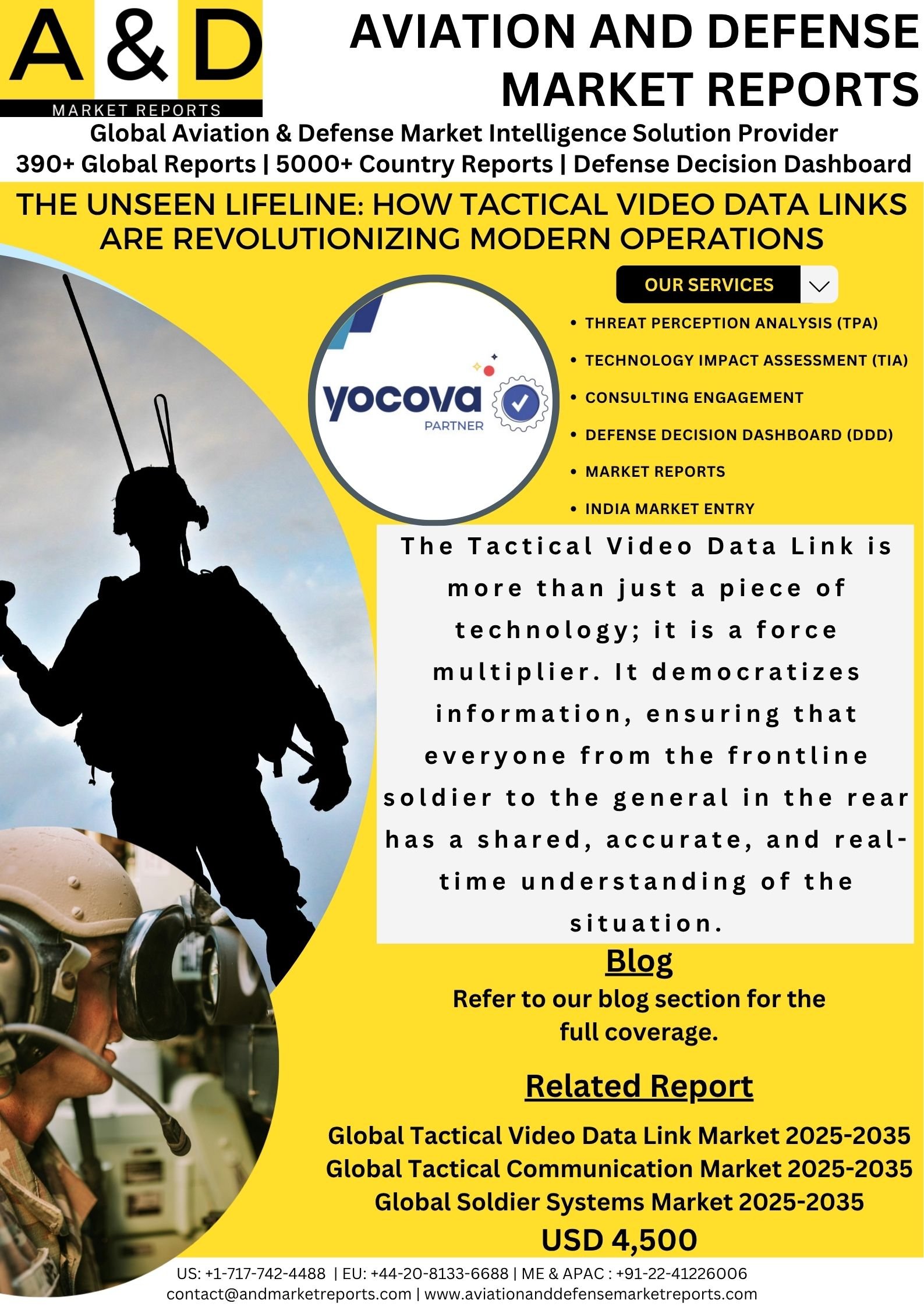
The Tactical Video Data Link is more than just a piece of technology; it is a force multiplier. It democratizes information, ensuring that everyone from the frontline soldier to the general in the rear has a shared, accurate, and real-time understanding of the situation. It reduces risk, enhances precision, and saves lives. As the technology continues to evolve, becoming smarter, faster, and more resilient, this invisible lifeline will only deepen its role as the backbone of 21st-century tactical operations, turning the fog of war into a clear, actionable picture.